- All Drug Categories
- Home
- Anti-cancer Drugs
- Healthcare Products
- Medical Information
- Statement
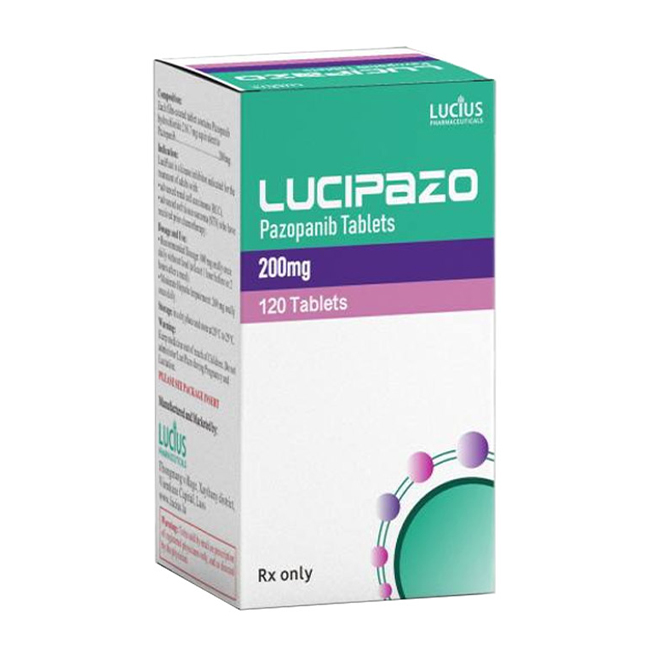
All Names: pazopanib、Votrient、帕唑帕尼、培唑帕尼、维全特
Indications:Suitable for patients diagnosed with advanced renal cell carcinoma (RCC) who require systemic treatment, as well as patients diagnosed with advanced soft tissue sarcoma (STS) who have previously received chemotherapy and require further treatment.
Manufacturer:LUCIUS PHARMACEUTICAL (LAOS) CO., LTD
Customs Clearance Procedure:If the customs requires the package for customs clearance, please pay the customs clearance fee according to the content of EMS SMS and customs regulations.
In China, pazopanib was approved for market on March 3, 2017; The National Medical Products Administration (NMPA) has approved pazopanib for first-line treatment of advanced renal cell carcinoma patients and advanced renal cancer patients who have received cytokine therapy.
1、 Drug name
1. Common name: pazopanib
2. Product Name: VOTRIENT
2、 Indications
Used to treat patients with advanced renal cell carcinoma (RCC).
3、 Specifications and characteristics
200mg、 Tablets.
4、 Usage and dosage
1. Recommended dosage: 800mg orally, once daily.
2. Medication time: Take on an empty stomach (1 hour before or 2 hours after meals).
3. Cannot be crushed and taken (may increase absorption rate and affect efficacy).
5、 Dose adjustment
1. Liver dysfunction: reduce to 200mg/day for moderate liver dysfunction patients; Prohibited for individuals with severe liver function impairment.
2. Drug interactions:
When combined with strong CYP3A4 inhibitors (such as ketoconazole), reduce to 400mg.
Strong CYP3A4 inducers (such as rifampicin) should be avoided in combination.
3. Other adjustments: Adjust in increments of 200mg based on tolerance, with a maximum dose not exceeding 800mg.
6、 Medication precautions
1. Dietary impact: Both high-fat and low-fat diets can increase blood drug concentrations by 2 times and must be taken on an empty stomach.
2. Omission treatment: If it is less than 12 hours before the next medication, skip it and do not make up for it.
3. Vomiting treatment: If vomiting occurs after taking medication, do not take additional medication. Follow the original plan for the next dose.
4. Before and after surgery: Stop medication for at least 7 days before surgery, and determine the time to resume medication after surgery based on the healing of the wound.
7、 Medication for special populations
1. Pregnant women: May cause fetal damage, prohibited during pregnancy (pregnancy grade D).
2. Breastfeeding period: Suspend breastfeeding (unknown if medication is administered).
3. Children: Safety has not been established.
4. Older adults: Patients aged 65 and above need to be closely monitored for liver function.
8、 Adverse reactions
1. Common (≥ 20%): Diarrhea, hypertension, hair loss, nausea, anorexia, vomiting.
2. Serious adverse reactions:
Hepatotoxicity (monitoring ALT/AST), QT interval prolongation (monitoring electrocardiogram), bleeding events (prohibited for those with a history of bleeding within 6 months), arterial thrombosis (risk of myocardial infarction/stroke).
9、 Contraindications
There are no absolute contraindications, but the following situations are prohibited:
1. Severe liver dysfunction.
2. History of cerebral hemorrhage/gastrointestinal bleeding within 6 months.
3. Pregnancy period.
10、 Drug interactions
1. CYP3A4 inhibitors: Avoid using potent inhibitors in combination (such as clarithromycin).
2. CYP3A4 inducer: Avoid using strong inducers (such as rifampicin) in combination.
3. Narrow therapeutic window drugs: Avoid using drugs metabolized by CYP3A4/2D6/2C8 in combination (such as warfarin).
11、 Storage method
Not explicitly stated, it is recommended to follow the standard oral tablet storage method (avoid light, cool and dry place).
pazopaniinformation