- All Drug Categories
- Home
- Anti-cancer Drugs
- Healthcare Products
- Medical Information
- Statement
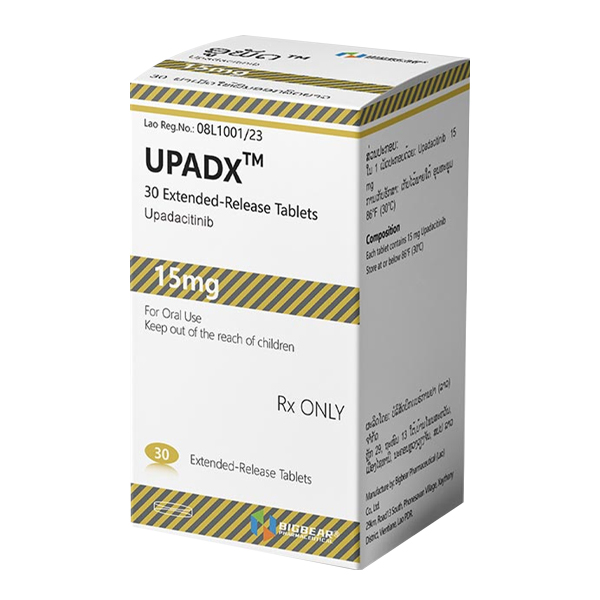
All Names: RINVOQ、upadacitinib、乌帕替尼
Indications:Suitable for patients with rheumatoid arthritis, psoriatic arthritis, atopic dermatitis, ulcerative colitis, Crohn's disease, ankylosing spondylitis, non radiological axial spondyloarthritis, polyarticular juvenile idiopathic arthritis, and giant cell arteritis in adults and children aged 2 years and above (atopic dermatitis is 12 years and above and weight ≥ 40kg).
Manufacturer:Daxiong
Customs Clearance Procedure:If the customs requires the package for customs clearance, please pay the customs clearance fee according to the content of EMS SMS and customs regulations.
Upatinib is a highly efficient and selective Janus kinase (JAK) inhibitor that inhibits the activity of JAK enzymes, blocks the JAK-STAT signaling pathway, suppresses the release of pro-inflammatory cytokines, and reduces inflammatory responses.
1、 Drug name
1. Common name: Upatinib
2. Product Name: RINVOQ ®/ RINVOQ ® LQ
3. English name: Upadacitinib
2、 Indications
This product is a Janus kinase (JAK) inhibitor, suitable for the treatment of the following patients with insufficient response or intolerance to one or more tumor necrosis factor (TNF) blockers:
1. Adult moderate to severe active rheumatoid arthritis.
2. Active psoriatic arthritis in adults and children aged 2 and above.
3. Adults and those aged 12 and above (weighing at least 40 kilograms) with refractory moderate to severe atopic dermatitis.
4. Adult moderate to severe active ulcerative colitis.
5. Adult moderate to severe active Crohn's disease.
6. Adult active ankylosing spondylitis.
7. Active non radiological axial spondyloarthritis with objective inflammatory signs in adults.
8. Patients aged 2 years and above with active polyarthrosis of juvenile idiopathic arthritis.
3、 Specifications and characteristics
Tablets: 15 milligrams.
4、 Main components
1. Active ingredient: Upatinib.
2. Tablet excipients: including colloidal silica, hydroxypropyl methylcellulose, magnesium stearate, mannitol, microcrystalline cellulose, etc.
5、 Usage and dosage
1. Administration route: Oral.
2. Relationship with food: It can be taken together with food or taken alone.
3. Tablets: Swallow the whole tablet, do not chew, crush, or pry open.
4. Conventional dosage:
(1) Rheumatoid arthritis, psoriatic arthritis, ankylosing spondylitis, and non radiological axial spondyloarthritis: The recommended dose for adults is 15 milligrams once daily.
(2) Atopic dermatitis: For adults and patients aged 12 and above (weighing ≥ 40 kg), the recommended starting dose is 15 milligrams once daily; If there is insufficient response, consider increasing to 30 milligrams once daily. Patients aged 65 and above are recommended to take 15 milligrams once daily.
(3) Ulcerative colitis: The recommended dose for adult induction is 45 milligrams once daily for 8 weeks; During the maintenance period, it is recommended to take 15 milligrams once daily. For refractory patients, 30 milligrams once daily may be considered.
(4) Crohn's disease: The recommended dose for adult induction is 45 milligrams once daily for 12 weeks; During the maintenance period, it is recommended to take 15 milligrams once daily. For refractory patients, 30 milligrams once daily may be considered.
(5) Pediatric patients: The dosage for psoriatic arthritis and polyarthritis juvenile idiopathic arthritis is based on body weight, using oral solutions or tablets.
6、 Dose adjustment
1. Renal insufficiency:
(1) Most indications for rheumatoid arthritis include mild to severe renal dysfunction that requires adjustment.
(2) Atopic dermatitis: For severe renal insufficiency, it is recommended to take 15 milligrams once daily.
(3) Ulcerative colitis/Crohn's disease: severe renal insufficiency, induction period of 30mg once daily, maintenance period of 15mg once daily.
(4) Patients with end-stage renal disease are not recommended to use it.
2. Liver dysfunction:
(1) Most indications for rheumatoid arthritis include mild to moderate without adjustment.
(2) Ulcerative colitis/Crohn's disease: Mild to moderate liver dysfunction, induction period of 30mg once daily, maintenance period of 15mg once daily.
(3) Patients with severe liver dysfunction are not recommended to use it.
3. Drug interactions:
(1) When used in combination with potent CYP3A4 inhibitors (such as ketoconazole), 30mg is not recommended for patients with atopic dermatitis; Patients with ulcerative colitis/Crohn's disease need to adjust the induction and maintenance doses.
(2) Avoid co administration with potent CYP3A4 inducers such as rifampicin.
(3) Laboratory abnormalities or infections: In the event of severe infection, neutrophil count, lymphocyte count, or hemoglobin below a specific threshold, medication should be discontinued.
7、 Medication precautions
1. Before and after meals: The timing of taking medication is not affected by eating.
2. Missed dose: If a dose is missed, it should be taken as soon as possible. If it is close to the next dose, skip the missed dose and take the next dose at the regular time. Do not take twice the dosage at the same time.
3. Vomiting: There is no specific guidance yet, it is recommended to consult a doctor.
4. Grapefruit: During medication, one should avoid consuming grapefruit or drinking grapefruit juice.
5. Drug residues in feces: If tablet residues are repeatedly found in feces or stoma output, the doctor should be informed.
8、 Medication for special populations
1. Pregnant women: Based on animal data, it may pose a risk to the fetus. Effective contraceptive measures should be taken during the medication period and 4 weeks after the last dose. Pregnancy needs to be reported to the monitoring plan.
2. Breastfeeding period: It is not recommended to breastfeed, and breastfeeding should not be done within 6 days after the last dose.
3. Children: The safety and effectiveness of medication for specific indications and age groups have been established or extrapolated, please refer to the indications for details.
4. Elderly people: may have an increased risk of infection and malignant tumors.
5. Liver/kidney dysfunction: refer to the dose adjustment section.
9、 Adverse reactions
Common adverse reactions vary depending on the indications, mainly including:
1. Severe infection (such as tuberculosis, invasive fungal infection).
2. Malignant tumors and lymphoproliferative diseases.
3. Major adverse cardiovascular events.
4. Thrombosis formation.
5. Hypersensitivity reaction.
6. Gastrointestinal perforation.
7. Laboratory abnormalities (neutropenia, lymphopenia, anemia, elevated blood lipids, elevated liver enzymes).
8. Patients with atopic dermatitis also report acne, shingles, and other symptoms.
9. Patients with ulcerative colitis and Crohn's disease reported upper respiratory tract infections, acne, elevated liver enzymes, and so on.
10、 Contraindications
Individuals with known hypersensitivity reactions to Upatinib or any excipients are prohibited from using it.
11、 Drug interactions
1. Strong CYP3A4 inhibitors may increase exposure to Upatinib, and dosage adjustment or avoidance of co administration is necessary.
2. Strong CYP3A4 inducers may reduce the efficacy of Upatinib and are not recommended for combination.
3. Avoid using in combination with other JAK inhibitors, biological DMARDs, or potent immunosuppressants such as azathioprine and cyclosporine.
4. Avoid using live vaccines during medication.
12、 Storage method
Store at 2 ° C to 25 ° C, keeping the original bottle sealed and moisture-proof.
upadacitinibinformation