- All Drug Categories
- Home
- Anti-cancer Drugs
- Healthcare Products
- Medical Information
- Statement
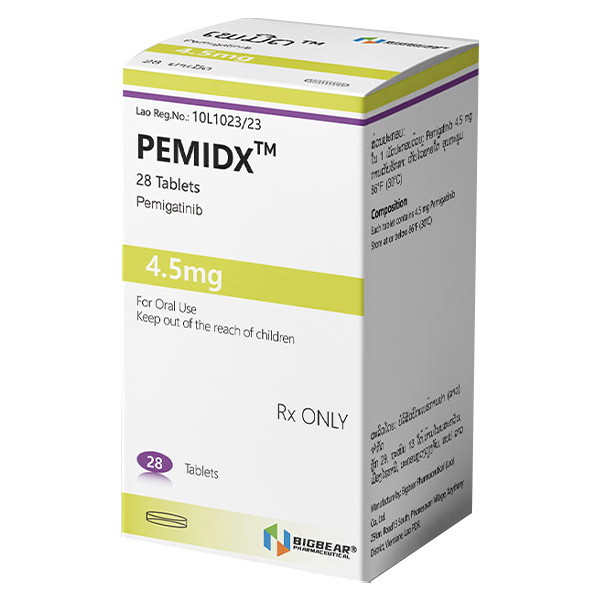
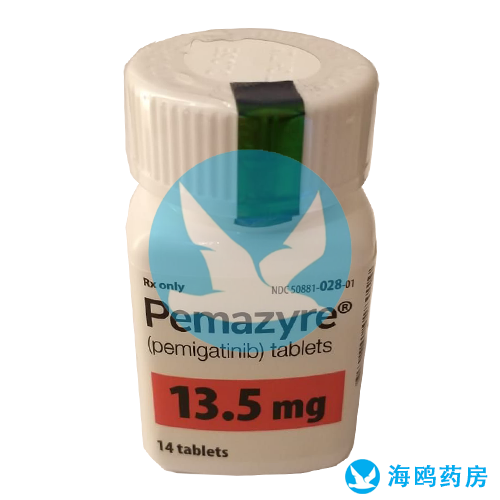
All Names: pemigatinib、pemazyre、佩米替尼、培美替尼、培米替尼、达伯坦
Indications:Adult patients with locally advanced or metastatic cholangiocarcinoma who have received previous treatment and cannot be resected, and whose tumors have been confirmed by FDA approved testing to have FGFR2 fusion or other rearrangements, as well as adult patients with recurrent or refractory myeloid/lymphoid tumors (MLNs) with FGFR1 rearrangements.
Manufacturer:Daxiong
Customs Clearance Procedure:If the customs requires the package for customs clearance, please pay the customs clearance fee according to the content of EMS SMS and customs regulations.
Pemigatinib is the first selective FGFR receptor tyrosine kinase inhibitor approved in China.
1、 Drug name
1. Common name: Pembatinib
2. Product Name: PEMAZYRE ™
3. Chemical name: Pemigatinib
2、 Indications
Suitable for treating adult patients with previously treated, unresectable locally advanced or metastatic cholangiocarcinoma, whose tumors have been confirmed by FDA approved testing methods to have fibroblast growth factor receptor 2 (FGFR2) fusion or other rearrangements. This indication is approved under the accelerated approval pathway based on overall response rate and duration of response.
3、 Specifications and characteristics
Tablets, 4.5 milligrams.
4、 Main components
1. Active ingredient: Pemigatinib.
2. Non active ingredients: magnesium stearate, microcrystalline cellulose, sodium starch glycolate.
5、 Usage and dosage
1. Recommended dosage: 13.5 milligrams, oral, once daily.
2. Medication regimen: Take the medication continuously for 14 days, followed by a 7-day discontinuation, forming a 21 day treatment cycle.
3. Medication method: Swallow the whole tablet, it can be taken with food or on an empty stomach, and take the medication at approximately the same time every day.
4. Duration of treatment: Treatment should be continued until disease progression or unacceptable toxicity occurs.
6、 Dose adjustment
1. Dose reduction for adverse reactions:
First dose reduction: 9 milligrams, once daily, taken for 14 days and stopped for 7 days.
Second dose reduction: 4.5 milligrams, once daily, taken for 14 days and stopped for 7 days. If unable to tolerate 4.5 milligrams, the medication will be permanently discontinued.
2. Dose adjustment for specific adverse reactions:
Retinal pigment epithelium detachment: Asymptomatic and stable patients can continue medication; Patients with symptoms or deterioration need to suspend medication. After improvement, the dosage can be reduced and restored. If it persists, permanent discontinuation of medication may be considered.
Hyperphosphatemia: Measures such as suspending medication, reducing dosage, or permanently stopping medication may be taken based on blood phosphorus levels (such as>7mg/dL or>10mg/dL), and phosphorus lowering therapy may be necessary.
Other grade 3 adverse reactions: Suspend medication until it returns to grade 1 or baseline level, and if it recovers within 2 weeks, reduce the dose for recovery; If there is no recovery or recurrence, the medication will be permanently discontinued. Grade 4 adverse reactions require permanent discontinuation of medication.
Dose adjustment with CYP3A inhibitors: Avoid co administration with strong or moderate CYP3A inhibitors. If it must be used in combination, the dose of pemotinib should be reduced (such as from 13.5 milligrams to 9 milligrams, or from 9 milligrams to 4.5 milligrams).
7、 Medication precautions
1. Medication time: Take medication at approximately the same time every day, before and after meals.
2. Omission treatment: If one dose is missed and more than 4 hours before the next dose, it should be taken as soon as possible; If it has been less than 4 hours, skip the missed dose and take the next dose according to the original plan. Do not take double the dosage to make up for missed doses.
3. Vomiting treatment: If vomiting occurs after taking the medication, there is no need to take it again. Follow the original plan to take the next dose at the next time.
4. Swallowing requirements: The tablet should be swallowed in its entirety and should not be crushed, chewed, split, or dissolved.
8、 Medication for special populations
1. Pregnant women: Based on animal studies, this product may cause harm to the fetus, and pregnant women should be informed of the potential risks to the fetus.
2. Breastfeeding women: It is recommended that women do not breastfeed during the treatment period and within one week after the last dose.
3. Women and men with fertility potential: Female patients should take effective contraceptive measures during treatment and within one week after the last dose. When male patients have female partners of childbearing age, effective contraceptive measures should also be taken during treatment and within one week after the last dose.
4. Child patients: Safety and efficacy have not yet been established.
5. Elderly patients: No overall differences in safety or efficacy were observed compared to younger patients.
6. Kidney injury patients: Mild or moderate kidney injury patients do not require dose adjustment; The recommended dosage for patients with severe kidney injury has not yet been determined.
7. Liver injury patients: Mild or moderate liver injury patients do not require dose adjustment; The recommended dosage for patients with severe liver injury has not yet been determined.
9、 Adverse reactions
1. Common adverse reactions (incidence ≥ 20%) include hyperphosphatemia, hair loss, diarrhea, nail toxicity, fatigue, taste disorders, nausea, constipation, stomatitis, dry eyes, dry mouth, decreased appetite, vomiting, joint pain, abdominal pain, hypophosphatemia, back pain, and dry skin.
2. Serious adverse reactions include retinal pigment epithelium detachment and hyperphosphatemia. Other serious adverse reactions occurring in ≥ 2% of patients include abdominal pain, fever, cholangitis, pleural effusion, acute kidney injury, etc.
10、 Contraindications
None.
11、 Drug interactions
1. Strong and moderate CYP3A inducers: Co administration should be avoided as it can reduce the blood concentration of pemetrexed, which may affect efficacy.
2. Strong and moderate CYP3A inhibitors: should be avoided in combination. If it must be used in combination, the dose of pemetrexed should be reduced as it may increase the blood concentration of pemetrexed and worsen adverse reactions.
3. Gastric acid lowering agents: Proton pump inhibitors (such as esomeprazole) are expected to have no clinical significance in terms of their impact on exposure to pemetrexed. H2 receptor antagonists (such as ranitidine) have no effect.
4. Patients should be informed to avoid taking grapefruit products.
12、 Storage method
Store at room temperature of 20 ° C to 25 ° C (68 ° F to 77 ° F); Allow short distance transportation between 15 ° C and 30 ° C (59 ° F and 86 ° F).
pemigatinibinformation