- All Drug Categories
- Home
- Anti-cancer Drugs
- Healthcare Products
- Medical Information
- Statement
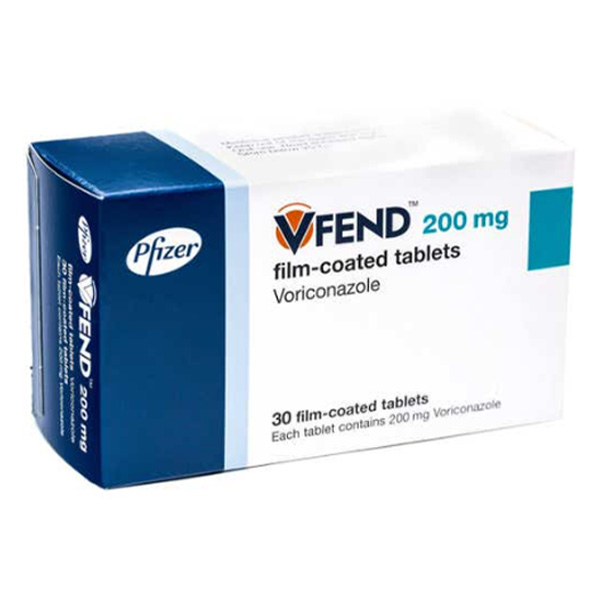
All Names: Vorizol、voriconazole、Vfend、伏立康唑、威凡
Indications:Suitable for adults and children aged 2 and above who require treatment for invasive aspergillosis, candidemia, esophageal candidiasis, and specific refractory fungal infections.
Manufacturer:Pfizer Inc
Customs Clearance Procedure:If the customs requires the package for customs clearance, please pay the customs clearance fee according to the content of EMS SMS and customs regulations.
Fluconazole is a broad-spectrum triazole antifungal drug. Developed by Pfizer, it was first approved for market by the European Medicines Agency (EMA) in March 2002 and received approval in the United States in May of the same year.
1、 Drug name
Common name: Voriconazole
Product Name: Vfend ®
2、 Indications
Used to treat the following severe fungal infections in adult and pediatric patients aged 2 years and above:
Invasive aspergillosis.
Candidiaemia in patients with non neutropenia and deep tissue infections caused by Candida: skin, abdominal, renal, bladder wall, and wound infections.
Esophageal candidiasis.
Severe infections caused by Scedosporum pyosporum and Fusarium species (including Fusarium solani) are limited to patients who are unresponsive or intolerant to other treatments.
3、 Specifications and characteristics
Tablet: 5200mg, white film coated tablet, capsule shaped, with "Pfizer" engraved on one side and "VOR200" engraved on the other side.
4、 Main components
Active ingredient: Fluconazole.
Tablet excipients: cross-linked carboxymethyl cellulose sodium, lactose monohydrate, magnesium stearate, polyvinylpyrrolidone, pre gelatinized starch, coating containing hydroxypropyl methylcellulose, lactose monohydrate, titanium dioxide, and triacetin glycerol ester.
5、 Usage and dosage
Administration route: Depending on the patient's condition and tolerance, intravenous infusion, oral tablets, or oral suspension can be used. Oral preparations should be taken at least 1 hour before meals or at least 1 hour after meals.
Adult standard dosage:
Invasive aspergillosis, Clostridium sporogenes, and Fusarium wilt: The first day loading dose is intravenous infusion of 6mg/kg every 12 hours; The maintenance dose is 4mg/kg intravenously every 12 hours, or 200mg orally every 12 hours (for those weighing ≥ 40kg).
Candidiaemia and other deep Candida infections: The first day loading dose is intravenous infusion of 6mg/kg every 12 hours; The maintenance dose is 3-4mg/kg intravenously every 12 hours, or 200mg orally every 12 hours.
Esophageal candidiasis: Take 200mg orally every 12 hours.
Dosage for children aged 2 and above: It should be calculated based on age, weight, and type of infection. Usually, a loading dose is given followed by a maintenance dose (the specific dose should strictly follow the instructions table and be calculated by the doctor).
Intravenous infusion: The maximum infusion rate should not exceed 3mg/kg per hour, and each infusion should last for 1 to 3 hours.
6、 Dose adjustment
Adult liver damage: For patients with mild to moderate liver damage (Child Pugh A and B grades), the maintenance dose should be halved. Patients with severe liver damage (Child Pugh C grade) have limited experience using it and only use it when the benefits outweigh the risks.
Adult kidney damage: Oral administration does not require dose adjustment. For patients with moderate to severe renal insufficiency (creatinine clearance rate<50mL/min), intravenous administration should be avoided unless it is assessed that the benefits outweigh the risks.
Drug interaction: When used in combination with phenytoin or efavirenz, the maintenance dose of voriconazole needs to be increased (the specific dose is adjusted by the doctor).
7、 Medication precautions
Medication time: Tablets should be taken at least 1 hour before meals or 1 hour after meals.
Missing medication: It should be replenished as soon as possible. But if it is close to the next dose, skip the missed dose and take the next dose according to the original plan. Do not take double the dose at once.
Vomiting: If vomiting occurs shortly after taking medication, please consult a doctor to see if additional medication is needed.
8、 Medication for special populations
Children: The safety and effectiveness of children aged 2 and above have been established. The safety and efficacy of medication for children under 2 years old have not yet been established.
Elderly: No need to adjust dosage, but adverse reactions should be monitored.
Pregnant women: There is a risk of embryo fetal toxicity. Unless absolutely necessary, it should not be used. Women with reproductive potential should take effective contraceptive measures during treatment and after discontinuing medication.
Breastfeeding period: There is no relevant data yet, and the pros and cons should be weighed before considering stopping breastfeeding or choosing other treatments.
Genetic metabolic issues: Tablets contain lactose, oral suspensions contain sucrose, and corresponding dosage forms are contraindicated for patients with related intolerance.
9、 Adverse reactions
The most common adverse reactions in adults (≥ 2%) include visual impairment, fever, nausea, rash, vomiting, chills, headache, liver dysfunction, tachycardia, and hallucinations.
The most common adverse reactions in children (≥ 5%) include visual impairment, fever, vomiting, nosebleeds, nausea, rash, abdominal pain, etc.
Serious adverse reactions include: hepatotoxicity, severe skin reactions (such as Stevens Johnson syndrome), QT interval prolongation and arrhythmia, infusion related reactions, visual impairment (including optic neuritis), photosensitivity, nephrotoxicity, adrenal insufficiency, etc.
10、 Contraindications
Individuals allergic to fluconazole or any excipients.
Do not use in combination with the following drugs: imipramine, quinidine, ivabradine, sirolimus; Rifampicin, carbamazepine, long-acting barbiturates, efavirenz, ritonavir (high dose), rifampicin, ergot alkaloids, St. John's wort; Naloxol, Tovaptan, Lurasidone, Finalidone.
Patients with chronic lymphocytic leukemia or small lymphocytic lymphoma are prohibited from using voriconazole during the initiation and dose escalation phases of treatment with vinclar.
11、 Drug interactions
Voriconazole is metabolized by hepatic enzymes CYP2C19, CYP2C9, and CYP3A4, and is also a potent inhibitor of these enzymes.
Medications that significantly reduce the blood concentration of voriconazole (co administration is prohibited): rifampicin, carbamazepine, long-acting barbiturates, St. John's wort, high-dose ritonavir, and rifampicin.
Fluconazole can significantly increase the blood drug concentration (which may require contraindications or dose adjustments) of drugs such as sirolimus, ergot alkaloids, tacrolimus, cyclosporine, phenytoin, warfarin, certain opioid drugs (such as fentanyl, hydrocodone), certain sulfonylurea oral hypoglycemic drugs, statins, etc.
The combination with phenytoin or efavirenz requires an increase in the dose of voriconazole.
12、 Storage method
Tablets: Store at room temperature of 15 ° C to 30 ° C.
13、 Manufacturer
Manufacturer: Pfizer Inc
Vfendinformation