- All Drug Categories
- Home
- Anti-cancer Drugs
- Healthcare Products
- Medical Information
- Statement
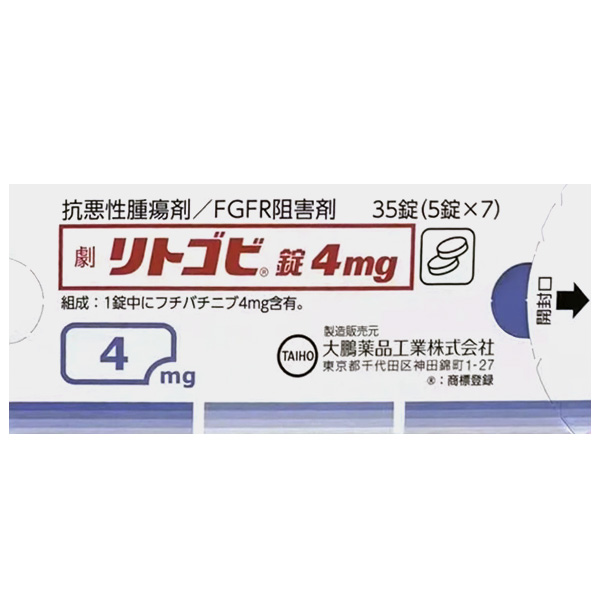
All Names: Lytgobi、futibatinib、福巴替尼片
Indications:It is indicated for adult patients with unresectable, locally advanced, or metastatic intrahepatic cholangiocarcinoma who have previously received treatment and are accompanied by FGFR2 gene fusion or other rearrangements.
Manufacturer:Dapeng Pharmaceutical Industry Co., Ltd
Customs Clearance Procedure:If the customs requires the package for customs clearance, please pay the customs clearance fee according to the content of EMS SMS and customs regulations.
Futibatinib is an oral small molecule kinase inhibitor that blocks the proliferation and survival of tumor cells by irreversibly binding to fibroblast growth factor receptors (FGFR) 1, 2, 3, and 4, inhibiting their phosphorylation and downstream signaling pathways.
1. Drug name
1. Common name: Futibatinib
2. Trade name: LYTGOBI
3. English name: futibatinib
II. Indications
It is indicated for adult patients with previously treated, unresectable, locally advanced, or metastatic intrahepatic cholangiocarcinoma who harbor a fibroblast growth factor receptor 2 (FGFR2) gene fusion or other rearrangement. This indication is based on accelerated approval, and subsequent confirmatory trials may be required to verify clinical benefit.
III. Specifications and Characteristics
1. Specification: 4mg per tablet
2. Characteristic: round
IV. Main Components
Active ingredient: Forbatide
V. Usage and Dosage
1. Recommended dosage: Take 20mg (5 tablets of 4mg each) orally once daily until disease progression or unacceptable toxicity occurs.
2. Administration: Swallow the tablet whole, do not crush, chew, break or dissolve it. It can be taken with food or on an empty stomach, and it is recommended to take it at a fixed time each day.
VI. Dose adjustment
Adjust the dosage according to the severity of adverse reactions:
1. Initial reduction: 16mg (4 tablets) once daily
2. Second reduction: 12mg (3 tablets) once daily
3. If the patient still cannot tolerate the 12mg dose, the medication should be permanently discontinued.
4. The specific basis for adjustment includes the severity of retinal pigment epithelium detachment, hyperphosphatemia, and other adverse reactions.
VII. Medication Precautions
1. Before and after meals: It can be taken with food or on an empty stomach.
2. Handling of missed doses: If a dose is missed for more than 12 hours, skip the missed dose and take the next scheduled dose as per the original schedule.
3. Vomiting treatment: If vomiting occurs after taking the medication, there is no need to take a supplementary dose. Simply take the next dose as scheduled.
4. Do not take it together with grapefruit products.
VIII. Medication for special populations
1. Pregnant women: It has embryo-fetal toxicity and is prohibited.
2. Lactation: It is not recommended to breastfeed during the treatment period and within 1 week after the last dose.
3. Women and men of childbearing age: Effective contraception measures should be taken during treatment and within 1 week after the last dose.
4. Children: Safety and efficacy have not been established.
5. Elderly patients: No overall difference was observed compared to younger patients.
IX. Adverse reactions
1. Common adverse reactions include: nail toxicity, musculoskeletal pain, constipation, diarrhea, fatigue, dry mouth, hair loss, stomatitis, abdominal pain, dry skin, joint pain, taste disturbance, dry eye, nausea, decreased appetite, urinary tract infection, hand-foot syndrome, vomiting, etc.
2. Common abnormalities in the laboratory include: elevated blood phosphorus, elevated creatinine, decreased hemoglobin, elevated blood glucose, elevated blood calcium, decreased blood sodium, and elevated liver enzymes.
X. Contraindications
No specific contraindications.
XI. Drug interactions
1. Avoid combination with dual P-gp and strong CYP3A inhibitors or inducers.
2. Fexatinib is an inhibitor of P-gp and BCRP. When combined with related substrate drugs, adverse reactions should be monitored and dose adjustments considered.
3. There is no significant interaction with gastric acid inhibitors (such as lansoprazole).
XII. Storage method
Store at room temperature between 20°C to 25°C (68°F to 77°F), with short-term storage allowed within the range of 15°C to 30°C (59°F to 86°F).
futibatinibinformation