- All Drug Categories
- Home
- Anti-cancer Drugs
- Healthcare Products
- Medical Information
- Statement
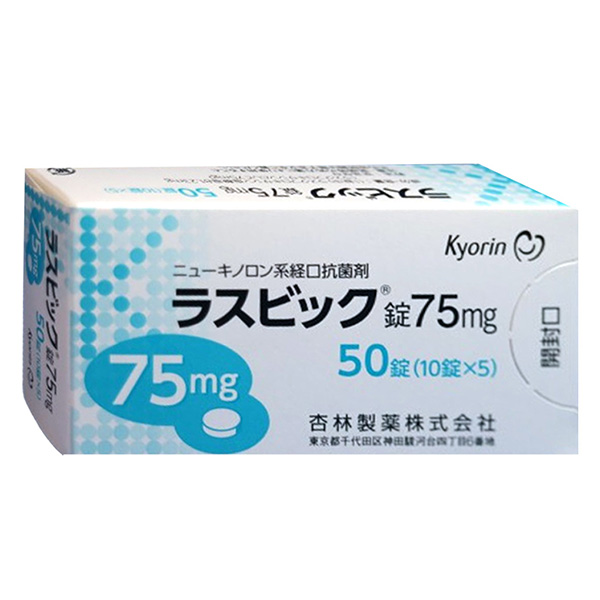
All Names: lasvic、Lascufloxacin Hydrochloride、盐酸拉库沙星、ラスクフロキサシン塩酸塩錠
Indications:Used for adult patients, specific indications include: pharyngitis, tonsillitis, acute bronchitis, pneumonia, secondary infections of chronic respiratory diseases, otitis media, sinusitis, etc.
Manufacturer:Kyorin Pharmaceutical Co., Ltd.
Customs Clearance Procedure:If the customs requires the package for customs clearance, please pay the customs clearance fee according to the content of EMS SMS and customs regulations.
Lacofloxacin hydrochloride is a novel quinolone antibacterial drug developed by Kyorin Pharmaceutical Co., Ltd. in Japan, marketed as Lasvic.
1、 Drug name
1. Common name: Lasvic ® Tablets75mg)
2. Product Name: Raspine Tablets 75mg
3. English name: LascufloxacinHydrochlorideTablets
2、 Main components
Each tablet contains 81.23mg of Rakufloxacin hydrochloride (equivalent to 75mg of Rakufloxacin).
3、 Specifications and characteristics
1. Specification: 75mg/tablet.
2. Appearance: Light yellow film coated tablet, with a diameter of about 7.8mm, a thickness of about 3.8mm, and a mass of about 196mg.
4、 Indications
1. This product is suitable for infections caused by the following bacteria that are sensitive to Rakufloxacin: Staphylococcus, Streptococcus, Pneumococcus, Moraxella, Klebsiella, Escherichia, Haemophilus influenzae, Legionella pneumophila, Prevotella, and Mycoplasma pneumoniae.
2. Specific indications include: pharyngitis/pharyngitis, tonsillitis (including peritonsillitis and abscess), acute bronchitis, pneumonia, secondary infections of chronic respiratory diseases, otitis media, and sinusitis.
5、 Usage and dosage
1. Adult usual dosage: 75mg (1 tablet) per dose, once daily, orally.
2. Dose adjustment: Currently, there is no dose adjustment plan provided for routine situations, but caution should be exercised when using medication for special populations (such as those with liver and kidney dysfunction), as detailed in Section 7.
6、 Medication precautions
1. Medication time: It is recommended to take on an empty stomach. Taking it together with preparations containing aluminum, magnesium, calcium, iron, and zinc (such as antacids and mineral vitamins) can significantly reduce its efficacy and should be avoided.
2. Omission treatment: If missed, it should be replenished as soon as possible. If it is close to the next medication time, skip the missed dose and take the next dose according to the original plan. Do not take double the dose at once.
3. Vomiting after taking medication: If vomiting occurs shortly after taking medication, it is recommended to consult a doctor or pharmacist to assess whether supplementation is necessary.
7、 Medication for special populations
1. Taboo population: It is contraindicated for individuals who are allergic to any ingredients of this product or other quinolone drugs, pregnant women or women who may become pregnant, and children.
2. Patients with liver dysfunction: Mild to moderate liver dysfunction should be used with caution. Pharmacokinetic parameters may change, but conventional dose adjustments are not necessary. Patients with severe liver dysfunction have insufficient data and should be used with caution.
3. Patients with renal insufficiency: Mild to moderate renal insufficiency does not require dose adjustment. Severe renal insufficiency has limited data and should be used with caution under the guidance of a doctor.
4. Elderly: The area under the medication time curve may be higher in elderly patients (66-79 years old) than in non elderly individuals, but dosage adjustment is usually not necessary and close observation should be maintained during medication.
5. Other special patients: patients with a history/risk of epilepsy, severe heart disease (such as arrhythmia), myasthenia gravis, aortic aneurysm or aortic dissection. The use of this product increases the risk and should be used with caution and closely monitored.
8、 Adverse reactions
1. Serious side effects (requiring immediate medical attention): including shock/allergic reactions, leukopenia, interstitial pneumonia, QT interval prolongation/ventricular tachycardia, hypoglycemia, pseudomembranous colitis and other severe colitis, Achilles tendinitis/tendon rupture, liver function damage, rhabdomyolysis, syncope, psychiatric symptoms (such as blurred consciousness and delirium), worsening of myasthenia gravis, aortic aneurysm/aortic dissection.
2. Other common side effects (incidence ≥ 0.1%): diarrhea, nausea; Increased eosinophils and decreased white blood cells; Itching and rash; Elevated levels of alanine aminotransferase and gamma glutamyl transpeptidase; Aspartate aminotransferase is elevated; Headache, increased blood insulin, and positive urine protein.
9、 Contraindications
1. Patients with a history of allergies to the ingredients of this product or other quinolone antibiotics.
2. Pregnant or potentially pregnant women.
3. Children.
10、 Drug interactions
1. Significant impact on absorption (co administration prohibited):
Preparations containing aluminum, magnesium, calcium, iron, and zinc (such as antacids, iron supplements, mineral supplements) can form chelates with this product, severely reducing its efficacy. Therefore, simultaneous use should be avoided.
2. Increased toxicity risk (cautious combination):
(1) Non steroidal anti-inflammatory drugs (such as flurbiprofen): may increase the risk of seizures.
(2) Theophylline/Aminophylline: This product may increase the blood concentration of theophylline and increase the risk of toxicity. When used in combination, it is necessary to monitor and consider reducing the dose of theophylline.
3. Affects the blood drug concentration of this product:
(1) CYP3A4 inducers (such as rifampicin, phenytoin, carbamazepine): may reduce the blood concentration of this product and weaken its efficacy.
(2) CYP3A4 inhibitors (such as itraconazole): may increase the blood concentration of this product.
4. This product affects other drugs:
(1) Calcium channel blockers (such as nifedipine) and leukotriene receptor antagonists (such as montelukast): This product may increase the blood concentration of these drugs.
(2) Hypoglycemic drugs (such as metformin): Clinical studies have shown no significant interaction.
11、 Storage method
1. Store at room temperature.
2. Keep out of reach of children.
3. Please place the medication in its original packaging to avoid moisture.
12、 Manufacturer
Xinglin Pharmaceutical Co., Ltd.
lasvicinformation