- All Drug Categories
- Home
- Anti-cancer Drugs
- Healthcare Products
- Medical Information
- Statement
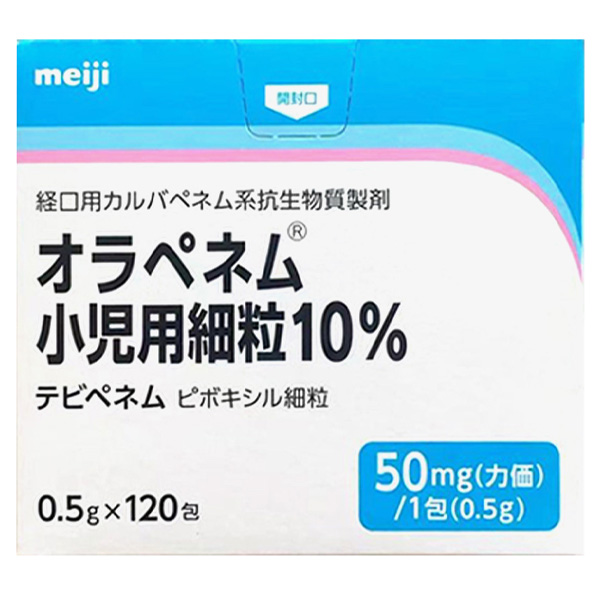
All Names: Tebipenem Pivoxil、Orapenem Fine Granules for Pediatric、 替比培南酯、替比培南酯颗粒、奥拉培南小儿用细粒10%、オラペネム小児用細粒10%
Indications:Suitable for pediatric patients with community-acquired pneumonia, acute otitis media, and acute sinusitis caused by strains of Staphylococcus aureus that are sensitive to telmisartan, and adjusted according to body weight.
Manufacturer:Meiji Fruit Pharmaceutical Co., Ltd., Japan
Customs Clearance Procedure:If the customs requires the package for customs clearance, please pay the customs clearance fee according to the content of EMS SMS and customs regulations.
Terbinapine granules were developed by Meiji Pharmaceutical Co., Ltd. in Japan and were first launched in Japan in 2009. It is an oral carbapenem antibiotic specifically used to treat respiratory infections caused by drug-resistant bacteria in children.
1、 Drug name
1. Common name: Tebipenem Pivoxil Granules
2. Product Name: Olapenem Small Grain 10%
2、 Indications
1. Suitable for infections caused by sensitive bacteria: pneumonia, otitis media, and sinusitis.
2. Suitable bacterial strains: Staphylococcus aureus, Streptococcus, Streptococcus, Streptococcus, Moraxella catarrhalis, and Haemophilus influenzae that are sensitive to telmisartan.
3、 Specifications and characteristics
1. Specification: Each 1g particle contains 100mg (potency) of telmisartan ester (calculated as telmisartan).
2. Dosage form: Fine granule formulation.
3. Appearance: Yellow light red color, with a fragrant aroma.
4、 Main components
Active ingredient: Tebipenem Pivoxil.
5、 Usage and dosage
1. Conventional dose: 4mg/kg (potency) per dose for children, twice a day, taken orally after meals.
2. Maximum dose: If necessary, it can be increased to 6mg/kg per dose (potency), twice a day.
3. Course of treatment: In principle, it should not exceed 7 days.
6、 Dose adjustment
Patients with renal dysfunction need to adjust the dosage or extend the dosing interval, following the doctor's advice (based on pharmacokinetic data, blood drug concentration increases and half-life prolongs in patients with reduced renal clearance).
7、 Medication precautions
1. Medication time: It must be taken after meals to reduce gastrointestinal adverse reactions.
2. Omission treatment: If missed, there is no need to supplement, just take the medication according to the next scheduled time.
3. Vomiting treatment: If vomiting occurs after taking medication, it is not recommended to take additional medication; Frequent vomiting or inability to take orally requires medical attention.
4. Whole medicine storage: The granules are prone to moisture absorption, and should be sealed and moisture-proof after being divided. They should only be opened when taken.
8、 Medication for special populations
1. Pregnant women: Use only when the benefits outweigh the risks; Medication during late pregnancy may lead to neonatal hyponatremia.
2. Children
The incidence of diarrhea/soft stool in children under 3 years old is relatively high (34.6%), and attention should be paid to fluid replacement and symptomatic treatment.
Hypoglycemia related to hyponatremia may occur, especially in infants and young children.
3. Patients with renal dysfunction
Patients with severe kidney damage experience delayed excretion and require close monitoring of central nervous system symptoms such as spasms and consciousness disorders.
People with mild to moderate kidney injury should also be cautious.
4. Epilepsy or central nervous system disease patients: may induce spasms or consciousness disorders.
9、 Adverse reactions
1. Common (>5%): Diarrhea/soft stool (incidence 19.5%).
2. Occasional (1% -5%): vomiting, rash, thrombocytosis, and elevated AST/ALT.
3. Rare but serious:
Hypocarnitinemia with hypoglycemia (high risk in infants and young children)
Shock, allergic reactions..
Spasms and consciousness disorders.
Pseudo membranous colitis, acute kidney injury, severe liver injury.
10、 Contraindications
1. Individuals allergic to this product or other carbapenems, penicillins, cephalosporins.
2. Patients who are currently taking sodium valproate may experience a decrease in blood concentration of valproate and a recurrence of epilepsy.
11、 Drug interactions
1. Prohibited combination: Sodium valproate (may cause uncontrolled epilepsy).
2. Attention should be paid to the combination:
H2 receptor antagonists (such as famotidine) or antacids: can reduce the absorption of telmisartan (Cmax decreases by 40% -60%), it is recommended to take them intermittently.
Betamethasone: can increase the blood concentration of telmisartan and prolong its half-life.
12、 Storage method
1. Store at room temperature and avoid moisture.
2. Bottled preparations must be strictly sealed after blending.
3. Subcontracted preparations should be stored against moisture and opened before use.
4. Validity period: 3 years.
13、 Manufacturer
Manufacturer and seller: Meiji Seika Pharma Co., Ltd.
Tebipeneminformation