- All Drug Categories
- Home
- Anti-cancer Drugs
- Healthcare Products
- Medical Information
- Statement
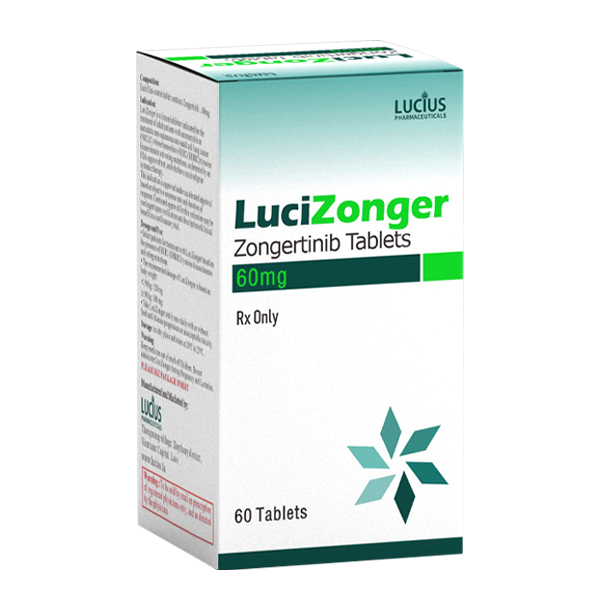
All Names: Hernexeos、Zongertinib、宗格替尼、佐博替尼、宗艾替尼
Indications:Adult patients with unresectable or metastatic non squamous non-small cell lung cancer, confirmed by testing to have HER2 tyrosine kinase domain activation mutations, and have received systemic therapy.
Manufacturer:LUCIUS PHARMACEUTICAL (LAOS) CO., LTD
Customs Clearance Procedure:If the customs requires the package for customs clearance, please pay the customs clearance fee according to the content of EMS SMS and customs regulations.
Zongertinib is a kinase inhibitor that primarily exerts anti-tumor effects by inhibiting the phosphorylation and downstream signaling of human epidermal growth factor receptor 2 (HER2).
1、 Drug name
1. Common name: Zonggetinib
2. English name: Zongertinib
3. Product Name: HERNEXEOS ®
2、 Indications
This product is suitable for treating adult patients with unresectable or metastatic non squamous non-small cell lung cancer, provided that their tumors have HER2 (ERBB2) tyrosine kinase domain activation mutations (confirmed by FDA approved testing methods) and have received systemic treatment in the past.
3、 Specifications
Specification: 60mg tablets.
4、 Main components
Active ingredient: Each tablet contains 60 milligrams of zonotinib.
5、 Usage and dosage
1. Recommended dosage: Calculated based on body weight, taken orally once a day.
2. Weight less than 90 kilograms: 120 milligrams (i.e. 2 tablets of 60 milligrams).
3. Weight equal to or greater than 90 kilograms: 180 milligrams (i.e. 3 pills of 60 milligrams).
4. Medication timing: It can be taken on an empty stomach or with food until the disease progresses or unacceptable toxicity occurs.
5. Usage: Swallow the whole tablet with clean water, do not cut, crush or chew.
6. Missing server:
If the missed dose is within 12 hours, it should be taken as soon as possible upon recollection.
If the missed dose exceeds 12 hours, the dose should be skipped and the regular dose should be taken at the next scheduled time.
7. Vomiting: If vomiting occurs after taking medication, do not take additional doses and continue taking medication as scheduled at the next scheduled time.
6、 Dose adjustment
For adverse reactions of different severity (such as hepatotoxicity, left ventricular dysfunction, interstitial lung disease/pneumonia, etc.), one of the following measures should be taken according to medical advice (details should refer to the adjustment plan in the prescription information):
1. Suspend medication.
2. Reduce the dosage.
3. Permanently discontinue medication.
4. After permanent discontinuation of medication, it will no longer be resumed.
7、 Medication precautions
1. Hepatotoxicity: May cause serious or even life-threatening liver damage, regular monitoring of liver function is necessary during treatment.
2. Left ventricular dysfunction: may lead to serious cardiac problems, and regular assessment of cardiac function is necessary before and during treatment.
3. Interstitial lung disease/pneumonia (ILD/pneumonia): may cause serious or life-threatening lung problems, and new or worsening respiratory symptoms should be monitored.
4. Embryo fetal toxicity: May cause harm to the fetus, and women with fertility must take effective contraceptive measures during treatment and within 2 weeks after the last dose. Prohibited during pregnancy and lactation.
5. Diarrhea: It is common and may be severe. It is necessary to inform the doctor in a timely manner and take supportive treatment.
6. Drug interactions: Doctors should be informed of all medications being used.
7. Avoid co administration with potent CYP3A inducers (if co administration is necessary, increase the dosage of this product).
8. Avoid co administration with certain BCRP substrates (if necessary, monitor for adverse reactions of these drugs).
9. Fertility impact: This product may impair the fertility of both women and men.
8、 Medication for special populations
1. Pregnant women: prohibited.
2. Breastfeeding women: Breastfeeding is prohibited during the treatment period and within 2 weeks after the last dose.
3. Women and men with fertility potential: Effective contraceptive measures should be taken during treatment and 2 weeks after the last dose. May damage fertility.
4. Children: Safety and efficacy have not yet been established.
5. Elderly patients: No significant differences were observed in clinical studies compared to younger patients.
9、 Adverse reactions
1. The most common adverse reactions: incidence rate ≥ 20%, including diarrhea, hepatotoxicity, rash, fatigue, and nausea.
2. The most common serious laboratory abnormalities: incidence rate ≥ 2%, including decreased lymphocytes, increased alanine aminotransferase, increased aspartate aminotransferase, decreased blood potassium, and increased gamma glutamyl transferase.
3. Serious adverse reactions: may result in severe liver damage, left ventricular dysfunction, interstitial lung disease/pneumonia.
10、 Contraindications
None.
11、 Drug interactions
1. Strong CYP3A inducer: significantly reduces the blood concentration of zonotinib, which may lead to reduced efficacy and should be avoided in combination. If unavoidable, increase the dosage of this product as recommended.
2. BCRP substrate: Zongtinib may increase the blood drug concentration of certain BCRP substrate drugs, thereby increasing the risk of adverse reactions to these drugs. For BCRP substrate drugs with higher risks, co administration should be avoided; For other BCRP substrates, monitoring should be strengthened during the co administration period.
12、 Storage method
1. Temperature: Store at room temperature of 20 ° C to 25 ° C (68 ° F to 77 ° F) and allow short-term exposure to an environment of 15 ° C to 30 ° C (59 ° F to 86 ° F).
2. Packaging: Store in the original bottle to prevent moisture and keep the cap tightly closed. The two desiccants inside the bottle cannot be removed.
3. Usage period after opening: The medicine bottle must be used within 3 months after being opened for the first time. Any remaining pills after 3 months of opening should be discarded.
Zongertinibinformation