- All Drug Categories
- Home
- Anti-cancer Drugs
- Healthcare Products
- Medical Information
- Statement
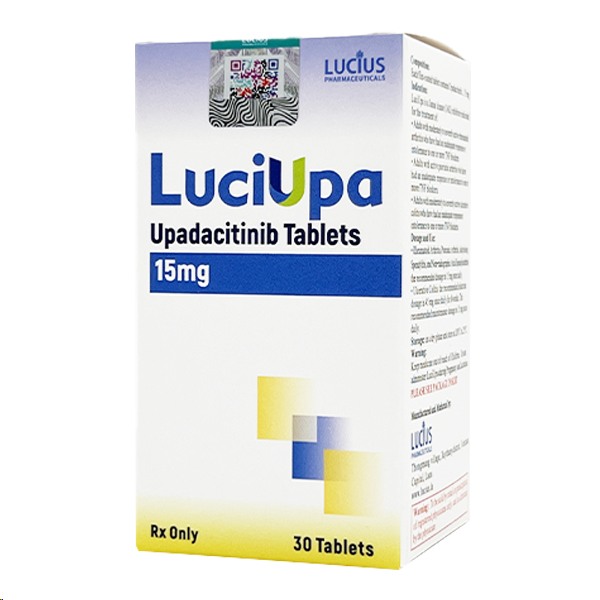
All Names: RINVOQ,upadacitinib,乌帕替尼
Indications:Used for treating moderate to severe rheumatoid arthritis
Manufacturer:LUCIUS PHARMACEUTICAL (LAOS) CO., LTD
Customs Clearance Procedure:If the customs requires the package for customs clearance, please pay the customs clearance fee according to the content of EMS SMS and customs regulations.
1、 Indications
Upatinib (trade name: RINVOQ/RINVOQLQ) is a Janus kinase (JAK) inhibitor, suitable for the following diseases:
1. Rheumatoid arthritis (RA):
Adults with moderate to severe active RA and insufficient or intolerant response to one or more TNF inhibitors.
2. Psoriatic arthritis (PsA):
Active PsA in adults and children aged ≥ 2 years, with insufficient or intolerant response to TNF inhibitors.
3. Atopic dermatitis (AD):
Moderate to severe refractory AD in adults and children aged ≥ 12 years (weight ≥ 40kg), with poor control or unsuitability of other systemic treatments (including biologics).
4. Ulcerative colitis (UC):
Adults with moderate to severe active UC and insufficient or intolerant response to TNF inhibitors.
5. Crohn's disease (CD):
Adults with moderate to severe active CD and insufficient or intolerant response to TNF inhibitors.
6. Ankylosing spondylitis (AS):
Adult active AS with insufficient or intolerant response to TNF inhibitors.
7. Multi joint juvenile idiopathic arthritis (pJIA):
Children aged ≥ 2 years with active pJIA and insufficient or intolerant response to TNF inhibitors.
Usage restrictions:
Do not use other JAK inhibitors, biologics (such as DMARDs), or potent immunosuppressants (such as azathioprine, cyclosporine) in combination.
Patients with atopic dermatitis should avoid using other immunomodulators in combination.
2、 Usage and dosage
General requirements
Dosage form:
Sustained release tablets (15mg/30mg/45mg) should be swallowed whole and should not be broken, crushed, or chewed.
Oral liquid (1mg/mL) requires a dedicated adapter and syringe for administration, and cannot be interchanged with tablets.
Baseline assessment:
Before treatment, it is necessary to check the latent/active tuberculosis, viral hepatitis, blood routine (lymphocytes, neutrophils, hemoglobin), liver function and pregnancy status, and update the vaccination.
Dose adjustment:
If lymphocytes<500/mm ³, neutrophils<1000/mm ³, or hemoglobin<8g/dL, avoid initiating or interrupting treatment.
Administer according to indications
1. Rheumatoid arthritis/ankylosing spondylitis:
Adults: 15mg once daily.
2. Psoriatic arthritis:
Adults: 15mg once daily.
Children aged ≥ 2 years: Administer according to body weight (10~<20kg: 3mg oral solution, twice a day); 20~<30kg: 4mg oral solution, twice a day; ≥ 30kg: 6mg oral solution twice daily or 15mg tablet once daily.
3. Atopic dermatitis:
Adults<65 years old and children ≥ 12 years old (weight ≥ 40kg): starting with 15mg once daily, if the efficacy is insufficient, it can be increased to 30mg once daily.
Adults aged 65 and above: 15mg once daily.
4. Ulcerative colitis:
Induction period: 45mg once daily for 8 weeks.
Maintenance period: 15mg once daily; Difficult to treat/severe patients may consider 30mg once daily.
5. Crohn's disease:
Induction period: 45mg once daily for 12 weeks.
Maintenance period: 15mg once daily; Difficult to treat/severe patients may consider 30mg once daily.
6.pJIA:
Children aged ≥ 2 years old should be given medication according to their body weight (similar to psoriatic arthritis).
Adjustment for special populations
Renal insufficiency:
UC/CD with severe impairment (eGFR15~<30mL/min): induction period: 30mg once daily, maintenance period: 15mg once daily.
AD with severe damage: 15mg once daily.
End stage renal disease (eGFR<15mL/min) is contraindicated.
Liver dysfunction:
UC/CD with mild to moderate impairment (Child Pugh A/B): induction period 30mg once daily, maintenance period 15mg once daily.
Severe damage (Child Pugh C) is prohibited.
Drug interactions:
Strong CYP3A4 inhibitors (such as ketoconazole): AD patients should avoid using a combined dose of 30mg; The induction period for UC/CD patients is reduced to 30mg once daily.
Strong CYP3A4 inducers (such as rifampicin): Avoid combination use.
3、 Side effects
1. Severe infections (including tuberculosis, bacterial/fungal/viral infections): can result in hospitalization or death, and infection signs should be monitored during treatment.
2. Increased mortality rate: The all-cause mortality rate of JAK inhibitors is higher than that of TNF inhibitors in RA patients.
3. Malignant tumors (such as lymphoma and lung cancer): The risk is higher than that of TNF inhibitors, and smokers have a higher risk.
4. Major cardiovascular events (MACE, such as myocardial infarction and stroke): RA patients have a higher risk than TNF inhibitors.
5. Thrombosis (deep vein thrombosis, pulmonary embolism): High risk patients should avoid using it.
Common adverse reactions
Rheumatoid/psoriatic arthritis: upper respiratory tract infection, herpes zoster, herpes simplex, nausea, cough, fever, acne, headache.
Atopic dermatitis: upper respiratory tract infection, acne, herpes simplex, headache, elevated creatine kinase, cough, allergies, folliculitis.
Ulcerative colitis: upper respiratory tract infection, elevated creatine kinase, acne, decreased neutrophils, elevated liver enzymes, rash.
Crohn's disease: upper respiratory tract infection, anemia, fever, acne, shingles, headache.
4、 Precautions
1. Infection risk: Patients with active infections (including local infections) are prohibited from using it; Severe infection during treatment requires discontinuation of medication.
2. Allergic reactions: Severe allergies (such as rapid onset allergies) require permanent discontinuation of medication.
3. Gastrointestinal perforation: High risk patients (such as diverticulitis, combined use of NSAIDs/glucocorticoids) need to be monitored for abdominal pain symptoms.
4. Laboratory monitoring: Regularly check blood routine, liver enzymes, and blood lipids (evaluated after 12 weeks of treatment).
5. Embryotoxicity: Animal experiments have shown a risk of teratogenicity, and women of childbearing age should use contraception for 4 weeks after discontinuing the medication.
6. Vaccination: Avoid using live vaccines and complete all immunizations before treatment.
7. Drug residue: Patients with shortened gastrointestinal transit time may have unabsorbed drugs in their feces, and the efficacy needs to be evaluated.
5、 Medication for special populations
Pregnant women: May cause harm to the fetus, prohibited during pregnancy. Contraception is required during the medication period and 4 weeks after discontinuation.
Breastfeeding period: Medications can be excreted through breast milk. It is recommended to avoid breastfeeding for 6 days after discontinuing the medication.
Children: ≥ 2 years old: applicable for pJIA and PsA; Age ≥ 12 years (≥ 40kg): suitable for AD; <2 years old: pJIA/PsA safety has not been established; <12 years old or weight<40kg: The safety of AD has not been established.
Older adults (≥ 65 years old) have an increased risk of adverse events (such as severe infections) in RA/PsA patients.
Due to limited data on UC/CD/AS patients, caution should be exercised when using medication.
Liver and kidney dysfunction: Administer according to the previous "adjustment for special populations".
6、 Contraindications
People who are allergic to Upatinib or any excipients are prohibited from using it.
upadacitinibinformation