- All Drug Categories
- Home
- Anti-cancer Drugs
- Healthcare Products
- Medical Information
- Statement
All Names:
Indications:
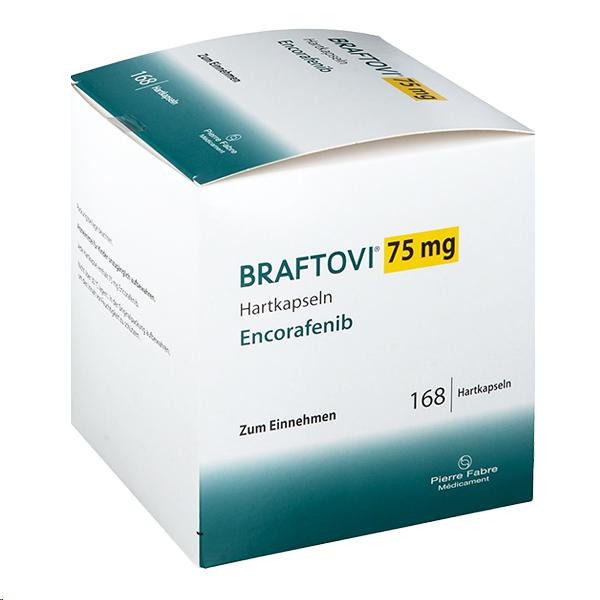
Manufacturer:Pierre Fabre
Customs Clearance Procedure:If the customs requires the package for customs clearance, please pay the customs clearance fee according to the content of EMS SMS and customs regulations.
Encorafenib is an oral small molecule BRAF kinase inhibitor.
1. Drug name
Common name: Encorafenib
Product Name: BRAFTOVI ™
English name: Encorafenib Capsules
2. Indications
Applicable population: Used in combination with Binimetinib for the treatment of unresectable or metastatic melanoma (BRAF V600E or V600K mutations, subject to FDA approved testing confirmation).
Restriction: Not applicable to patients with wild-type BRAF melanoma.
3. Specifications and characteristics
Specifications:
50mg capsules: Orange cap print "A", beige body print "LGX 50mg".
75mg capsules: beige cap print "A", white body print "LGX 75mg".
Appearance: Hard gelatin capsule, with contents ranging from white to off white powder.
4. Main components
Active ingredient: Encorafenib (alanine aminotransferase).
Auxiliary materials: copolypyrrolidone, poloxamer 188, microcrystalline cellulose, succinic acid, cross-linked polyvinylpyrrolidone, colloidal silica, plant-based magnesium stearate.
5. Usage and dosage
Conventional dose: 450 mg orally, once daily (in combination with Bimetinib 45 mg twice daily), before or after meals.
Omission: If missed, take a replacement within 12 hours; If it exceeds 12 hours, skip and do not double the dosage.
Vomiting: No need to take additional medication after vomiting, follow the original plan for the next dose.
6. Dose adjustment
Adverse reaction adjustment:
The first dose is reduced to 300 mg/day, and the second dose is reduced to 200 mg/day. If intolerance persists, the medication will be permanently discontinued.
Specific toxicities (such as QTc prolongation and uveitis) require temporary or permanent discontinuation of medication (see Table 2 for details).
Drug interactions:
CYP3A4 strong/medium acting inhibitors: Reduce the dosage to 1/3 (strong inhibitors) or 1/2 (medium acting inhibitors) of the original dosage.
7. Medication precautions
Diet: No need to fast, but avoid grapefruit (which may increase blood drug concentration).
Monitoring:
Monitor electrocardiogram (QT interval), electrolytes, liver function, skin lesions, and changes in vision before and during medication.
Contraindications: There are no clear contraindications, but caution should be exercised regarding the risk of concomitant medication (such as CYP3A4 inducers).
8. Medication for special populations
Pregnant women: may cause fetal harm and require the use of non hormonal contraception (hormonal contraceptives may be ineffective).
Breastfeeding period: Avoid breastfeeding during treatment and within 2 weeks of discontinuing medication.
Children: Safety has not been established.
Liver/kidney dysfunction: mild to moderate without adjustment; No recommended dosage for severe cases.
9. Adverse reactions
Common (≥ 25%): fatigue, nausea, vomiting, abdominal pain, joint pain.
Serious:
Skin squamous cell carcinoma/basal cell carcinoma (2.6%), bleeding (19%), QT prolongation, uveitis (4%).
The risk of skin toxicity is higher when used alone (such as 51% for palmar and plantar erythema syndrome).
10. Contraindications
There are no absolute contraindications, but wild-type BRAF patients are contraindicated.
11. Drug interactions
CYP3A4 inhibitors/inducers: avoid using strong/medium acting inducers in combination; The dosage of the inhibitor needs to be adjusted.
QT prolongation drugs: Avoid combination therapy (such as antiarrhythmic drugs).
Hormonal contraceptive pills: may fail, non hormonal contraception should be used instead.
12. Storage method
Store at 20 ° C-25 ° C (15 ° C-30 ° C allowed), sealed in the original bottle, moisture-proof (do not remove desiccant).
Encorafenibinformation