- All Drug Categories
- Home
- Anti-cancer Drugs
- Healthcare Products
- Medical Information
- Statement
All Names:
Indications:
Manufacturer:Bristol-Myers Squibb Company,USA
Customs Clearance Procedure:If the customs requires the package for customs clearance, please pay the customs clearance fee according to the content of EMS SMS and customs regulations.
Opdulag is suitable for the treatment of adult and pediatric patients aged 12 and above with unresectable or metastatic melanoma. It is recommended to administer it intravenously every 4 weeks, and specific medication should be taken according to the doctor's guidance.
1. Drug name and main ingredients
Common name: Opdulag
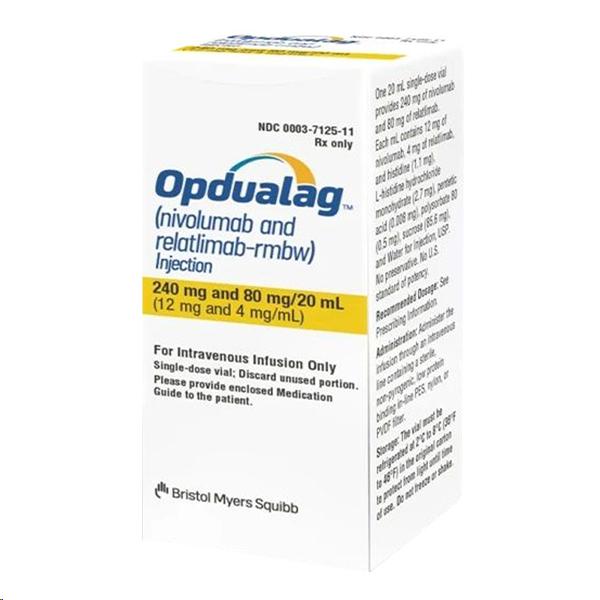
Product Name: OPDUALAG ™
Dosage form: Intravenous injection
2. Indications
Applicable population: Adult and pediatric patients aged 12 years and above with unresectable or metastatic melanoma.
Restriction: Indications must be confirmed through FDA approved testing.
3. Specifications and characteristics
Specification: Each 20mL single dose vial contains 240mg of nivolumab and 80mg of ranibizumab (12mg/mL and 4mg/mL).
Appearance: Clear to microemulsion light, colorless to light yellow solution, may contain a small amount of semi transparent to white particles.
4. Main components
Active ingredients: nivolumab (anti-PD-1 monoclonal antibody) and ranibizumab (anti-LAG-3 monoclonal antibody).
Accessories: Histidine, L-histidine hydrochloride monohydrate, pantothenic acid, polysorbate 80, sucrose, and injection water.
5. Usage and dosage
Conventional dosage:
Adults and children aged ≥ 12 years and weighing ≥ 40kg: 480mg nivolumab+160mg ranibizumab, intravenous infusion every 4 weeks for 30 minutes.
Children weighing less than 40kg: No recommended dosage has been established.
Missed administration: Make up for the infusion as soon as possible, and skip if it is close to the next administration time.
Diet: No special requirements.
6. Dose adjustment
Immune mediated adverse reactions (IMAR):
Grade 3: Suspend medication and consider restarting after recovery.
Grade 4 or recurrent Grade 3: permanent discontinuation of medication.
Infusion reaction:
Grade 1-2: Slow down infusion rate or interrupt.
Grade 3-4: Permanent discontinuation of medication.
7. Medication precautions
Monitoring requirements: Regularly check liver function, kidney function, thyroid function, and electrocardiogram before and during medication.
Infusion management: Use a 0.2-1.2 μ m filter, rinse the tubing after infusion, and prohibit simultaneous infusion with other drugs.
Storage conditions:
Unopened: Keep refrigerated at 2-8 ℃ and avoid light exposure. Do not freeze or shake.
After preparation: Use at room temperature for 8 hours or refrigerated for 24 hours.
8. Medication for special populations
Pregnant women: May cause harm to the fetus, contraception should be used until 5 months after the last dose.
Breastfeeding period: Avoid breastfeeding during treatment and within 5 months of discontinuing medication.
Children: Patients aged ≥ 12 and ≥ 40kg are safe and effective, but there is insufficient data for smaller groups.
Liver/kidney dysfunction: Mild to moderate without adjustment, severe without data available.
9. Adverse reactions
Common (≥ 20%): musculoskeletal pain (45%), fatigue (39%), rash (28%), itching (25%), diarrhea (24%).
Serious but rare:
Immune mediated pneumonia (3.7%), hepatitis (6%), and myocarditis (1.7%).
Endocrine disorders (17% thyroid dysfunction, 4.2% adrenal insufficiency).
10. Contraindications
There are no absolute contraindications, but it is contraindicated for those who are allergic to the ingredients.
11. Drug interactions
Immunosuppressants: May weaken the efficacy, avoid combination therapy.
CYP3A4 strong inducer: not studied, use with caution.
12. Production and Storage
Manufacturer: Bristol Myers Squibb.
Storage: Store in the original packaging at 2-8 ℃ away from light and avoid shaking.
Opdualaginformation