- All Drug Categories
- Home
- Anti-cancer Drugs
- Healthcare Products
- Medical Information
- Statement
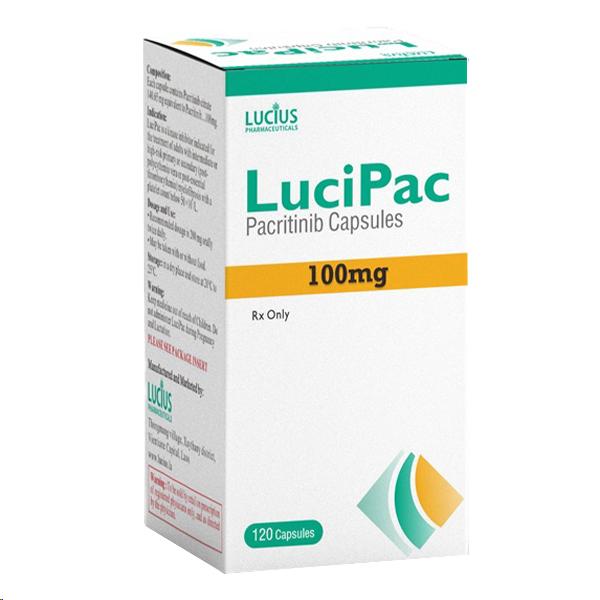
All Names:
Indications:
Manufacturer:LUCIUS PHARMACEUTICAL (LAOS) CO., LTD
Customs Clearance Procedure:If the customs requires the package for customs clearance, please pay the customs clearance fee according to the content of EMS SMS and customs regulations.
Pacritinib is an oral multi-target tyrosine kinase inhibitor. Compared to traditional JAK inhibitors, the significant advantage of Pacritinib is that it does not require dose adjustment due to thrombocytopenia, filling the treatment gap in high-risk MF patients.
1. Drug name and main ingredients
Common name: Pacritinib
Product Name: VONJO ™
Dosage form: Oral capsules
Main ingredients: Each capsule contains 100mg of Paquintinib citrate (equivalent to 100mg of base)
Accessories: Microcrystalline cellulose, polyethylene glycol 8000 (PEG8000), magnesium stearate; The capsule shell contains gelatin, titanium dioxide, iron oxide black, etc.
2. Indications
Bone marrow fibrosis (MF): used to treat adult patients with medium to high risk primary or secondary (after polycythemia vera or primary thrombocytosis) bone marrow fibrosis, and platelet count below 50 × 10 ⁹/L.
Note: This indication is approved based on accelerated reduction of spleen volume and further clinical benefits need to be verified.
3. Specifications and characteristics
Specification: 100mg/capsule (120 capsules/bottle)
Appearance: Opaque hard capsule, red cap printed with "Pacritinib 100mg", gray body printed with "C78837".
4. Usage and dosage
Conventional dose: 200mg orally, twice a day, before or after meals, taken whole.
Omission treatment: Skip the missed dose and take the next dose according to the original plan. It is prohibited to take double the dose.
Discontinue medication before surgery: Discontinue medication 7 days before elective surgery and restart after hemostasis.
5. Dose adjustment
Adverse reaction adjustment
Measures for handling adverse reactions
Suspend medication for grade 3/4 diarrhea until it returns to ≤ grade 1. When restarting, reduce dosage by 50% and use antidiarrheal medication.
Suspend medication for severe thrombocytopenia and reduce dosage by 50% after recovery; If there is a recurrence, the medication will be permanently discontinued.
If QTc>500ms, medication should be suspended. If it returns to ≤ 480ms within one week, the original dose can be restarted. Otherwise, the dosage should be reduced.
Suspend medication for moderate to severe bleeding and reduce dosage by 50% after recovery; If bleeding endangers life, the medication will be permanently discontinued.
Adjustment for special populations
Liver dysfunction: Moderate to severe (Child Pugh B/C) is contraindicated.
Renal insufficiency: eGFR<30mL/min is prohibited.
6. Medication precautions
Monitoring requirements:
Baseline and regular check ups for blood routine, coagulation function, electrocardiogram, and liver function.
Timely fluid replacement and use antidiarrheal drugs (such as loperamide) when experiencing diarrhea.
Diet: No special restrictions, but it is necessary to maintain hydration.
Vomiting: If vomiting is severe, it may be considered to administer medication in divided doses or in combination with antiemetic drugs.
7. Medication for special populations
Pregnant women: Use only when benefits outweigh risks (animals show embryotoxicity).
Breastfeeding period: Breastfeeding is prohibited within 2 weeks after discontinuation of medication.
Children: Safety has not been established.
Elderly: No need to adjust dosage, but close monitoring of adverse reactions is necessary.
8. Adverse reactions
Common (≥ 20%): diarrhea (48%), thrombocytopenia (34%), nausea (32%), anemia (24%), peripheral edema (22%).
Serious but rare:
Bleeding (11% severe, 2% fatal), infection (including opportunistic infections), QT interval prolongation (3.8%), secondary malignant tumors (such as lymphoma).
9. Contraindications
Individuals who are allergic to pakinib or excipients.
Combination use of potent CYP3A4 inhibitors/inducers (such as clarithromycin, rifampicin).
Moderate to severe liver dysfunction (Child Pugh B/C) or eGFR<30mL/min.
10. Drug interactions
CYP3A4 inhibitors/inducers: Strong acting drugs are contraindicated, and combination use of medium acting drugs (clarithromycin ↑ AUC 80%, rifampicin ↓ AUC 87%) is avoided.
P-gp/BCRP/OCT1 substrates: Avoid using sensitive substrates such as digoxin and methotrexate in combination.
11. Storage method
Unopened: Store at room temperature (<30 ° C), keep away from light in the original packaging, and have a shelf life of 36 months.
After opening: The bottle cap should be tightened to prevent moisture and light.
12. Manufacturer
Manufacturer: CTIBioPharma Corp. (USA)
Note: If severe diarrhea, bleeding, or arrhythmia occurs during medication, seek medical attention immediately. Specific medication should be taken according to medical advice.
Pacritinibinformation