- All Drug Categories
- Home
- Anti-cancer Drugs
- Healthcare Products
- Medical Information
- Statement
All Names:
Indications:
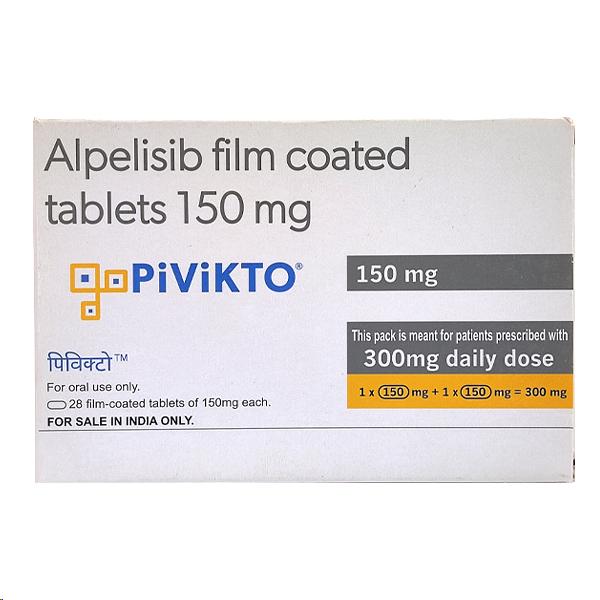
Manufacturer:PIVIKTO
Customs Clearance Procedure:If the customs requires the package for customs clearance, please pay the customs clearance fee according to the content of EMS SMS and customs regulations.
Alpelisib is an oral small molecule PI3K α inhibitor, which is specially used to treat patients with advanced or metastatic breast cancer carrying PIK3CA gene mutation.
1、 Drug name
1. Common name: Alpelisib
2. Product Name: VIJOICE ®
3. Dosage forms: tablets (50mg, 125mg, 200mg), oral granules (50mg/pack)
2、 Indications
Suitable for the treatment of adult and pediatric patients aged 2 years and above with PIK3CA related overgrowth spectrum (PROS) who require systemic therapy.
3、 Specifications and characteristics
1. Tablets:
50mg: Light yellow, round, film coated tablets, with "C7" engraved on one side and "NVR" engraved on the other side.
125mg: Dark yellow, oval shaped, film coated tablets with "Y7" engraved on one side and "NVR" engraved on the other side.
200mg: Light yellow, oval shaped, film coated tablets with "CL7" engraved on one side and "NVR" engraved on the other side.
2. Oral granules:
50mg/pack: A mixture of white to off white powder and granules, packaged for single use.
4、 Main components
Active ingredient: Apilis
5、 Usage and dosage
1. Adult patients: The recommended dosage is 250mg, once daily, taken orally with meals.
2. Pediatric patients (2 to<18 years old): The recommended starting dose is 50mg, once daily, taken orally with meals.
If children aged ≥ 6 years need to optimize the efficacy after 24 weeks of treatment, it may be considered to increase the dosage to 125mg once daily.
At the age of 18, it can gradually increase to 250mg.
Medication requirements: It should be taken with meals and taken at a fixed time every day.
6、 Dose adjustment
1. Omission: If missed, it can be taken with meals within 9 hours after the regular medication time; If it exceeds 9 hours, skip the daily dose and take the medication normally the next day.
2. Vomiting: If vomiting occurs after taking medication, there is no need to take it again. The next day, take the medication according to the original plan.
3. Adverse reaction dose adjustment:
Discontinue administration, reduce dosage, or permanently discontinue medication based on the severity of adverse reactions.
The adult dose can be gradually reduced to 125mg or 50mg once daily; The dosage for children can be reduced to 50mg once daily.
When unable to tolerate a daily dose of 50mg, permanent discontinuation of the medication is required.
7、 Medication precautions
1. Medication time:
Should be taken with meals to optimize absorption.
2. Formulation selection:
50mg dosage can be selected as tablets or granules; 125mg or 250mg doses can only be used in tablets.
Do not mix tablets and granules to achieve the target dose.
3. People with swallowing difficulties:
Tablets can be prepared as oral suspensions (taken after mixing with water), while granules can be taken after mixing with water, milk, apple juice, or soft foods (such as soy sauce or yogurt).
4. Monitoring requirements:
Regular monitoring of fasting blood glucose, glycated hemoglobin (HbA1c), and liver function is required before and during treatment.
Pay attention to observing skin reactions, respiratory symptoms, diarrhea or colitis manifestations.
8、 Medication for special populations
1. Patients with liver dysfunction: Mild to severe liver dysfunction (Child Pugh A, B, C grades) do not require dose adjustment.
2. Patients with renal insufficiency: mild to moderate renal insufficiency (CLcr30-89mL/min) do not require dose adjustment; Insufficient data on severe renal insufficiency (CLcr<30mL/min), caution is required.
3. Elderly people: Limited data, individualized assessment is needed.
4. Pregnant women: have embryonic fetal toxicity, need to be informed of the risks and use effective contraceptive measures.
5. Breastfeeding women: Breastfeeding is prohibited during the treatment period and within one week after the last dose.
6. Children: The safety and efficacy of patients under 2 years old have not been established.
9、 Adverse reactions
1. Common adverse reactions (≥ 10%):
Diarrhea, stomatitis, and high blood sugar.
2. Serious adverse reactions:
Severe hypersensitivity reactions (such as allergic reactions, angioedema);
Serious skin adverse reactions (such as Stevens Johnson syndrome, toxic epidermal necrolysis);
Hyperglycemia (possibly accompanied by hyperosmolar hyperglycemia or ketoacidosis);
Pneumonia or interstitial lung disease;
Diarrhea or colitis (which may lead to dehydration or acute kidney injury).
3. Laboratory abnormalities: Common conditions include hypocalcemia, hypophosphatemia, hyperglycemia, hyperbilirubinemia, etc.
10、 Contraindications
Individuals with a history of severe allergies to Apilis or any excipients are prohibited from using it.
11、 Drug interactions
1. CYP3A4 strong inducers (such as rifampicin): Avoid combination therapy as it may lower the blood concentration of aprepitis.
2. BCRP inhibitors: Avoid combination therapy as it may increase exposure to aspirin and the risk of adverse reactions.
3. CYP2C9 substrates (such as warfarin): need to be closely monitored, as aspirin may reduce their blood drug concentration and efficacy.
4. Gastric acid suppressants (such as ranitidine): may reduce the absorption of aspirin and should be taken with meals to alleviate the effects.
12、 Storage method
Stored at 20 ° C to 25 ° C (68 ° F to 77 ° F), allowing for short distance transportation between 15 ° C to 30 ° C (59 ° F to 86 ° F).
The tablet suspension should be taken within 60 minutes after preparation; Granules should be taken within 2 hours after mixing with food/liquids.
Alpelisibinformation