- All Drug Categories
- Home
- Anti-cancer Drugs
- Healthcare Products
- Medical Information
- Statement
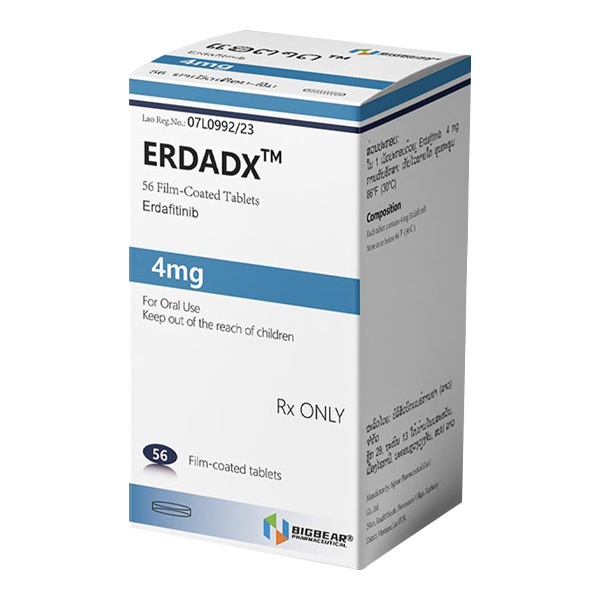
All Names: Erdafitinib,Balversa、厄达替尼、博珂
Indications:Suitable for adult patients with locally advanced or metastatic urothelial carcinoma, susceptibility to FGFR3 gene alterations, and disease progression after at least one previous systemic treatment.
Manufacturer:Daxiong
Customs Clearance Procedure:If the customs requires the package for customs clearance, please pay the customs clearance fee according to the content of EMS SMS and customs regulations.
On January 19, 2024, the FDA further fully approved erdatinib for the treatment of specific patients with locally advanced or metastatic urothelial carcinoma, further consolidating its position in this treatment field.
1、 Drug name
1. Common name: Edatinib
2. Product Name: BALVERSA
3. English name: Erdafitinib
2、 Indications
1. Suitable for treating adult patients with locally advanced or metastatic urothelial carcinoma, whose tumors have susceptible FGFR3 or FGFR2 gene alterations and have disease progression during or after receiving at least first-line platinum based chemotherapy, including progression within 12 months of neoadjuvant or adjuvant platinum based chemotherapy.
2. Prior to use, confirmation of FGFR gene alteration status must be obtained through FDA approved companion testing.
3、 Specifications and characteristics
4 milligrams: tablets.
4、 Main components
1. Active ingredient: Edatinib.
5、 Usage and dosage
1. Recommended starting dose: 8mg (two 4mg tablets), once daily, orally.
2. Dose increase: On the 14th to 21st day of treatment, if the serum phosphate level is below 5.5mg/dL and there are no eye disorders or grade 2 or above adverse reactions, the dose can be increased to 9mg (three 3mg tablets) once daily.
3. Usage: Swallow the whole tablet, it can be taken with food or taken separately. Treatment should continue until disease progression or unacceptable toxicity occurs.
6、 Dose adjustment
1. Dose adjustment is based on the severity of adverse reactions.
2. Hyperphosphatemia: Dose interruption, reduction, or discontinuation based on serum phosphate levels. For example, medication should be suspended when the level is between 7.0-9.0mg/dL until the original dose is restored or the dose is reduced after recovery; When the level is higher than 10.0mg/dL or accompanied by significant changes in renal function, medication should be suspended, and two dose levels should be reduced after recovery.
3. Eye disorders: When central serous retinopathy/retinal pigment epithelium detachment occurs, medication should be temporarily suspended according to the severity. After recovery, the dosage should be reduced (such as from grade 1 to the next grade, from grade 3 to two grades), and for grade 4, medication should be permanently discontinued.
4. Other adverse reactions: If a grade 3 adverse reaction occurs, medication should be temporarily suspended. After returning to grade 1 or baseline, the dose should be reduced by one grade and restarted; Grade 4 adverse reactions require permanent discontinuation of medication.
5. The dose reduction follows a step-by-step plan, such as decreasing from 9 milligrams to 8 milligrams, 6 milligrams, 5 milligrams, 4 milligrams, and then stopping the medication.
7、 Medication precautions
1. Before and after meals: can be taken.
2. Missed dose: If the dosage is missed, it should be taken as soon as possible when remembered on the same day. The next day, restore the normal daily medication schedule. Double doses should not be taken to compensate for missed doses.
3. Vomiting: If vomiting occurs after taking medication, additional doses should not be taken. The next dose should be taken according to the normal schedule the next day.
8、 Medication for special populations
1. Pregnant women: Based on the mechanism of action and animal research, this product can cause fetal harm and is contraindicated for pregnant women. Women of childbearing age should take effective contraceptive measures during treatment and within one month after the last dose.
2. Breastfeeding women: It is recommended not to breastfeed during the treatment period and within one month after the last dose.
3. Women and men with fertility: Women should undergo a pregnancy test before treatment. Male and female patients should take effective contraceptive measures during treatment and within one month after the last dose.
4. Children: Safety and effectiveness have not yet been established.
5. Elderly patients: No overall difference in safety or efficacy was observed compared to younger patients.
6. Liver and kidney dysfunction: Patients with mild to moderate kidney dysfunction or mild liver dysfunction do not require dose adjustment. The medication data for patients with severe renal dysfunction, renal dysfunction requiring dialysis, and moderate or severe liver dysfunction are unknown.
7. CYP2C9 weak metabolizers: Patients with known or suspected CYP2C9 * 3/* 3 genotypes may have elevated levels of edatinib in their blood and require monitoring for adverse reactions.
9、 Adverse reactions
1. The most common adverse reactions (including laboratory abnormalities with an incidence rate of ≥ 20%) include: elevated phosphate levels, stomatitis, fatigue, elevated creatinine, diarrhea, dry mouth, nail peeling, elevated alanine aminotransferase, elevated alkaline phosphatase, decreased blood sodium, decreased appetite, decreased albumin, taste disorders, decreased hemoglobin, dry skin, elevated aspartate aminotransferase, decreased blood magnesium, dry eye syndrome, hair loss, palmar and plantar redness and swelling syndrome, constipation, decreased phosphate, abdominal pain, elevated blood calcium, nausea, and musculoskeletal pain.
2. Serious adverse reactions include eye disorders and hyperphosphatemia.
10、 Contraindications
None.
11、 Drug interactions
1. Avoid co administration with potent CYP2C9 or CYP3A4 inducers as they may significantly reduce the blood concentration of erlotinib.
2. When used in combination with potent CYP2C9 or CYP3A4 inhibitors, it may increase the blood concentration and toxicity of erlotinib, and alternative therapies or close monitoring of adverse reactions should be considered.
3. In combination with intermediate acting CYP2C9 or CYP3A4 inducers, it may be necessary to increase the dose of edatinib to 9 milligrams.
4. Avoid co administration with drugs that can alter serum phosphate levels before the initial dose increase period (days 14 to 21).
5. Avoid co administration with sensitive CYP3A4 substrates with narrow therapeutic windows.
6. Co administration with OCT2 substrates (such as metformin) may increase their blood drug concentration and toxicity, and alternative therapies or substrate dosage adjustments should be considered.
7. When combined with P-glycoprotein substrates with a narrow therapeutic window, administration should be given at least 6 hours apart.
12、 Storage method
Store at 20 ° C to 25 ° C (68 ° F to 77 ° F); Allowable deviation between 15 ° C and 30 ° C (59 ° F and 86 ° F).
Erdafitinibinformation