- All Drug Categories
- Home
- Anti-cancer Drugs
- Healthcare Products
- Medical Information
- Statement
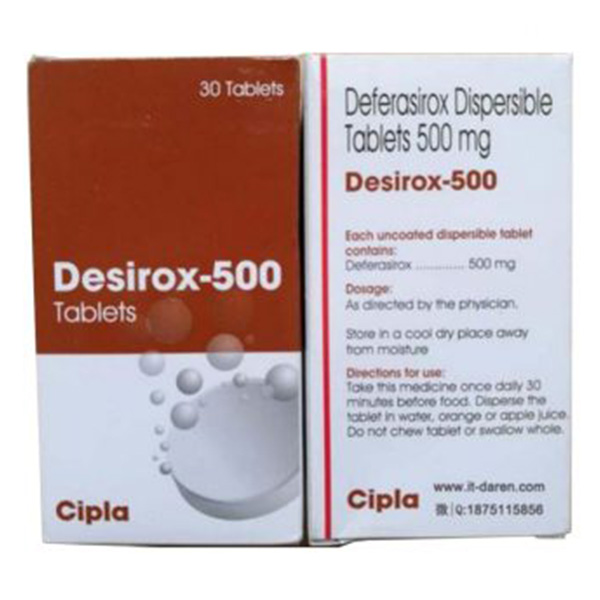
All Names: Deferasirox、Jadenu、地拉罗司、恩瑞格
Indications:Suitable for patients aged 2 years and above with chronic iron overload caused by repeated blood transfusions (meeting the requirement of transfusion concentrated red blood cell total volume ≥ 100mL/kg and sustained serum ferritin>1000 μ g/L), as well as non transfusion dependent thalassemia (NTDT) syndrome chronic iron overload patients aged 10 years and above with liver iron concentration (LIC) ≥ 5mgFe/g dry weight and serum ferritin>300 μ g/L.
Manufacturer:Cipla, India
Customs Clearance Procedure:If the customs requires the package for customs clearance, please pay the customs clearance fee according to the content of EMS SMS and customs regulations.
Deferasirox is an iron chelator that belongs to the class of orally active drugs. It promotes the excretion of iron in the body by selectively binding with iron ions (Fe ³ ⁺) to form stable water-soluble complexes.
1、 Drug name
Common name: Deferasirox
2、 Indications
Used to treat chronic iron overload (transfusion induced hemosiderosis) caused by blood transfusion in children aged 2 and above.
This indication is based on the effect of reducing liver iron concentration and serum ferritin levels, and has not yet been proven to improve survival rates or disease-related symptoms.
3、 Specifications and characteristics
Specification: Tablets, each containing 500mg of Deferasirox.
4、 Main components
Active ingredient: Deferasirox.
5、 Usage and dosage
Recommended initial dose: For patients with transfusion induced iron overload, the recommended initial dose is once daily, 20mg/kg body weight each time (taken orally as a suspension). The dose should be calculated to the nearest whole tablet.
Usage:
Do not chew or swallow the whole piece.
It should be taken on an empty stomach at least 30 minutes before meals, preferably at a fixed time each day.
Monitoring and adjustment: Monitor serum ferritin every month and adjust the dosage every 3-6 months according to the trend, with an adjustment range of 5 or 10mg/kg. If the dose control of 30mg/kg is poor (such as serum ferritin consistently above 2500mcg/L without a decreasing trend), it may be considered to increase it to 40mg/kg. It is not recommended to use doses exceeding 40mg/kg. If serum ferritin continues to be below 500mcg/L, temporary interruption of treatment should be considered.
6、 Dose adjustment
Liver injury patients:
Mild (Child Pugh A): No adjustment required.
Moderate (Child Pugh B): Reduce the initial dose by 50%.
Severe (Child Pugh C): Avoid use.
Renal injury patients: Patients with creatinine clearance rate (ClCr) between 40 and 60mL/min have a 50% reduction in initial dose. Patients with serum creatinine levels greater than twice the upper limit of the age corresponding normal value or ClCr levels less than 40mL/min are contraindicated.
When serum creatinine increases:
Adults and adolescents (≥ 16 years old): If the serum creatinine level increases by ≥ 33% compared to the baseline average, a follow-up examination should be conducted within one week; If the increase is still ≥ 33%, the dose will be reduced by 10mg/kg.
Pediatric patients (2-15 years old): If serum creatinine increases to more than 33% above the baseline mean and exceeds the upper limit of the corresponding normal value for age, the dose will be reduced by 10mg/kg.
All patients: If serum creatinine is greater than twice the upper limit of the corresponding normal value for age or ClCr is less than 40mL/min, treatment should be stopped.
Combination medication:
UGT inducers (such as rifampicin, phenytoin, phenobarbital, ritonavir): avoid co administration. If necessary, consider increasing the starting dose of Deferasirox by 50% and monitoring serum ferritin and clinical response for further adjustment.
Bile acid binding resins (such as colexanide, colervastatin, coleoptilol): avoid co use. If necessary, consider increasing the starting dose of Deferasirox by 50% and monitoring serum ferritin and clinical response for further adjustment.
7、 Medication precautions
Before and after meals: It must be taken on an empty stomach at least 30 minutes before meals.
Leakage: It is recommended to follow the principle of taking at a fixed time every day. If there is a leakage, consult a doctor or pharmacist.
Vomiting: If vomiting occurs after taking medication, you should consult a doctor to see if it is necessary to take additional medication.
Other:
During medication, the simultaneous use of aluminum containing antacids should be avoided.
Treatment requires close monitoring, including regular laboratory tests for kidney function (serum creatinine, creatinine clearance rate) and liver function (transaminase, bilirubin), as well as regular auditory and ophthalmic examinations before and during treatment.
Skin rash may occur, mild to moderate treatment can be continued, and severe cases require interruption of treatment.
8、 Medication for special populations
Children (2 years old and above): Safety and efficacy have been established, and the recommended starting dose and adjustment are the same as for adults. The safety and efficacy of patients under 2 years old have not yet been established.
Elderly people (≥ 65 years old): The frequency of adverse reactions is higher, and due to decreased liver, kidney, and heart function and increased risk of comorbidities, toxicity signs should be closely monitored, usually starting from the lower end of the dosage range.
Pregnant women: Based on animal research, it may cause harm to the fetus and should only be used when potential benefits outweigh potential risks.
Breastfeeding women: It is not yet clear whether the medication is excreted with human milk, and the importance of the medication to the mother should be weighed before deciding to stop breastfeeding or medication.
9、 Adverse reactions
The most common adverse reactions (>5%) are diarrhea, vomiting, nausea, abdominal pain, rash, and elevated serum creatinine.
Serious Warning:
Renal toxicity: can lead to acute kidney failure or even death, and regular monitoring of renal function is necessary.
Hepatotoxicity: can cause liver damage or even liver failure, and regular monitoring of liver function is necessary.
Gastrointestinal bleeding: can lead to gastrointestinal bleeding and even death, especially in elderly patients with underlying diseases, with a high risk.
Other important adverse reactions: bone marrow suppression (neutropenia, granulocyte deficiency, worsening anemia, thrombocytopenia), severe allergic reactions, severe skin reactions (such as Stevens Johnson syndrome), hearing and eye abnormalities, etc.
10、 Contraindications
This product is contraindicated for the following patients:
Serum creatinine is greater than twice the upper limit of the age corresponding normal value or creatinine clearance rate is less than 40mL/min.
Poor physical condition.
High risk myelodysplastic syndrome.
Late stage malignant tumors.
The platelet count is less than 50x10 ^ 9/L.
Known to be allergic to Deferasirox or any of its components.
11、 Drug interactions
Aluminum containing antacids: avoid co administration.
CYP2C8 substrates (such as regorafenib): Deferasirox inhibits CYP2C8 and increases the blood concentration of co administered drugs. When using regorazine in combination, consider reducing its dosage and closely monitoring blood sugar.
CYP1A2 substrates (such as theophylline): Deferasirox can inhibit CYP1A2 and increase the blood concentration of co administered drugs. Avoid co administration with theophylline. If co administration is necessary, monitor the concentration of theophylline and consider adjusting the dosage.
UGT inducers (such as rifampicin): may reduce the blood concentration of Deferasirox and decrease its efficacy. Avoid co administration, if necessary, consider increasing the dose of Deferasirox.
Bile acid binding resin (such as colexamide): may reduce the blood concentration of Deferasirox and decrease its therapeutic effect. Avoid co administration, if necessary, consider increasing the dose of Deferasirox.
CYP3A4 substrates (such as cyclosporine, simvastatin, and hormonal contraceptives): Deferasirox may induce CYP3A4, reducing the effectiveness of combination therapy and requiring close monitoring.
12、 Storage method
Stored at 25 ° C (77 ° F), allowing fluctuations within the range of 15-30 ° C (59-86 ° F). moisture-proof. Place in a sealed, dark container.
Deferasiroxinformation