- All Drug Categories
- Home
- Anti-cancer Drugs
- Healthcare Products
- Medical Information
- Statement
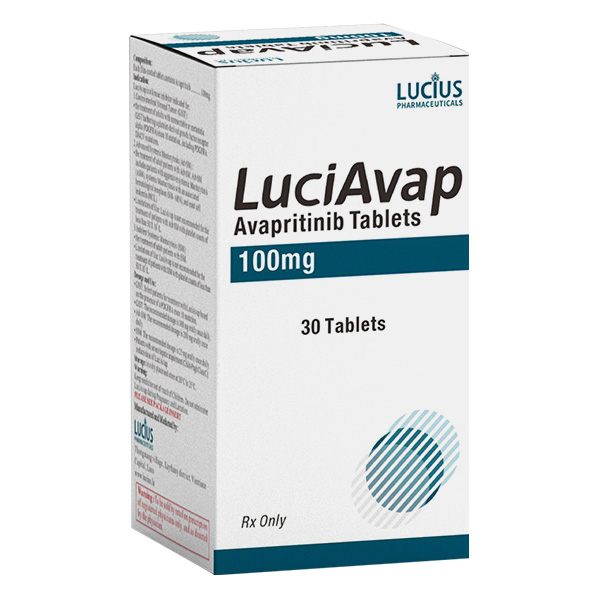
All Names: BLU-285、Avapritinib、Ayvakit、 阿伐替尼、泰吉华、阿伐普利尼、阿伐替尼片
Indications:Afatinib is indicated for adult patients (aged ≥18 years) who meet the following criteria: patients with unresectable or metastatic GIST carrying PDGFRA exon 18 mutations (including D842V mutation); patients with AdvSM (including ASM, SM-AHN, MCL) with platelet counts ≥50×10⁹/L; and patients with ISM with platelet counts ≥50×10⁹/L.
Manufacturer:LUCIUS PHARMACEUTICAL (LAOS) CO., LTD
Customs Clearance Procedure:If the customs requires the package for customs clearance, please pay the customs clearance fee according to the content of EMS SMS and customs regulations.
Avapritinib is a tyrosine kinase inhibitor that blocks the proliferation of tumors and mast cells by targeting and inhibiting KITD816V, PDGFRA, and PDGFRAD842 mutants, thereby preventing their autophosphorylation and sustained activation.
1. Drug name and ingredients
Drug Name: Avapritinib. Trade Name: AYVAKIT®.
Main ingredients: Each tablet contains a specific dose of afatinib. The active ingredient is afatinib.
II. Indications
Gastrointestinal stromal tumor (GIST): Used for the treatment of adult unresectable or metastatic GIST carrying mutations in exon 18 of platelet-derived growth factor receptor alpha (PDGFRA), including the PDGFRA D842V mutation. Prior to use, PDGFRA exon 18 mutations must be confirmed through testing.
Advanced systemic mastocytosis (AdvSM): used for the treatment of adult AdvSM, including aggressive systemic mastocytosis (ASM), systemic mastocytosis with associated hematologic neoplasms (SM-AHN), and mast cell leukemia (MCL).
Indolent systemic mastocytosis (ISM): used for the treatment of adult ISM.
III. Specifications and Characteristics
This product is a film-coated tablet, 100 mg.
IV. Usage and Dosage
Recommended dosage
GIST: The recommended dosage is 300 mg once daily, taken orally. Patients should be selected based on the presence of PDGFRA exon 18 mutations.
AdvSM: The recommended dosage is 200 mg once daily, taken orally.
ISM: The recommended dosage is 25 mg once daily, taken orally.
Dosage: It should be taken on an empty stomach, at least 1 hour before meals or 2 hours after meals. Swallow the entire tablet with water, do not crush or chew it.
Handling of missed doses: If a dose is missed, it should be taken as soon as remembered, unless it is less than 8 hours before the next scheduled dose. If it is less than 8 hours, the missed dose should be skipped and the next dose should be taken at the scheduled time. Do not take two doses within 8 hours.
Vomiting treatment: If vomiting occurs after taking the medication, do not take an additional dose. Take the next dose as scheduled.
V. Dose adjustment
Dose adjustments should be made based on the type and severity of adverse reactions, primarily following the principles outlined in the table below:
Intracranial hemorrhage: Regardless of its severity, once it occurs, the use of apatinib must be permanently discontinued.
Cognitive effect:
Grade 1: Medication can be continued at the original dose or reduced; alternatively, medication can be temporarily suspended, and then resumed at the original dose or reduced dose after symptoms improve to baseline or resolve.
Grade 2 or 3: Discontinue medication until symptoms improve to baseline, Grade 1, or resolve, then resume medication at the original dose or reduce the dose.
Grade 4: Permanent discontinuation of afatinib.
Other adverse reactions of ≥ Grade 3 or Grade 4: Discontinue the medication, and after the symptoms improve to ≤ Grade 2, resume the medication at the original dose or reduce the dose based on clinical judgment.
Thrombocytopenia (AdvSM patients only): For patients with a platelet count <50x10⁹/L, drug administration should be discontinued. Once the platelet count recovers to ≥50x10⁹/L, drug administration should be resumed at a reduced dose level (see dosage escalation). If the platelet count fails to recover, consideration should be given to administering platelet support therapy.
Recommended Dose Titration (for Dose Reduction): There are specific dose reduction steps for different indications. For example, patients with GIST should have their initial dose reduced to 200 mg once daily, and then reduced to 100 mg once daily for the second reduction; patients with AdvSM should have their initial dose reduced to 100 mg once daily, and then reduced to 50 mg once daily for the second reduction, etc. For patients who cannot tolerate the lowest effective dose (100 mg for GIST and 25 mg for AdvSM), the medication should be permanently discontinued.
Co-administration with CYP3A inhibitors: Co-administration with strong or moderate CYP3A inhibitors should be avoided. If co-administration with moderate inhibitors is unavoidable, the starting dose should be reduced to 100 mg once daily for GIST patients, and to 50 mg once daily for AdvSM patients; co-administration should be avoided for ISM patients.
Liver dysfunction:
Patients with mild or moderate hepatic insufficiency do not require dosage adjustments.
Patients with severe hepatic insufficiency (Child-Pugh Class C) require adjusted initial dosages: 200 mg once daily for GIST patients, 100 mg once daily for AdvSM patients, and 25 mg every other day for ISM patients.
Renal insufficiency: No dosage adjustment is required for patients with mild or moderate renal insufficiency. The recommended dosage for patients with severe renal insufficiency or end-stage renal disease has not yet been determined.
Medication for the elderly: Clinical studies have shown that there is no overall difference in safety and efficacy between elderly and younger patients, and no special dosage adjustments are necessary.
VI. Medication for special populations
Pregnancy: Afatinib may pose a risk to the fetus. Effective contraception should be taken by women of childbearing potential during treatment and for 6 weeks after the last dose. Pregnancy testing should be performed before medication. Male patients with female partners of childbearing potential should also take effective contraception during treatment and for 6 weeks after the last dose.
Lactation: It is recommended that women refrain from breastfeeding during treatment and for at least 2 weeks after the last dose.
Children: Safety and effectiveness have not been established.
Fertility: Animal studies suggest that afatinib may impair fertility in both women and men. Treatment may affect sperm production or female fertility.
VII. Adverse reactions (most common)
GIST patients: edema, nausea, fatigue/asthenia, cognitive impairment, vomiting, decreased appetite, diarrhea, increased tearing, abdominal pain, constipation, rash, dizziness, and changes in hair color.
Patients with AdvSM: edema, diarrhea, nausea, fatigue/asthenia.
ISM patients: ocular edema, dizziness, peripheral edema, and flushing.
VIII. Contraindications
No known contraindications.
IX. Drug interactions
Drugs to be avoided in combination:
Strong and moderate CYP3A inhibitors (such as itraconazole, voriconazole, and clarithromycin) can increase the plasma concentration of afatinib and elevate the risk of adverse reactions. If co-administration with moderate inhibitors cannot be avoided, the dosage must be reduced.
Strong and moderate CYP3A inducers (such as rifampin, phenytoin, carbamazepine, and St. John's wort): can reduce the plasma concentration of afatinib, potentially leading to decreased efficacy.
Drugs to be noted:
Hormonal contraceptives containing ethinyl estradiol: Apatinib may increase the exposure to ethinyl estradiol, thereby elevating the risk of associated adverse reactions. If necessary, it is recommended to use formulations containing ≤20 micrograms of ethinyl estradiol (unless a higher dose is required).
X. Medication Precautions (Patient Instructions)
Intracranial hemorrhage: Severe (including fatal) intracranial hemorrhage may occur during medication. Patients should be aware of related symptoms (such as severe headache, nausea, vomiting, changes in vision, lethargy, dizziness, confusion, severe weakness on one side of the body), and seek immediate medical attention and permanently discontinue medication if any of these symptoms occur.
Cognitive effects: Cognitive impairment may occur, including memory loss, confusion, attention disorders, amnesia, lethargy, etc. In severe cases, dosage adjustment may be necessary. During medication, if any new or worsening cognitive symptoms occur, inform medical personnel. Avoid driving or operating dangerous machinery when symptoms are evident.
Photosensitivity: May cause photosensitivity reactions. During treatment and for 1 week after drug withdrawal, direct sunlight and ultraviolet exposure should be limited, and sunscreen or protective clothing should be used when going out.
Monitoring: Platelet count needs to be monitored before the initiation of treatment and during the initial phase of treatment (every 2 weeks for the first 8 weeks) in patients with AdvSM.
XI. Storage method
Store at room temperature between 20°C to 25°C (68°F to 77°F), and allow short-distance transportation between 15°C to 30°C (59°F to 86°F).
Avapritinibinformation