- All Drug Categories
- Home
- Anti-cancer Drugs
- Healthcare Products
- Medical Information
- Statement
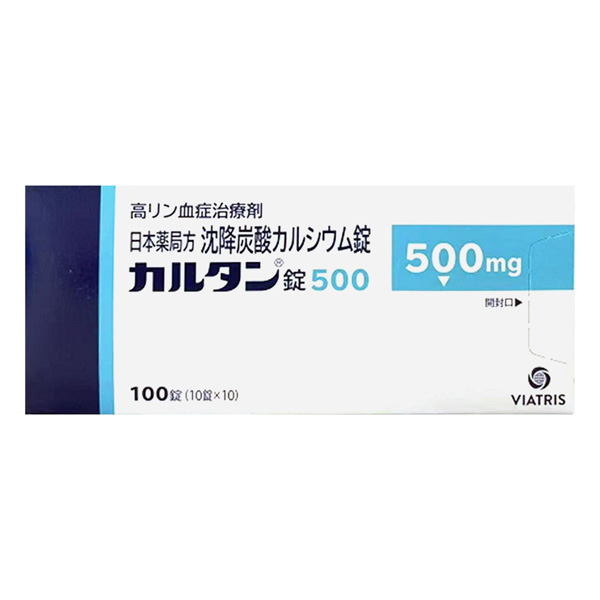
All Names: Precipitated Calcium Carbonate、Caltan Tablets、沉淀碳酸钙片、カルタン錠500
Indications:Used to improve hyperphosphatemia, suitable for patients with chronic kidney failure who are undergoing preservation (non dialysis) and dialysis treatment.
Manufacturer:日本Viatris
Customs Clearance Procedure:If the customs requires the package for customs clearance, please pay the customs clearance fee according to the content of EMS SMS and customs regulations.
Precipitation calcium carbonate tablets are oral tablets of precipitation calcium carbonate recorded in the Japanese Pharmacopoeia, belonging to inorganic salt phosphate binders.
1、 Drug name
1. Product Name: Caltan Ingot 500
2. Common name: Precipitated Calcium Carbonate Tablets
2、 Indications
Improve hyperphosphatemia in patients with chronic renal insufficiency during storage and dialysis.
3、 Specifications and characteristics
1. Specification: Each tablet contains 500mg of precipitated calcium carbonate.
2. Appearance: White tablets.
4、 Main components
1. Active ingredient: Precipitated Calcium Carbonate.
2. Additives: lactose hydrate, low degree of substitution hydroxypropyl cellulose, hydroxypropyl cellulose, magnesium stearate.
5、 Usage and dosage
1. Regular dosage: Adults usually take 3.0g of precipitated calcium carbonate daily, divided into three doses, orally taken immediately after meals.
2. Dose adjustment: It can be adjusted appropriately according to age and symptoms.
6、 Dose adjustment
If the effect is not significant after taking the medication continuously for 2 weeks, the medication should be stopped and consideration should be given to switching to other appropriate therapies such as limiting phosphorus intake.
7、 Medication precautions
1. Usage: Take immediately after meals (straight after).
2. Usage: If it is packaged in PTP, it should be taken out of the PTP plate to avoid ingestion and sharp edges piercing the esophageal mucosa.
3. Omission treatment: Not clearly stated, it is recommended to take it regularly in divided doses every day.
8、 Medication for special populations
1. Elderly people: usually with decreased physiological function, medication should be administered with caution and reduced if necessary.
2. Child: Not mentioned.
3. Pregnancy/lactation period: not mentioned.
4. Comorbidity patients:
(1) Individuals with heart/lung dysfunction: Elevated calcium levels may inhibit heart and lung function.
(2) Constipation patients: may hinder calcium/phosphorus excretion.
(3) Patients with hypercalcemia may experience worsening symptoms.
(4) Patients with gastric acid deficiency: may have poor efficacy due to reduced drug solubility.
9、 Adverse reactions
1. Metabolic abnormalities: electrolyte imbalance such as hypercalcemia and alkalosis.
2. Digestive tract: constipation (common), diarrhea, nausea, acid reflux secretion.
3. Liver: Elevated levels of gamma GTP, AST, LDH, ALP, and triglycerides.
4. Long term/high-dose administration: Kidney stones, urinary tract stones.
5. Allergic reaction: itching.
10、 Contraindications
1. Patients with hypothyroidism.
2. Individuals with a history of allergies to calcium carbonate.
11、 Drug interactions
1. Should be taken at intervals of at least 2 hours: Tetracycline antibiotics and Neoquinolone antibiotics.
2. Be cautious and use:
(1) Sodium/calcium polystyrene sulfonate: may affect its absorption and excretion.
(2) Quinidine: may be affected by pH value.
(3) Active vitamin D supplements: can easily lead to hypercalcemia.
(4) Avoid consuming large amounts of cow's milk at the same time: it may cause milk alkali syndrome.
(5) Rosuvastatin: It should be taken at least 1 hour before and after to avoid weakened efficacy.
Caltaninformation