- All Drug Categories
- Home
- Anti-cancer Drugs
- Healthcare Products
- Medical Information
- Statement
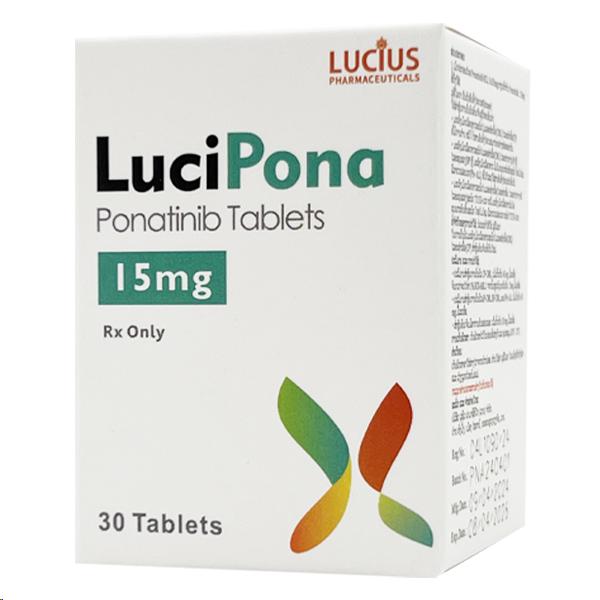
All Names:
Indications:
Manufacturer:LUCIUS PHARMACEUTICAL (LAOS) CO., LTD
Customs Clearance Procedure:If the customs requires the package for customs clearance, please pay the customs clearance fee according to the content of EMS SMS and customs regulations.
Ponatinib is a tyrosine kinase inhibitor that inhibits tumor cell proliferation by targeting the activity of BCR-ABL fusion proteins (including T315I mutant) and various other kinases (such as VEGFR, PDGFR, FGFR, etc.), blocking abnormal signal transduction.
1、 Indications
Punatinib is a kinase inhibitor suitable for treating the following adult patients:
Chronic myeloid leukemia (CML) in chronic, accelerated, or acute phases, and resistant or intolerant to previous tyrosine kinase inhibitors (TKIs) treatment
Philadelphia chromosome positive acute lymphoblastic leukemia (Ph+ALL) with resistance or intolerance to previous tyrosine kinase inhibitors (TKIs) treatment
2、 Mechanism of action
Punatinib is a multi-target tyrosine kinase inhibitor that primarily exerts anti-tumor effects through the following mechanisms:
Inhibition of tyrosine kinase activity in BCR-ABL and its T315I mutant (IC50 values of 0.4 and 2.0 nM, respectively)
Inhibition of VEGFR, PDGFR, FGFR, EPH receptors, and SRC family kinases
Block kinase activity such as KIT, RET, TIE2, and FLT3
Display in animal models that can reduce tumor volume expressing natural or T315I mutant BCR-ABL
3、 Usage and dosage
1. Recommended dosage
Standard dose: 45mg orally, once daily (can be taken with food or on an empty stomach)
Medication method: Swallow the whole tablet, do not chew, crush or break it open
Continue treatment until disease progression or unacceptable toxicity occurs
2. Dose adjustment
Bone marrow suppression related adjustments:
First occurrence of ANC<1 × 10 ⁹/L or platelet<50 × 10 ⁹/L: Suspend administration, resume at 45mg after recovery
Second occurrence: Resume at 30mg after pause
Third occurrence: Resume at 15mg after pause
Non hematological toxicity adjustment:
Hepatotoxicity:
ALT/AST>3 × ULN: Resume at 30mg after pause
Once again: pause and resume at 15mg
ALT/AST>3 × ULN and bilirubin>2 × ULN: permanent discontinuation of medication
Pancreatitis:
Asymptomatic level 3-4 lipase elevation: pause and resume at 30mg
Symptomatic grade 3 pancreatitis: Resume at 30mg after pause
Grade 4 pancreatitis: permanent discontinuation of medication
Combined with strong CYP3A inhibitors:
The dosage should be reduced to 30mg once daily
4、 Adverse reactions
Common adverse reactions (≥ 20%):
Systemic: fatigue (39%), fever (23%)
Cardiovascular: Hypertension (68%)
Skin: rash (54%), dry skin (39%)
Gastrointestinal tract: Abdominal pain (49%), constipation (37%), nausea (23%)
Musculoskeletal: Joint pain (26%), muscle pain (22%)
Nervous system: headache (39%), peripheral neuropathy (13%)
Serious adverse reactions:
Hematological system: thrombocytopenia (36%), neutropenia (24%), anemia (9%)
Cardiovascular: heart failure (4%), arrhythmia (5%)
Digestive system: pancreatitis (6%), gastrointestinal bleeding (4%)
Others: fluid retention (3%), tumor lysis syndrome (<1%)
Key precautions:
Arterial thrombosis: 8% of patients in clinical trials experienced severe arterial thrombosis (including fatal myocardial infarction and stroke)
Hepatotoxicity: May cause liver failure or even death
5、 Medication precautions
Important monitoring requirements:
Cardiovascular: Regular ECG monitoring before and during treatment
Hematology: Complete blood cell count once every 2 weeks before treatment and for the first 3 months, followed by once a month thereafter
Liver function: baseline and regular testing of ALT/AST/bilirubin
Pancreas: Serum lipase testing every 2 weeks for the first 2 months
Drug interactions:
Strong CYP3A inhibitors: need to be reduced to 30mg/day (such as ketoconazole)
Strong CYP3A inducer: Avoid combination therapy (such as rifampicin)
Medications that increase gastric pH: may reduce the bioavailability of Punatinib (such as PPI)
Key points of patient education:
Avoid grapefruit, starfruit, and pomegranate products
If the missed dose is ≤ 12 hours, it can be supplemented, and if it is>12 hours, the current dose will be skipped
Vomiting after taking medication does not require supplementation
Seek medical attention immediately if the following symptoms occur:
Chest pain/difficulty breathing (may indicate thrombosis)
Jaundice/brown urine (may indicate hepatotoxicity)
Severe diarrhea/abdominal pain (may indicate pancreatitis)
Abnormal bleeding/bruising
6、 Medication for special populations
Pregnancy/lactation
Pregnancy: There is a risk of teratogenicity, and effective contraception is necessary during and after discontinuation of medication
Breastfeeding: Breastfeeding is prohibited during medication and for one week after discontinuation of medication
hepatic insufficiency
Use with caution in Child Pugh B/C patients
Dose adjustment may be necessary
Elderly patients
Patients aged 65 and above have a higher incidence of adverse reactions
Need for closer monitoring
Pediatric drugs
The safety and efficacy of patients under 18 years old have not been established yet
Storage conditions: Store at 20-25 ° C and store in the original packaging away from light
Ponatinibinformation