- All Drug Categories
- Home
- Anti-cancer Drugs
- Healthcare Products
- Medical Information
- Statement
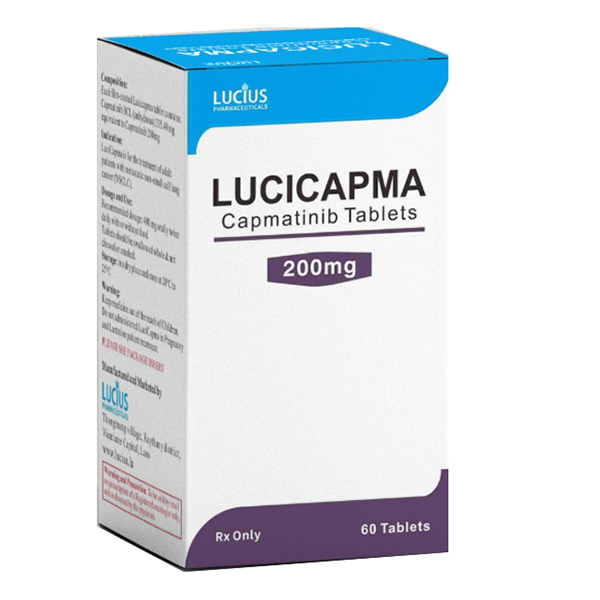
All Names: Capmatinib、Tabrecta、卡马替尼、卡玛替尼、妥瑞达
Indications:Suitable for adult patients with metastatic non-small cell lung cancer who have MET exon 14 jump mutation
Manufacturer:LUCIUS PHARMACEUTICAL (LAOS) CO., LTD
Customs Clearance Procedure:If the customs requires the package for customs clearance, please pay the customs clearance fee according to the content of EMS SMS and customs regulations.
Capmatinib is an oral small molecule kinase inhibitor that selectively targets mesenchymal epithelial transition factor (MET), particularly targeting mutations that cause MET exon 14 skipping.
1、 Drug name and main ingredients
1. Common name: Capmatinib
2. Product Name: TABRECTA ® (US listed name)
3. Dosage form: Film coated tablets
4. Main ingredients: Each tablet contains 150mg or 200mg of carbamatinib (in the form of succinate), and excipients include microcrystalline cellulose, cross-linked polyvinylpyrrolidone, magnesium stearate, etc.
2、 Indications
Metastatic non-small cell lung cancer (NSCLC): Used to treat adult patients with MET exon 14 jump mutation confirmed by FDA approved testing. This indication has been granted accelerated approval based on overall response rate and duration of response, and clinical benefits may need to be validated in the future.
3、 Specifications and characteristics
1. Specification: 200mg
2. Appearance: Thin film coated sheet, smooth surface, content is white to off white powder.
4、 Usage and dosage
1. Recommended dosage: 400mg orally, twice a day (with an interval of about 12 hours), can be taken with food or on an empty stomach.
2. Medication method: Swallow the whole tablet, do not break, crush or chew.
3. Omission treatment: If missed or vomited, there is no need to take additional medication. Follow the original plan for the next dose.
5、 Dose adjustment
1. Adverse reaction adjustment: The first dose was reduced to 300mg twice daily, and the second dose was reduced to 200mg twice daily. If it is still intolerable, permanently discontinue the medication.
2. Abnormal liver function: permanent discontinuation of medication when ALT/AST>3 times the upper limit of normal (ULN) accompanied by elevated bilirubin levels; A simple elevation of ALT/AST can temporarily suspend administration and reduce dosage after recovery.
3. Renal insufficiency: Mild to moderate without adjustment, severe (CrCl<30mL/min) not studied.
6、 Medication precautions
1. Dietary impact: Not affected by food, but avoid taking with aluminum/magnesium antacids (with a 2-hour interval).
2. Photogenic reaction: may cause photosensitivity, sun protection is recommended.
3. Pulmonary toxicity: Monitor for new or worsening respiratory symptoms (such as cough, fever, and difficulty breathing), suspected interstitial lung disease (ILD) requiring permanent discontinuation of medication.
7、 Medication for special populations
1. Pregnant women: prohibited (animal experiments show teratogenicity).
2. Breastfeeding period: Breastfeeding is prohibited during the treatment period and within one week after the last dose.
3. Children: Safety has not been established.
4. Elderly: No need to adjust dosage.
8、 Adverse reactions
1. Common (≥ 20%): peripheral edema (52%), nausea (44%), fatigue (32%), vomiting (28%), difficulty breathing (24%), decreased appetite (21%).
5. Serious reactions: ILD/pneumonia (4.5%, fatal), hepatotoxicity (ALT/AST elevation of 13%, 6% grade 3-4).
9、 Contraindications
There are no absolute contraindications, but it should be avoided for those known to be allergic to the ingredients.
10、 Drug interactions
1. CYP3A strong/moderate inducers (such as rifampicin): reduce efficacy and avoid combination therapy.
2. CYP1A2/P-gp/BCRP substrates (such as caffeine, digoxin): may increase their blood drug concentration and require dosage adjustment.
11、 Storage method
1. Store in original packaging, moisture-proof, with built-in desiccant.
2. Storage temperature: 20-25 ° C (short-term fluctuations of 15-30 ° C are allowed). Discard if not used within 6 weeks after opening.
Note: Regular monitoring of liver function, lung function, and MET mutation status is required during treatment. Avoid co administration with potent CYP3A inhibitors such as ketoconazole.
Capmatinibinformation