- All Drug Categories
- Home
- Anti-cancer Drugs
- Healthcare Products
- Medical Information
- Statement
All Names:
Indications:
Manufacturer:Ono Pharmaceutical
Customs Clearance Procedure:If the customs requires the package for customs clearance, please pay the customs clearance fee according to the content of EMS SMS and customs regulations.
Anamolin is a novel, oral, selective ghrelin receptor agonist developed and produced by Ono Pharmaceutical Company in Japan, mainly used for the treatment of cancer cachexia.
1、 Drug name
1. Common name: Anamorelin Hydrochloride
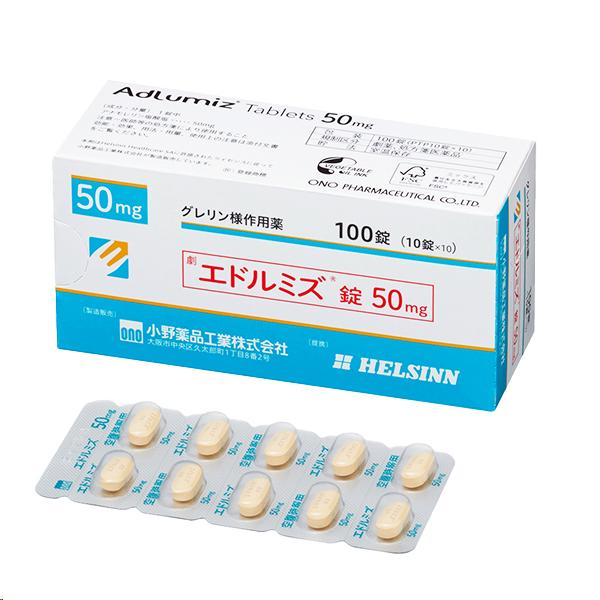
2. Product Name: ADLUMIZ Tablets
3. English name: ADLUMIZTablets
2、 Indications
It is suitable for the treatment of cancer cachexia in patients with non-small cell lung cancer, gastric cancer, pancreatic cancer and colorectal cancer.
3、 Specifications and characteristics
1. Specification: Each tablet contains 50mg of Anamolin Hydrochloride.
2. Appearance: Film coated tablets, light yellow in color, with a length diameter of about 14.1mm, a short diameter of about 6.6mm, a thickness of about 5.2mm, and a mass of about 364mg.
4、 Main components
Each tablet contains 50mg of Anamolin hydrochloride.
5、 Usage and dosage
The usual dose for adults is once a day, 100mg (i.e. 2 tablets), taken orally on an empty stomach.
6、 Dose adjustment
If there is no weight gain or improvement in appetite after 3 weeks of medication, the medication should be stopped.
It is not recommended to take medication for more than 12 weeks, and the necessity of continuing medication should be regularly evaluated.
7、 Medication precautions
1. Medication time: It should be taken on an empty stomach, and food should be avoided within 1 hour after taking the medication.
2. Omission: Not clearly stated, it is recommended to supplement or skip according to medical advice.
3. Vomiting: If vomiting occurs after taking medication, it is not recommended to take it again and wait for the next dose.
4. Monitoring requirements: Regular monitoring of electrocardiogram, blood pressure, heart rate, electrolytes, liver function, blood glucose, etc. is required during medication.
8、 Medication for special populations
1. For patients with moderate to severe liver dysfunction (Child Pugh B, C grade), it is contraindicated.
2. Patients with renal insufficiency: Mild to moderate renal insufficiency can be used, but data for severe cases is limited and caution should be exercised.
3. Elderly people: Due to decreased physiological function, medication should be taken with caution.
4. Pregnant women: Use only when the benefits outweigh the risks.
5. Breastfeeding women: It is necessary to weigh the pros and cons of medication and breastfeeding.
6. Children: Not recommended for use as no relevant clinical trials have been conducted.
9、 Adverse reactions
1. Common side effects (≥ 5%): stimulation of the conduction system inhibition (10.7%), hyperglycemia (4.3%), abnormal liver function (6.4%), decreased lymphocytes, nausea, diarrhea, fatigue, etc.
2. Other possible side effects: abnormal electrocardiogram, atrioventricular block, tachycardia, hypotension, rash, dry mouth, blurred vision, etc.
10、 Contraindications
The following patients are prohibited:
1. Individuals who are allergic to the ingredients of this product;
2. Patients with congestive heart failure, myocardial infarction, and angina pectoris;
3. Severe conduction system disorders (such as complete atrioventricular block);
4. Those who are currently using drugs such as clarithromycin, itraconazole, posaconazole, ritonavir, cobistat, and emtricitabine;
5. Individuals with moderate to severe liver dysfunction;
6. Individuals with gastrointestinal obstruction or organic abnormalities causing difficulty in oral feeding.
11、 Drug interactions
1. Taboo combination: Strong CYP3A4 inhibitors (such as clarithromycin, itraconazole, ritonavir, etc.) can significantly increase the blood concentration of the drug and increase the risk of side effects.
2. Caution should be exercised when using:
Antiarrhythmic drugs, beta blockers, and cardiotoxic anti-tumor drugs (such as anthracyclines);
Medications that can prolong the QT interval (such as amiodarone);
Intermediate acting CYP3A4 inhibitors (such as erythromycin, diltiazem);
Grapefruit juice (inhibits CYP3A4);
CYP3A4 inducers (such as carbamazepine, rifampicin, St. John's wort) may reduce the efficacy of this drug.
12、 Storage method
Stored at room temperature, with a shelf life of 4 years. (Storage method and effective period)
13、 Manufacturer
Manufacturer: Ono Pharmaceutical Co., Ltd
Anamorelininformation