- All Drug Categories
- Home
- Anti-cancer Drugs
- Healthcare Products
- Medical Information
- Statement
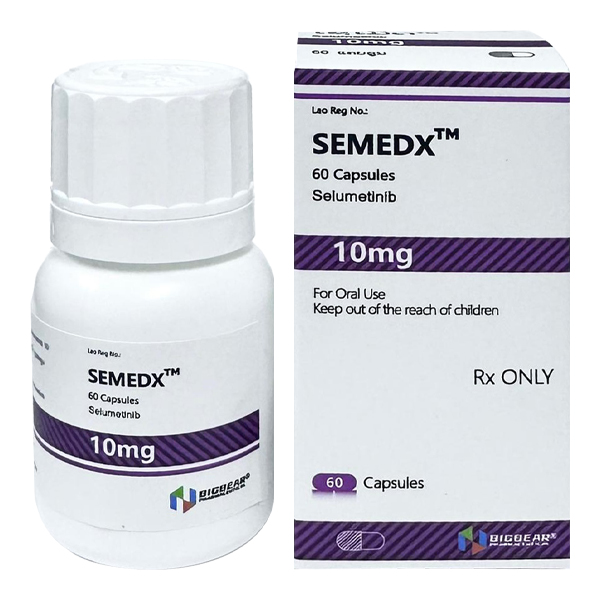
All Names: selumetinib、Koselugo、司美替尼、科塞优
Indications:Suitable for patients aged 2 years and above with type 1 neurofibromatosis (NF1) and inoperable pelvic neurofibromatosis.
Manufacturer:Daxiong
Customs Clearance Procedure:If the customs requires the package for customs clearance, please pay the customs clearance fee according to the content of EMS SMS and customs regulations.
Selumetinib is an oral small molecule kinase inhibitor that is a selective inhibitor of mitogen activated protein kinase 1/2 (MEK1/2).
1、 Drug name
1. Common name: Smetinib
2. Product Name: Koselugo
3. English name: Selumetinib
2、 Indications
Used to treat pediatric patients with type 1 neurofibromatosis (NF1) aged 2 years and older, who have symptomatic and inoperable plexiform neurofibromatosis (PN).
3、 Specifications and characteristics
10mg capsules, 25mg capsules.
4、 Main components
1. Active ingredient: Smetinib.
2. Accessory: Vitamin E polyethylene glycol succinate (TPGS). (Note: 10mg capsules contain 32mg vitamin E, 25mg capsules contain 36mg vitamin E).
5、 Usage and dosage
1. Recommended dosage: 25mg/m ², orally, twice daily (approximately every 12 hours), until disease progression or unacceptable toxicity occurs.
2. Administration method:
(1) Take on an empty stomach: Avoid eating for 2 hours before and 1 hour after taking the medication.
(2) Swallowing whole capsule: Swallow whole capsule with water, do not chew, dissolve or open the capsule.
(3) Patients who are unable to swallow the entire capsule should not use it.
6、 Dose adjustment
1. Based on body surface area (BSA): The specific dosage needs to be determined by referring to a table according to the patient's body surface area.
2. Based on adverse reactions: Depending on the severity of the adverse reactions (classified into 1-4 levels), measures such as suspending administration, reducing dosage, or permanently stopping medication will be taken.
3. Common situations that require dose adjustment include:
(1) Cardiomyopathy (decreased left ventricular ejection fraction (LVEF)).
(2) Eye toxicity (such as retinal vein occlusion (RVO) and retinal pigment epithelial detachment (RPED)).
(3) Severe diarrhea or rash.
(4) Significant increase in creatine phosphokinase (CPK) or rhabdomyolysis.
3. Based on liver function:
(1) Moderate liver injury (Child Pugh B): The dose should be reduced to 20mg/m ² twice a day.
(2) Severe liver injury (Child Pugh C): The recommended dosage has not been determined yet.
4. Based on drug interactions:
Avoid co administration with potent or moderate CYP3A4 inhibitors (such as itraconazole) or fluconazole. If unavoidable, the dose of sematinib should be reduced according to the table.
7、 Medication precautions
1. Before and after meals: must be taken on an empty stomach.
2. Missed medication: If it is more than 6 hours before the next dose, it should be taken as soon as possible; Otherwise, the missed dose should be skipped and the next dose should be taken according to the original plan. Do not supplement or double the dosage.
3. Vomiting: If vomiting occurs after taking medication, additional doses should not be taken, and the next planned dose should be taken on time.
8、 Medication for special populations
1. Pregnant women: May cause fetal harm, prohibited.
2. Breastfeeding women: Breastfeeding is prohibited during the treatment period and within one week after the last dose.
3. Women/men with fertility: Effective contraceptive measures must be taken during treatment and within one week after the last dose.
4. Children: Suitable for children aged 2 and above. The safety and efficacy of children under 2 years old have not yet been established.
5. Elderly: Clinical studies did not include a sufficient number of patients aged 65 and above.
6. Patients with liver dysfunction: Moderate injury should be reduced, and severe injury should be avoided.
7. Patients with renal insufficiency: No need to adjust dosage.
9、 Adverse reactions
1. Very common (≥ 40%): vomiting, rash (of all types), abdominal pain, diarrhea, nausea, dry skin, fatigue, musculoskeletal pain, fever, acne like rash, stomatitis, headache, paronychia, itching.
2. Serious Warning and Precautions:
Cardiomyopathy, ocular toxicity (can cause blindness), severe diarrhea, severe skin toxicity, elevated CPK and rhabdomyolysis, elevated vitamin E levels, and bleeding risk.
10、 Contraindications
None.
11、 Drug interactions
1. CYP3A4 strong/medium acting inhibitors (such as itraconazole, clarithromycin) or fluconazole: avoid co administration. If it must be used in combination, the dose of sematinib should be reduced.
2. CYP3A4 strong/medium acting inducers (such as rifampicin and carbamazepine): Avoid co administration as it may reduce the efficacy of sematinib.
3. Vitamin K antagonists (such as warfarin) or antiplatelet drugs (such as aspirin, clopidogrel): their combination may increase the risk of bleeding and require enhanced monitoring.
4. Food: Grapefruit/grapefruit juice can affect drug metabolism and should be avoided from consumption.
12、 Storage method
1. Store at 25 ° C (77 ° F) and allow fluctuations between 15 ° C and 30 ° C (59 ° F and 86 ° F).
2. Keep the original packaging of the medicine bottle and do not remove the desiccant package inside the bottle.
3. Moisture proof.
selumetinibinformation