- All Drug Categories
- Home
- Anti-cancer Drugs
- Healthcare Products
- Medical Information
- Statement
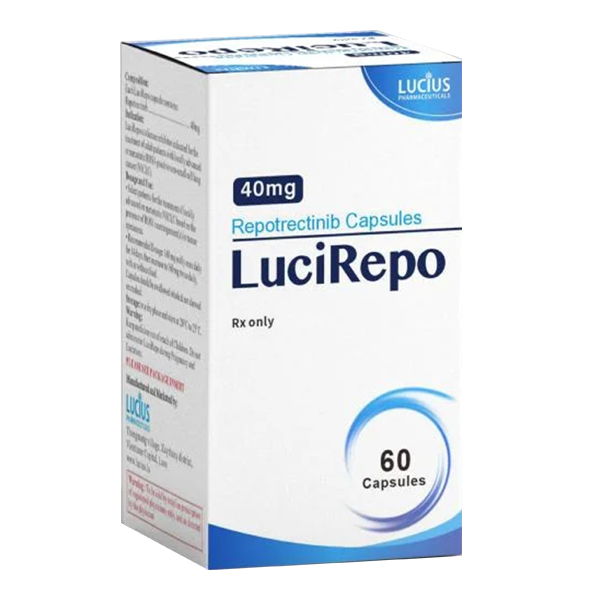
All Names: repotrectinib、Augtyro、瑞普替尼、洛普替尼、奥凯乐
Indications:Adult patients with locally advanced or metastatic ROS1 positive non-small cell lung cancer. Patients with locally advanced or metastatic NTRK gene fusion positive solid tumors in adults and children aged 12 and above.
Manufacturer:LUCIUS PHARMACEUTICAL (LAOS) CO., LTD
Customs Clearance Procedure:If the customs requires the package for customs clearance, please pay the customs clearance fee according to the content of EMS SMS and customs regulations.
Repotrectinib is the third pan solid tumor therapy after La Rotinib and Entrotinib, providing new hope for ROS1 positive NSCLC patients.
1、 Drug name
1. Common name: Riptinib
2. Product Name: AUGTYRO
3. English name: Repotrectinib
2、 Indications
This product is suitable for treating adult patients with locally advanced or metastatic ROS1 positive non-small cell lung cancer (NSCLC).
3、 Specifications and characteristics
This product is a 40mg capsule.
4、 Main components
1. Active ingredient: Riptinib.
2. Accessories: Microcrystalline cellulose, sodium dodecyl sulfate, cross-linked carboxymethyl cellulose sodium, colloidal silica. The capsule shell contains gelatin and titanium dioxide. The printing ink contains insect glue and FD&C Blue No.2 aluminum lake.
5、 Usage and dosage
1. Recommended dosage: Take 160mg (4 40mg capsules) orally once a day for the first 14 days; Then increase to twice daily, 160 milligrams each time, until disease progression or unacceptable toxicity occurs.
2. Usage: Can be taken with meals or on an empty stomach. It should be swallowed whole and should not be opened, chewed, crushed, or dissolved. Take medication at approximately the same time every day.
6、 Dose adjustment
1. Dose adjustment is based on the severity of adverse reactions. The recommended dosage level is to reduce the first dose to 120 milligrams (once or twice daily) and the second dose to 80 milligrams (once or twice daily).
2. Central nervous system response: For intolerable grade 2 or 3 reactions, suspend administration until improvement reaches ≤ grade 1 or baseline level, and then restore at the same or reduced dose; If there is a level 4 reaction, the medication will be permanently discontinued.
3. Interstitial lung disease/pneumonia: If suspected at any level, medication should be suspended; If diagnosed, the medication will be permanently discontinued.
4. Hepatotoxicity: Depending on the level of elevated transaminase and bilirubin levels, measures such as suspension, dose reduction, or permanent discontinuation of medication may be taken.
5. Elevated creatine kinase: Depending on the degree of elevation, administration is suspended until recovery, and then restored at the same or reduced dose.
6. Hyperuricemia: Discontinue administration at grade 3 or 4, and resume at the same or reduced dose after improvement.
7. Other clinically relevant adverse reactions: For intolerable grade 2, 3, or 4 reactions, medication should be suspended until improvement is achieved, and then restored or permanently discontinued at the same or reduced dose.
7、 Medication precautions
1. Medication time: Take at approximately the same time every day, either with food or on an empty stomach.
2. Omission or vomiting: If one dose is missed or vomiting occurs after taking the medication, it should not be taken again, but the regular dose should be taken at the next scheduled time. Two doses should not be taken simultaneously to compensate for missed or vomited doses.
8、 Medication for special populations
1. Pregnant women: Based on the mechanism of action and animal data, this product can cause fetal harm and is contraindicated for pregnant women. Women of childbearing age should use effective non hormonal contraceptive methods during treatment and within 2 months after the last dose (as this product may render certain hormonal contraceptives ineffective).
2. Breastfeeding women: It is recommended that women stop breastfeeding during the treatment period and within 10 days after the last dose.
3. Male of childbearing age: It is recommended that male partners with fertility potential use effective contraceptive measures during treatment and within 4 months after the last dose.
4. Children: The safety and efficacy of ROS1 positive NSCLC in pediatric patients have not been determined.
5. Elderly patients: No clinically significant differences in safety or efficacy were observed compared to younger patients.
6. Liver/kidney dysfunction: Patients with mild liver injury or mild to moderate kidney injury do not require dose adjustment. The recommended dosage for patients with moderate or severe liver injury, severe kidney injury, or kidney failure has not yet been determined.
9、 Adverse reactions
1. The most common adverse reactions (≥ 20%) include dizziness, taste disorders, peripheral neuropathy, constipation, dyspnea, ataxia, fatigue, cognitive impairment, and muscle weakness.
2. Serious adverse reactions to be cautious of: central nervous system reactions (such as dizziness, ataxia, cognitive impairment), interstitial lung disease/pneumonia, hepatotoxicity, muscle pain with elevated creatine phosphokinase, hyperuricemia, bone fractures.
10、 Contraindications
There are currently no obvious contraindications.
11、 Drug interactions
1. Strong and moderate CYP3A inhibitors: avoid using them simultaneously. Before starting treatment with this product, potent or moderate CYP3A inhibitors should be discontinued for 3-5 half lives.
2. P-glycoprotein inhibitors: avoid simultaneous use.
3. Strong and moderate CYP3A inducers: Avoid using them simultaneously.
4. Certain CYP3A4 substrates: Avoid co administration with CYP3A substrates with narrow therapeutic windows, as this product may lower its blood drug concentration, leading to decreased efficacy.
5. Hormonal contraceptive pills: Avoid simultaneous use as this product may reduce its efficacy, and effective non hormonal contraceptive methods should be used.
6. Grapefruit products: should be avoided during treatment as it may increase the blood concentration of this product.
12、 Storage method
Store at 20 ℃ to 25 ℃ (68 ℉ to 77 ℉); Allow short distance transportation between 15 ℃ and 30 ℃ (59 ℉ and 86 ℉).
repotrectinibinformation