- All Drug Categories
- Home
- Anti-cancer Drugs
- Healthcare Products
- Medical Information
- Statement
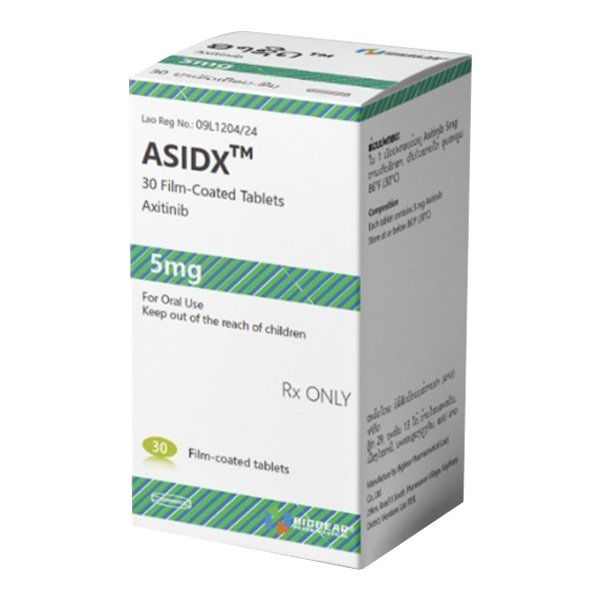
All Names: INLYTA、Axitinib、阿昔替尼、阿西替尼、英立达
Indications:Patients diagnosed with advanced renal cell carcinoma through pathology and who meet one of the criteria for first-line combination therapy for previously failed TKI or cytokine therapy, or for intermediate to high-risk unresectable or metastatic renal cell carcinoma.
Manufacturer:Daxiong
Customs Clearance Procedure:If the customs requires the package for customs clearance, please pay the customs clearance fee according to the content of EMS SMS and customs regulations.
Axitinib is a tyrosine kinase inhibitor that selectively inhibits the activity of vascular endothelial growth factor receptors (VEGFR-1), VEGFR-2, and VEGFR-3, blocking the tumor angiogenesis signaling pathway and thereby inhibiting tumor growth and metastasis.
1、 Drug name
1. Common name: Axitinib
2. Product Name: INLYTA ®
2、 Indications
Used to treat patients with advanced renal cell carcinoma (RCC) who have failed a previous systemic treatment.
3、 Specifications and characteristics
5mg tablets.
4、 Main components
Active ingredient: Axitinib.
5、 Usage and dosage
1. Recommended starting dose: 5mg orally, twice daily.
2. Medication interval: about 12 hours, can be taken with food or on an empty stomach.
3. Usage: Swallow the whole tablet and mix with a glass of water.
4. Omission treatment: If missed or vomited, do not take the next dose as scheduled.
6、 Dose adjustment
Adjust dosage based on safety and tolerability.
1. Patients with good tolerance: can increase from 5mg to 7mg, and then to 10mg (twice daily).
2. Patients in need of reduction: reduce from 5mg to 3mg, and if necessary, further reduce to 2mg (twice daily).
3. Patients with moderate liver injury: the initial dose is halved.
7、 Medication precautions
1. Attention should be paid to the interaction when taking antacids together.
2. Vomiting after taking medication does not require supplementation.
3. Avoid consuming grapefruit or drinking grapefruit juice.
8、 Medication for special populations
1. Pregnant women: Prohibited, may cause fetal damage.
2. Breastfeeding period: It is recommended to stop breastfeeding or discontinue medication.
3. Children: Safety and effectiveness have not been established.
4. Elderly: No need to adjust dosage.
5. Liver injury: Moderate requires reduction, severe has no research data.
6. Renal injury: Mild to moderate without adjustment, use with caution in end-stage renal disease.
9、 Adverse reactions
The most common (≥ 20%) adverse reactions include:
Diarrhea, hypertension, fatigue, decreased appetite, nausea, difficulty speaking, palmar and plantar redness and swelling syndrome, weight loss, vomiting, fatigue, constipation.
10、 Contraindications
There are no clear contraindications.
11、 Drug interactions
1. Avoid co administration with strong CYP3A4/5 inhibitors (such as ketoconazole), and reduce dosage if necessary.
2. Avoid co administration with strong CYP3A4/5 inducers such as rifampicin.
3. Combined use with amiodarone may lead to severe symptomatic bradycardia.
12、 Storage method
1. Storage temperature: 20 ° C-25 ° C (68 ° F-77 ° F).
2. Allow fluctuations within the range of 15 ° C-30 ° C (59 ° F-86 ° F).
13、 Important Warning
1. During treatment, blood pressure, thyroid function, liver function, and proteinuria need to be monitored.
2. Stop taking medication at least 24 hours before surgery.
3. Reversible posterior leukoencephalopathy syndrome (RPLS) may occur.
Axitinibinformation