- All Drug Categories
- Home
- Anti-cancer Drugs
- Healthcare Products
- Medical Information
- Statement
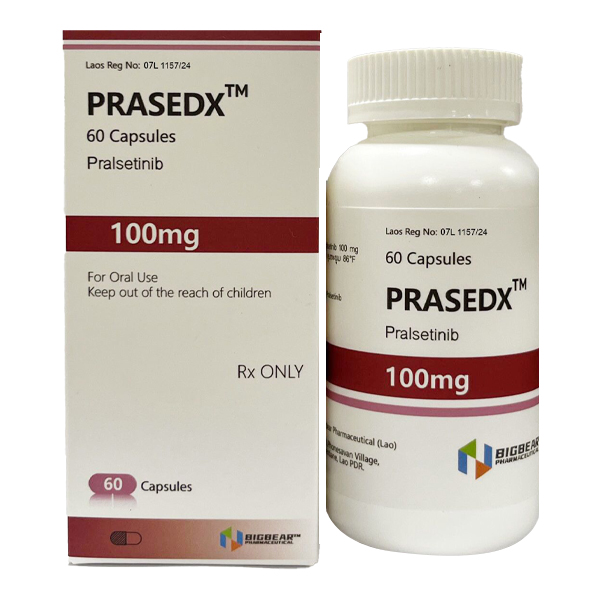
All Names: Gavreto、Pralsetinib、普拉替尼、普雷西替尼、帕拉西替尼、普雷替尼、普吉华
Indications:Adult patients with RET fusion positive metastatic non-small cell lung cancer (NSCLC) confirmed by FDA approved testing, as well as children and adult patients aged 12 years and above with RET fusion positive advanced or metastatic thyroid cancer who require systemic treatment and are difficult to treat with radioactive iodine (if applicable).
Manufacturer:Daxiong
Customs Clearance Procedure:If the customs requires the package for customs clearance, please pay the customs clearance fee according to the content of EMS SMS and customs regulations.
Pralsetinib is an oral, highly selective, and potent RET inhibitor.
1、 Drug name
1. Common name: Pratinib
2. Product Name: GAVRETO ®
3. English name: Pralsetinib
2、 Indications
1. Used to treat adult patients with metastatic RET fusion positive non-small cell lung cancer (NSCLC) detected through FDA approved testing.
2. Used to treat adult and pediatric patients aged 12 years and above with advanced or metastatic RET fusion positive thyroid cancer who require systematic treatment and are refractory to radioactive iodine (if applicable).
3、 Specifications and characteristics
1. Specification: 100 milligrams per capsule.
2. Appearance: Capsule.
4、 Main components
1. Active ingredient: Pratinib
2. Accessories include citric acid, hydroxypropyl methylcellulose, magnesium stearate, microcrystalline cellulose, pre gelatinized starch, sodium bicarbonate, etc. The capsule shell contains FD&C Blue 1, hydroxypropyl methylcellulose, and titanium dioxide.
5、 Usage and dosage
1. Recommended dosage: For adults and pediatric patients aged 12 and above, take 400 milligrams once a day on an empty stomach orally (at least 2 hours before medication and at least 1 hour after medication without eating).
Treatment should be continued until the disease progresses or unacceptable toxicity occurs.
2. Omission treatment: If missed on the same day, it should be replenished as soon as possible and the normal medication plan should be restored the next day.
3. Vomiting treatment: If vomiting occurs after taking medication, there is no need to take the next dose according to the original plan.
6、 Dose adjustment
1. Adverse reaction dose adjustment: Based on the severity of the adverse reaction, the first dose is reduced to 300 milligrams once daily, the second dose is reduced to 200 milligrams once daily, and the third dose is reduced to 100 milligrams once daily. If the patient still cannot tolerate 100 milligrams, the medication will be permanently discontinued.
2. Drug interaction dose adjustment:
When used in combination with potent or moderate CYP3A inhibitors and/or P-gp inhibitors, it should be avoided. If unavoidable, the dosage should be reduced.
When used in combination with potent or moderate CYP3A inducers, it should be avoided. If unavoidable, an increase should be made.
7、 Medication precautions
1. It must be taken on an empty stomach to avoid food affecting absorption.
2. Missing medication can be replenished on the same day and restored to normal the next day.
3. After vomiting, there is no need to take additional medication. Continue taking the medication as planned.
4. Regular monitoring of blood pressure, liver function, blood routine, etc. is required during medication.
5. Medication should be suspended before and after surgery: at least 5 days before elective surgery, and at least 2 weeks after major surgery until the wound heals.
8、 Medication for special populations
1. Pregnant women: There is a risk of embryo fetal toxicity, and it is contraindicated.
2. Breastfeeding period: It is not recommended to breastfeed during the medication period and within one week after the last dose.
3. Men and women of childbearing age: Effective non hormonal contraceptive measures should be taken. Women should use contraception during medication and within 2 weeks after discontinuation, while men should use contraception during medication and within 1 week after discontinuation.
4. Children: For thyroid cancer patients aged 12 and above, growth plates need to be monitored; The safety and efficacy of children under 12 years old have not been established.
5. Elderly: No need to adjust the dosage specifically.
6. Liver injury: Mild to moderate without adjustment, severe not studied.
9、 Adverse reactions
1. Common adverse reactions (≥ 25%): musculoskeletal pain, constipation, hypertension, diarrhea, fatigue, edema, fever, cough.
2. Common laboratory abnormalities at levels 3-4 (≥ 2%): decreased lymphocytes, decreased neutrophils, decreased hemoglobin, decreased blood phosphorus, decreased white blood cells, decreased blood sodium, increased AST/ALT, decreased corrected blood calcium, decreased platelets, increased alkaline phosphatase, increased or decreased blood potassium, increased bilirubin, etc.
3. Serious adverse reactions include interstitial lung disease/pneumonia, hypertension, hepatotoxicity, bleeding events, tumor lysis syndrome, etc.
10、 Contraindications
There are no clear contraindications.
11、 Drug interactions
1. Avoid co administration with potent or moderate CYP3A inhibitors and/or P-gp inhibitors, and reduce dosage if necessary.
2. Avoid co administration with potent or moderate CYP3A inducers, and increase if necessary.
3. There is no significant interaction with gastric acid reducing agents.
12、 Storage method
1. Store at 20 ° C to 25 ° C, allowing for short distance storage between 15 ° C and 30 ° C.
2. Moisture proof.
Pralsetinibinformation