- All Drug Categories
- Home
- Anti-cancer Drugs
- Healthcare Products
- Medical Information
- Statement
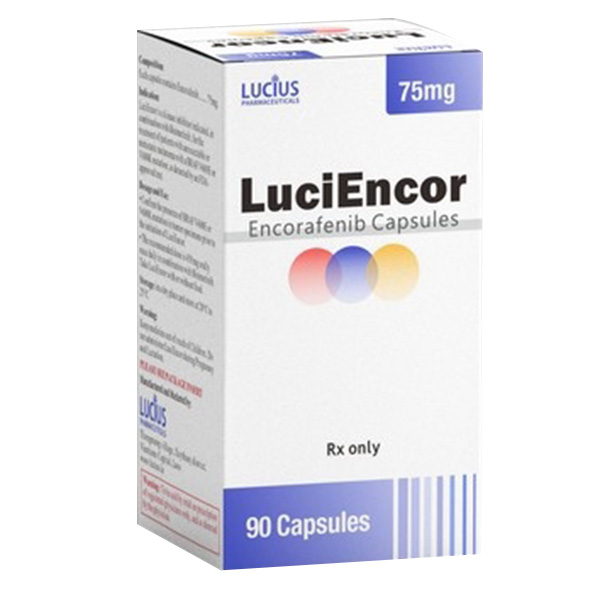
All Names: Braftovi、Encorafenib、康奈非尼、恩考芬尼、恩可非尼
Indications:Patients with BRAF-V600E or V600K mutation positive unresectable or metastatic melanoma, BRAF-V600E mutation positive metastatic colorectal cancer (CRC), and non-small cell lung cancer.
Manufacturer:LUCIUS PHARMACEUTICAL (LAOS) CO., LTD
Customs Clearance Procedure:If the customs requires the package for customs clearance, please pay the customs clearance fee according to the content of EMS SMS and customs regulations.
Encorafenib is an oral small molecule BRAF kinase inhibitor.
1、 Drug name
1. Common name: Conafenib
2. Product Name: BRAFTOVI ™
3. English name: Encorafenib
2、 Indications
1. The combination of Conafenib and Binimetinib is suitable for the treatment of unresectable or metastatic melanoma patients with BRAFV600E or V600K mutations confirmed by FDA approved testing methods.
2. Restricted use: This product is not suitable for the treatment of wild-type BRAF melanoma.
3、 Specifications and characteristics
Specification: 75mg capsules.
4、 Main components
1. Active ingredient: Encorafenib.
2. Auxiliary materials: copolymer ketone, poloxamer 188, microcrystalline cellulose, succinic acid, cross-linked ketone, colloidal silica, plant derived magnesium stearate. The capsule shell contains gelatin, titanium dioxide, iron oxide red, iron oxide yellow, black iron oxide, and imprinting ink.
5、 Usage and dosage
1. Recommended dosage: 450 milligrams (6 capsules of 75 milligrams), taken orally once a day, in combination with bimetinib.
2. Usage: Can be taken with food or on an empty stomach.
3. Combination therapy: Must be used in combination with Bimetinib, please follow the prescription information for Bimetinib.
6、 Dose adjustment
1. Regarding adverse reactions: the initial dose was reduced to 300 milligrams once daily; Reduce the second dose to 200 milligrams once daily; If the patient still cannot tolerate 200mg once daily, the medication will be permanently discontinued.
2. For specific adverse reactions: Based on the severity of the adverse reaction (according to NCICTCAEV4.03 grading), measures such as suspending medication, reducing dosage, or permanently stopping medication will be taken. For example, non cutaneous RAS mutation positive malignant tumors should be permanently discontinued; For specific levels of QTc interval prolongation, hepatotoxicity, dermatological reactions, and other adverse reactions, there are corresponding pause and reduction rules.
3. Co administration with CYP3A4 inhibitors: If co administration with potent or moderate CYP3A4 inhibitors is unavoidable, the dose should be reduced to one-third or one-half of the original dose, respectively.
7、 Medication precautions
1. Before and after meals: can be taken with food or on an empty stomach, no specific requirements.
2. Missing dose: If one dose is missed, it should be taken as soon as possible when remembered. If the next scheduled medication time is less than 12 hours away, skip the missed dose and take the next dose at the regular time. Do not supplement or take double doses.
3. Vomiting: If vomiting occurs after taking medication, there is no need to take additional doses, and medication should be taken at the next scheduled time according to the original plan.
8、 Medication for special populations
1. Pregnant women: May cause harm to the fetus. Effective contraceptive measures should be taken during the medication period and within 2 weeks after the last dose, and non hormonal contraceptive methods should be used as this product may render hormonal contraceptives ineffective.
2. Breastfeeding women: It is recommended not to breastfeed during the medication period and within 2 weeks after the last dose.
3. Men and women with fertility: Women need to undergo pregnancy testing before taking medication. Male medication may affect fertility.
4. Elderly patients: No overall differences in safety and efficacy were observed compared to younger patients.
5. Liver injury patients: Mild liver injury does not require dose adjustment; The recommended dosage for moderate or severe liver injury has not yet been established.
6. Kidney injury patients: Mild to moderate kidney injury does not require dose adjustment; The recommended dosage for severe kidney injury has not yet been established.
9、 Adverse reactions
1. Common adverse reactions (≥ 25%) include fatigue, nausea, vomiting, abdominal pain, and joint pain.
2. Serious adverse reactions include: newly developed primary malignant tumors (skin and non skin), bleeding, uveitis, QT interval prolongation, hepatotoxicity, etc.
3. Common laboratory abnormalities include elevated creatinine, elevated gamma glutamyl transferase, elevated alanine aminotransferase, elevated aspartate aminotransferase, hyperglycemia, anemia, etc.
10、 Contraindications
None.
11、 Drug interactions
1. Avoid co administration with potent or moderate CYP3A4 inducers as it may lower the blood concentration of Conafenib.
2. Avoid co administration with potent or moderate CYP3A4 inhibitors, and adjust the dose of conafenib if unavoidable.
3. Avoid co administration with sensitive CYP3A4 substrates (such as hormonal contraceptives) as it may increase their toxicity or decrease their efficacy.
4. Avoid co administration with drugs known to prolong QT/QTc intervals.
5. Avoid consuming grapefruit or grapefruit products during medication.
12、 Storage method
1. Store at room temperature between 20 ° C and 25 ° C, with short-term storage allowed between 15 ° C and 30 ° C.
2. Keep the original packaging bottle with desiccant inside, do not discard.
3. Moisture proof, tighten the bottle cap.
Encorafenibinformation