- All Drug Categories
- Home
- Anti-cancer Drugs
- Healthcare Products
- Medical Information
- Statement
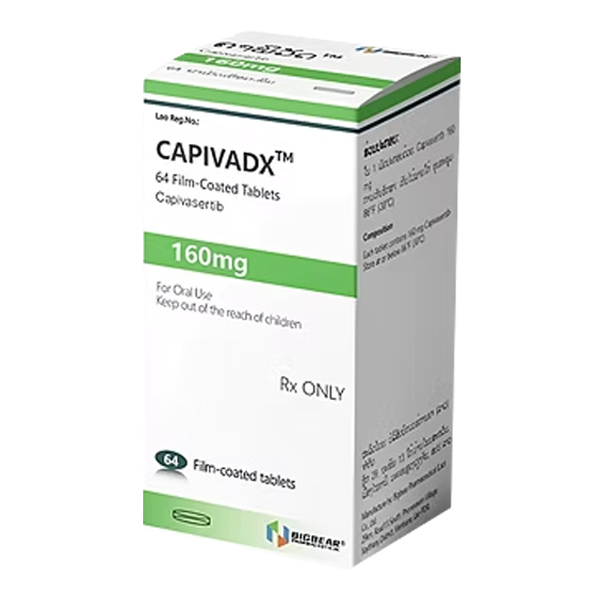
All Names: Capivasertib、Truqap、卡帕塞替尼
Indications:It is applicable to adult patients with HR positive, HER2 negative, locally advanced or metastatic breast cancer, one or more PIK3CA/AKT1/PTEN gene changes in tumor tissue confirmed by FDA approval testing, who progress after receiving at least one endocrine treatment in the environment of metastatic diseases, or relapse within 12 months after completing auxiliary endocrine treatment.
Manufacturer:Daxiong
Customs Clearance Procedure:If the customs requires the package for customs clearance, please pay the customs clearance fee according to the content of EMS SMS and customs regulations.
Capivasortib is an oral small molecule kinase inhibitor that works by targeting the activity of serine/threonine kinase AKT (including AKT1, AKT2, AKT3 subtypes). This drug can block the phosphorylation of downstream substrates in the AKT signaling pathway, thereby inhibiting tumor cell proliferation and inducing apoptosis.
1、 Drug name
1. Common name: Capivasortib
Product Name: TRUQAP ™
2、 Indications
TRUQAP combined with fluoxetine is suitable for the treatment of adult patients with hormone receptor (HR) positive, human epidermal growth factor receptor 2 (HER2) negative, locally advanced or metastatic breast cancer. These patients' tumors need to carry one or more PIK3CA/AKT1/PTEN gene changes detected by FDA approved testing methods, and have disease progression after receiving at least one endocrine based regimen in a metastatic disease environment, or relapse within 12 months after completing adjuvant therapy.
3、 Specifications
160mg tablets, 200mg tablets.
4、 Main components
Active ingredient: Kapasetinib.
5、 Usage and dosage
1. Recommended dosage: 400mg (i.e. 2 200mg tablets), taken orally twice a day (with an interval of about 12 hours), continuously for 4 days, followed by a 3-day discontinuation plan (4-day dosing/3-day discontinuation plan). Can be taken with food or on an empty stomach.
2. The tablet should be swallowed whole and should not be chewed, crushed, or split. Do not take pills that are damaged, cracked, or incomplete.
3. To be used in combination with Fluvistran, please follow the prescription information of Fluvistran for administration. For premenopausal and perimenopausal women, luteinizing hormone releasing hormone (LHRH) agonists should be administered simultaneously according to current clinical practice standards. Male patients may consider administering LHRH agonists.
6、 Dose adjustment
1. Dose adjustment for adverse reactions: Depending on the severity of the adverse reactions, it is necessary to suspend administration, reduce dosage, or permanently discontinue medication. The first dose was reduced to 320 milligrams (twice daily, 4 days of medication/3 days of discontinuation), and the second dose was reduced to 200 milligrams (twice daily, 4 days of medication/3 days of discontinuation). If the second dose reduction cannot be tolerated, the medication will be permanently discontinued. The specific adjustment plan has detailed regulations for high blood sugar, diarrhea, skin adverse reactions, etc.
2. Dose adjustment for drug interactions: Avoid co administration with potent CYP3A inhibitors. If unavoidable, the dose of TRUQAP should be reduced to 320 milligrams (twice daily, taken for 4 days/discontinued for 3 days). When used in combination with intermediate acting CYP3A inhibitors, the dose of TRUQAP should also be reduced to 320 milligrams (twice daily, taken for 4 days/discontinued for 3 days). After discontinuing potent or moderate CYP3A inhibitors, the previous dose of TRUQAP can be restored.
7、 Medication precautions
1. Medication and eating: can be taken before or after meals.
2. Missed dose: If remembered within 4 hours of the regular medication time, it should be taken immediately. If it exceeds 4 hours, the dose should be skipped and the next dose should be taken at the next regular time. Do not take two doses at the same time to make up for missed doses.
3. Vomiting: If vomiting occurs after taking medication, additional doses should not be taken, and the next dose should be taken at the next regular time.
8、 Medication for special populations
1. Pregnant women: Based on animal studies and mechanisms of action, TRUQAP can cause fetal damage. Pregnant women and women with fertility potential should be informed of the potential risks to the fetus. Women with fertility potential should take effective contraceptive measures during treatment and within one month after the last dose. Male patients with reproductive potential female partners should take effective contraceptive measures during treatment and within 4 months after the last dose. Before starting treatment, the pregnancy status of women with fertility potential should be verified.
2. Breastfeeding women: It is recommended that women do not breastfeed during TRUQAP treatment.
3. Pediatric medication: Safety and efficacy have not yet been established.
4. Elderly medication: In patients aged 65 and above, a higher incidence of grade 3 to 5 adverse reactions, dose reduction, interruption of administration, and permanent discontinuation of medication has been observed.
5. Patients with liver and kidney dysfunction: Mild to moderate renal dysfunction (CLcr30 to 89mL/min) or mild liver dysfunction do not require dose adjustment. Patients with moderate liver dysfunction should be closely monitored for adverse reactions. TRUQAP has not been studied in patients with severe renal or liver dysfunction.
9、 Adverse reactions
1. The most common adverse reactions (incidence ≥ 20%) and laboratory abnormalities include: diarrhea, skin adverse reactions, random blood glucose elevation, lymphocyte depletion, hemoglobin reduction, fasting blood glucose elevation, nausea, fatigue, leukopenia, triglyceride elevation, neutropenia, creatinine elevation, vomiting, and stomatitis.
2. Serious adverse reactions may include high blood sugar (possibly accompanied by ketoacidosis), severe diarrhea (possibly leading to dehydration), and severe skin adverse reactions (such as erythema multiforme, palmar and plantar erythroptosis syndrome, drug reactions with eosinophilia and systemic symptoms, etc.).
10、 Contraindications
Patients with a history of severe allergies to TRUQAP or any excipients are contraindicated.
11、 Drug interactions
1. CYP3A inhibitors: Strong and moderate CYP3A inhibitors can increase the blood concentration of capecitabine and increase the risk of adverse reactions. Combination with potent inhibitors should be avoided, and if unavoidable, the dose of TRUQAP should be reduced. When used in combination with intermediate acting inhibitors, the dose of TRUQAP should be reduced.
2. CYP3A inducers: Strong and moderate CYP3A inducers can reduce the blood concentration of capecitabine, which may decrease its efficacy. It should be avoided to use it together.
3. Medications that affect gastric acid: Gastric acid reducing agents (such as rabeprazole) have no clinically significant impact on the pharmacokinetics of capecitabine.
4. The effects of capecitabine on other drugs: TRUQAP may increase exposure to substrates such as CYP3A, CYP2D6, and UGT1A1.
5. Grapefruit: Grapefruit should not be consumed or grapefruit juice should be consumed during treatment as it may inhibit CYP3A and increase TRUQAP exposure.
12、 Storage method
Store in the original bottle at a temperature controlled between 20 ° C and 25 ° C (68 ° F and 77 ° F); Allow short distance transportation within the range of 15 ° C to 30 ° C (59 ° F to 86 ° F).
Capivasertibinformation