- All Drug Categories
- Home
- Anti-cancer Drugs
- Healthcare Products
- Medical Information
- Statement
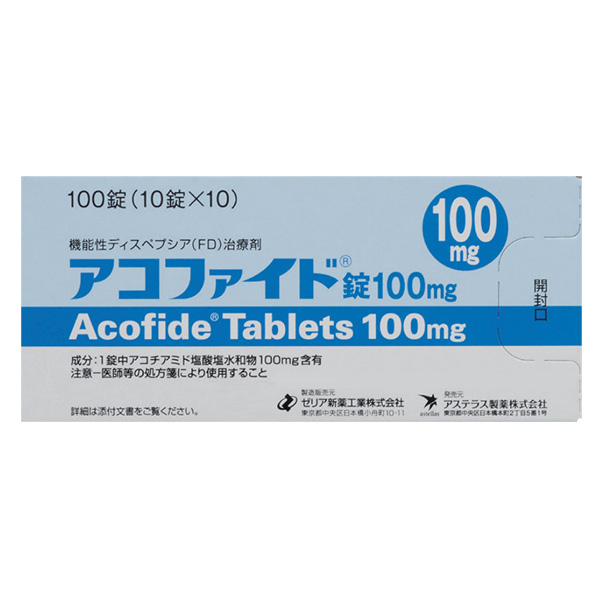
All Names: Acofide、Acotiamide、アコファイド錠、阿考替胺
Indications:Adult patients over 20 years old who experience symptoms such as postprandial abdominal distension, upper abdominal distension, and early satiety caused by functional dyspepsia.
Manufacturer:日本Zeria制药
Customs Clearance Procedure:If the customs requires the package for customs clearance, please pay the customs clearance fee according to the content of EMS SMS and customs regulations.
Acofide is a novel selective acetylcholinesterase (AChE) inhibitor developed by Zeria in Japan and jointly developed with Astellas.
1. Drug name
Common name: Acotiamide
English name: Acofide/Acotiamide
Product Name: Acotiamide
II. Indications
This product is suitable for functional dyspepsia, specifically including:
Dysmotility subtype: Postprandial fullness and early satiety caused by delayed gastric emptying.
Epigastric pain syndrome: Upper abdominal pain associated with gastric motility disorders.
It can be used to improve gastric motility, promote gastric emptying, and alleviate symptoms of indigestion.
III. Specifications and Characteristics
Specification: Each tablet (or each capsule) contains 100mg of Acotiamide Hydrochloride (calculated as Acotiamide).
Characteristics: White to almost white tablets or capsules.
IV. Main Components
Each tablet (capsule) contains 100mg of acotiamide hydrochloride.
V. Usage and Dosage
Adult conventional dosage: 100mg each time (i.e., 1 tablet/capsule), 3 times a day, taken orally 15-30 minutes before meals.
Course of treatment: It is generally recommended to take the medication continuously for 4 weeks, and the duration can be extended according to the condition and doctor's guidance.
Special populations (such as the elderly and individuals with impaired liver or kidney function) generally do not require dosage adjustments, but should use the medication under the supervision of a physician.
VI. Dose adjustment
Generally, no adjustment is necessary.
If a dose is missed, it should be taken as soon as possible. However, if it is close to the next scheduled dose, the missed dose should be skipped and the medication should be taken as per the original plan. It is prohibited to take a double dose.
If vomiting occurs after taking the medication, decide whether a supplementary dose is necessary based on the timing of the vomiting. If vomiting occurs shortly after taking the medication (within 30 minutes, for example), it is recommended to consult a doctor about whether a supplementary dose is necessary.
VII. Medication Precautions
Before and after meals: It must be taken 15-30 minutes before meals to enhance gastric motility and promote gastric emptying.
Handling of missed doses: As mentioned above, take the missed dose as soon as possible, but do not double the dose.
Vomiting management: If vomiting occurs immediately after taking the medication, a supplementary dose may be necessary; if vomiting occurs a longer time after taking the medication, a supplementary dose is generally not required.
Special precautions: It is not recommended to use this product in combination with anticholinergic drugs or other drugs that inhibit gastric motility, as this may affect the therapeutic effect.
Long-term medication monitoring: If long-term medication is required, symptoms and adverse reactions should be regularly assessed.
VIII. Medication for special populations
Children: Safety and effectiveness not established, not recommended for use.
Pregnant and lactating women: Data is insufficient, avoid use unless potential benefits outweigh risks.
Elderly individuals: Generally, no dosage adjustment is necessary, but closer monitoring may be required.
Liver dysfunction: Generally, no adjustment is needed for mild to moderate impairment; use with caution due to insufficient data for severe impairment.
Renal insufficiency: generally no adjustment is needed for mild to moderate impairment; use with caution due to insufficient data for severe impairment.
IX. Adverse reactions
Common adverse reactions (incidence rate > 1%) include:
Gastrointestinal reactions: diarrhea, nausea, abdominal pain, and constipation.
Nervous system: Headache, dizziness.
Others: rash, fatigue.
Serious adverse reactions (rare):
Elevated liver enzymes, allergic reaction.
If severe rash, jaundice, or persistent diarrhea occurs, discontinue the medication immediately and seek medical attention.
X. Contraindications
Individuals allergic to acotiamide or any excipients are prohibited from using this product.
It is prohibited for individuals with severe hepatic and renal insufficiency to use this product (unless adequate clinical monitoring is conducted).
Pregnant and lactating women, as well as children, are prohibited from using this product (unless there is a clear clinical necessity and after physician assessment).
XI. Drug Interactions
Combined use with anticholinergics (such as atropine) or gastric motility inhibitors (such as domperidone): may reduce the efficacy of acotiamide, avoid combined use.
Combined use with CYP450 enzyme inhibitors/inducers: Acotiamide is primarily metabolized by CYP3A4. Co-administration with strong CYP3A4 inhibitors (such as ketoconazole) may increase plasma drug concentration, necessitating monitoring for adverse reactions. Co-administration with inducers (such as rifampin) may reduce efficacy, requiring dose adjustment.
Combined use with anticoagulants (such as warfarin): Data is limited, use with caution, and monitor coagulation function.
It has no clear interactions with other digestive system drugs (such as proton pump inhibitors), but physicians should be consulted when used in combination.
XII. Storage method
Store at room temperature (15-30°C), avoiding moisture and direct sunlight.
Keep out of reach of children.
Acofideinformation