- All Drug Categories
- Home
- Anti-cancer Drugs
- Healthcare Products
- Medical Information
- Statement
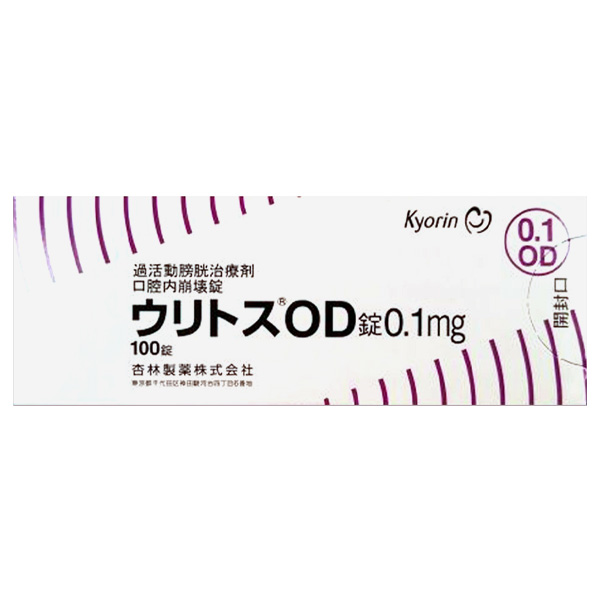
All Names: midafenacin、Uritos、 咪达那新片、膀胱过度活动症治疗剂、ウリトス錠
Indications:Adult patients aged 18 and above with overactive bladder.
Manufacturer:Kyorin Pharmaceutical Co., Ltd.
Customs Clearance Procedure:If the customs requires the package for customs clearance, please pay the customs clearance fee according to the content of EMS SMS and customs regulations.
Uritos, a new drug, significantly improves symptoms of urinary urgency, urinary frequency, and urge incontinence by blocking the M3 receptor in the bladder detrusor muscle to inhibit involuntary contractions.
1. Drug name
1. Common name: Imidafenacin Tablets.
2. Trade name: Uritos (ウリトス錠/OD錠).
3. Other names: Imidafenacin new tablets.
II. Indications
It is used to treat the urge sensation of urination, frequent urination, and urgent urinary incontinence caused by overactive bladder (OAB).
III. Specification and Characteristics
1. Specification: Each tablet contains 0.1mg of Imidafenacin.
2. Traits:
Uritos Tablets 0.1mg (regular tablets): Light red to light reddish-brown or light reddish-purple film-coated tablets, with a diameter of approximately 7.1mm, a thickness of approximately 3.5mm, and a mass of approximately 140mg. They are imprinted with the logos "URITOS 0.1" and "KP-197".
Wuritos OD tablet 0.1mg (orally disintegrating tablet): white plain tablet, approximately 7.6mm in diameter, approximately 4.1mm in thickness, and weighing approximately 180mg. It is imprinted with the logo "KP-121".
IV. Main components
Active ingredient: Imidafenacin.
5. Usage and Dosage
1. Conventional usage: Adults usually take 0.1mg (1 tablet) once a day, twice a day, orally after breakfast and dinner.
2. Dose adjustment: If the effect is insufficient, the dosage can be increased to 0.2mg (2 tablets) per dose, twice daily (i.e., the maximum daily dosage is 0.4mg).
VI. Dose Adjustment (for Special Populations)
1. Hepatic insufficiency: For patients with moderate or severe liver injury, the dosage is 0.1mg per dose, twice a day.
2. Renal insufficiency: For patients with severe renal impairment, the dosage is 0.1 mg once, twice a day.
3. Elderly people: Generally, there is no need to adjust the initial dosage, but due to potential decline in physiological functions, caution should be exercised when using.
VII. Medication Precautions
1. Before and after meals: It is recommended to take the medication after meals to reduce gastrointestinal discomfort, and food may enhance drug absorption.
2. Handling of missed doses: If a dose is missed, it should be taken as soon as possible; if it is close to the next scheduled dose, the missed dose should be skipped and the medication should be taken as per the original plan. Do not take a double dose at once.
3. Vomiting treatment: If vomiting occurs after taking the medication, there is no need to take a supplementary dose. Simply take the next scheduled dose as usual.
4. Other important notes:
During the medication period, patients may experience ocular accommodation disorders (such as photophobia and blurred vision), dizziness, and somnolence. Therefore, they should avoid driving or operating dangerous machinery.
Oral disintegrating tablets (OD tablets) can be placed on the tongue and allowed to disintegrate with saliva before swallowing, or they can be taken with water. However, it is prohibited to take them without water while in bed.
Medicines packaged in PTP packaging should be taken after being removed from the aluminum foil to prevent accidental ingestion of the foil, which could cause esophageal damage.
VIII. Medication for special populations
1. Pregnant women: Avoid use. Animal experiments have shown that the drug can pass through the placenta.
2. Lactating women: The necessity of treatment should be weighed against the benefits of breastfeeding, and consideration should be given to temporarily discontinuing breastfeeding. Animal experiments have shown that the drug can be secreted into breast milk.
3. Children: Safety and effectiveness have not been established, and use is not recommended.
4. Elderly people: Use with caution, as they may be more prone to side effects.
5. Patients with specific diseases: Patients with urinary disorders such as prostatic hypertrophy, arrhythmias, cognitive dysfunction, Parkinson's disease, ulcerative colitis, and hyperthyroidism should use with caution, as it may exacerbate their conditions.
IX. Adverse reactions
1. Common adverse reactions (≥5%): dry mouth (intraoral dryness, with an incidence rate of approximately 33.1%) and constipation.
2. Other adverse reactions (0.1-5%): stomach and abdominal discomfort, nausea, abdominal pain, abdominal distension, diarrhea, loss of appetite, indigestion, drowsiness, abnormal taste, dizziness, numbness, headache, palpitations, extrasystole, elevated blood pressure, sore throat, cough, dry throat, hoarseness, photophobia, blurred vision, abnormal sensation in the eyes, etc.
3. Serious side effects (to be vigilant):
Acute glaucoma (increased intraocular pressure).
Urinary retention.
Liver function impairment (elevated AST, ALT, and bilirubin levels).
Paralytic ileus (severe constipation, abdominal distension).
Hallucinations, delirium.
Arrhythmias such as QT interval prolongation and ventricular tachycardia.
X. Contraindications
The following patients are prohibited from using:
1. Patients with urinary ponding.
2. Patients with pyloric stenosis, duodenal obstruction, intestinal obstruction, and paralytic ileus.
3. Patients with low motility/tension of the digestive tract.
4. Patients with angle-closure glaucoma.
5. Patients with myasthenia gravis.
6. Patients with severe heart disease.
7. Patients with a history of allergy to the ingredients of this medicine.
XI. Drug interactions
1. Strong CYP3A4 inhibitors (such as itraconazole, clarithromycin, and erythromycin): Co-administration may inhibit the metabolism of this drug, leading to increased plasma drug concentration, thus caution is advised.
2. Other anticholinergic drugs (such as tricyclic antidepressants, phenothiazines, and monoamine oxidase inhibitors): Co-administration may enhance anticholinergic side effects (such as dry mouth, constipation, and difficulty in urination).
XII. Storage method
1. Storage: Store at room temperature (the specific temperature range is not specified in the provided section, generally referring to 15-30°C).
2. Validity period: 3 years.
Special reminder for orally disintegrating tablets: After opening the aluminum-plastic blister packaging, it should be stored in a moisture-proof environment.
XIII. Manufacturer
Kyorin Pharmaceutical Co., Ltd.
Uritosinformation