- All Drug Categories
- Home
- Anti-cancer Drugs
- Healthcare Products
- Medical Information
- Statement
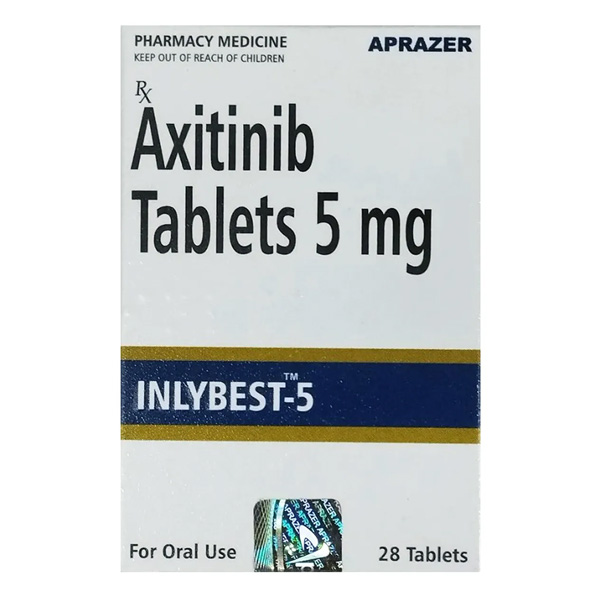
All Names: INLYTA、Axitinib、阿昔替尼、阿西替尼、英立达
Indications:Patients who have been pathologically diagnosed with advanced renal cell carcinoma and meet one of the following conditions: previous failure of TKI or cytokine therapy, or have intermediate-high risk unresectable or metastatic renal cell carcinoma requiring first-line combination therapy.
Manufacturer:Aprazer,India
Customs Clearance Procedure:If the customs requires the package for customs clearance, please pay the customs clearance fee according to the content of EMS SMS and customs regulations.
Axitinib is a tyrosine kinase inhibitor that blocks tumor angiogenesis signaling pathways by selectively inhibiting the activity of vascular endothelial growth factor receptor (VEGFR)-1, VEGFR-2, and VEGFR-3, thereby inhibiting tumor growth and metastasis.
1. Drug name:
1. Trade name: INLYTA
2. Common name: Axitinib
II. Indications:
Used for the treatment of advanced renal cell carcinoma (RCC) after a previous systemic treatment failure.
III. Specifications and Characteristics:
Specification: 5mg film-coated tablet
IV. Main Components:
Active ingredient: Axitinib
V. Usage and Dosage:
1. Recommended starting dose: Oral administration, 5mg each time, twice daily, with an interval of about 12 hours. It can be taken with or without food.
2. Usage: Swallow the entire tablet with a glass of water.
VI. Dose Adjustment:
1. The dosage can be adjusted based on individual safety and tolerance.
2. If a strong CYP3A4/5 inhibitor is required, the dose of INLYTA should be reduced by approximately half.
3. For patients with moderate liver injury, the initial dose should be reduced by about half.
4. Dose increase: If the patient tolerates well and has no adverse reactions of grade >2, the dose can be gradually increased to 7mg twice daily, and further to 10mg twice daily.
5. Dose reduction: If a reduction in dose is necessary, the recommended dose is 3mg twice daily, which can be further reduced to 2mg twice daily.
VII. Medication Precautions:
1. Before and after meals: It can be taken with or without food.
2. Missed dose: If a dose is missed, it should not be taken retroactively. The next dose should be taken at the regular time.
3. Vomiting: If vomiting occurs after taking the medication, do not take a supplementary dose. Take the next dose at the regular time.
VIII. Medication for special populations:
1. Pregnant women: May cause harm to the fetus. Not recommended for pregnant women. Women should avoid becoming pregnant during the medication period.
2. Lactating women: It is not known whether the drug is secreted into breast milk. During the medication period, breastfeeding should be stopped.
3. Children: Safety and efficacy have not been studied.
4. Elderly patients: Patients aged ≥65 years do not require adjustment of the starting dose, but it should be noted that elderly patients may be more sensitive.
5. Liver injury: Patients with moderate liver injury should have their initial dosage reduced, while patients with severe liver injury have not been studied.
6. Renal impairment: No need to adjust the starting dose based on renal impairment, but caution is required for patients with end-stage renal disease.
IX. Adverse reactions:
The most common (≥20%) adverse reactions include diarrhea, hypertension, fatigue, appetite loss, nausea, dysphonia, hand-foot syndrome, weight loss, vomiting, asthenia, and constipation.
2. Other serious adverse reactions include: arterial and venous thromboembolic events, bleeding events, gastrointestinal perforation and fistula formation, hypothyroidism, wound healing complications, reversible posterior leukoencephalopathy syndrome (RPLS), proteinuria, and elevated liver enzymes.
X. Contraindications:
No specific contraindications.
XI. Drug Interactions:
1. Avoid co-administration with strong CYP3A4/5 inhibitors. If co-administration is necessary, reduce the dose of INLYTA.
2. Avoid combination with strong CYP3A4/5 inducers.
3. Grapefruit or grapefruit juice may increase the plasma concentration of INLYTA and should be avoided.
12. Storage method:
Store at 20°C to 25°C (68°F to 77°F), with an allowable range of 15°C to 30°C (59°F to 86°F).
Axitinibinformation