- All Drug Categories
- Home
- Anti-cancer Drugs
- Healthcare Products
- Medical Information
- Statement
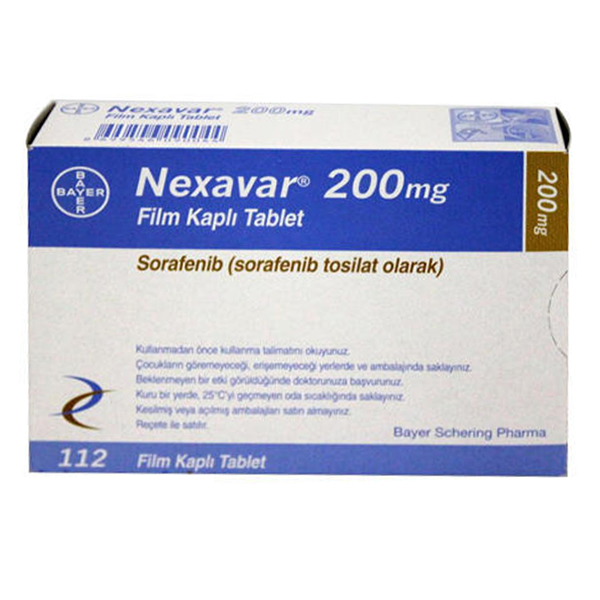
All Names: Sorafenib、Sorafenat、Soranib、Soranix、Nexavar、多吉美、索拉非尼
Indications:Patients with advanced renal cell carcinoma who are inoperable, patients with hepatocellular carcinoma who are inoperable or have distant metastasis, and patients with progressive radioiodine-refractory differentiated thyroid cancer who are experiencing local recurrence or metastasis.
Manufacturer:Bayer heathcare AG, Germany
Customs Clearance Procedure:If the customs requires the package for customs clearance, please pay the customs clearance fee according to the content of EMS SMS and customs regulations.
Sorafenib is a multikinase inhibitor that blocks tumor cell proliferation and angiogenesis signaling pathways by inhibiting RAF kinases (such as c-CRAF, BRAF, and mutant BRAF) within tumor cells and cell surface kinases (such as KIT, FLT-3, VEGFR-1/2/3, PDGFR-B, etc.), thereby inhibiting tumor growth.
I. Drug name
1. Trade name: NEXAVAR
2. Common name: Sorafenib
II. Indications
1. For the treatment of unresectable advanced hepatocellular carcinoma (HCC).
2. For the treatment of advanced renal cell carcinoma (RCC).
3. For the treatment of locally recurrent or metastatic, progressive, radioiodine-refractory differentiated thyroid cancer (DTC).
III. Specifications and Characteristics
1. Specification: 200mg tablet, each containing sorafenib equivalent to 274mg of sorafenib tosylate.
2. Characteristics: Round, double-convex, red film-coated tablets, with "Bayercross" imprinted on one side and "200" imprinted on the other side.
IV. Main components
Active ingredient: Sorafenib, present in the form of sorafenib tosylate.
V. Usage and Dosage
Recommended dosage: 400mg per dose (i.e., two 200mg tablets), twice daily, taken on an empty stomach (at least 1 hour before meals or 2 hours after meals).
VI. Dose adjustment
Based on the severity of adverse reactions, dosage adjustments can be made, including reducing the dosage to 400mg once daily or further adjustments. Specific adjustment plans should be guided by a doctor.
VII. Medication Precautions
1. Before and after meals: It should be taken on an empty stomach, at least 1 hour before meals or 2 hours after meals.
2. Missed dose: If a dose is missed, the individual should skip it and take the next scheduled dose on time. Do not double the dose to make up for the missed one.
3. Vomiting: If you vomit after taking the medication, there is no need to take a supplementary dose. Simply take the next dose as scheduled.
VIII. Medication for special populations
1. Pregnant and lactating women: May cause harm to the fetus. Pregnant women and women who may become pregnant should avoid use. Lactating women should discontinue breastfeeding.
2. Children: Safety and efficacy have not been established.
3. Elderly: Patients aged 65 and above do not require special dosage adjustments, but close monitoring is necessary.
4. Patients with hepatic and renal insufficiency: No dosage adjustment is required for patients with mild to moderate hepatic and renal insufficiency; studies have not been conducted for patients with severe hepatic insufficiency.
IX. Adverse reactions
1. Common adverse reactions include: diarrhea, fatigue, infection, hair loss, skin reactions on hands and feet, rash, weight loss, decreased appetite, nausea, gastrointestinal and abdominal pain, hypertension, and bleeding.
2. Serious adverse reactions include: cardiac ischemia/infarction, heart failure, hemorrhage, hypertensive crisis, cutaneous toxicity (such as Stevens-Johnson syndrome and toxic epidermal necrolysis), gastrointestinal perforation, and drug-induced liver injury.
X. Contraindications
1. Those who are allergic to sorafenib or any of its ingredients are prohibited from using it.
2. It is prohibited to use in combination with carboplatin and paclitaxel for patients with squamous cell lung cancer.
XI. Drug Interactions
1. Strong CYP3A4 inducers (such as rifampin) may reduce the plasma concentration of sorafenib, and their combined use should be avoided.
2. Neomycin may reduce the absorption of sorafenib, and combined use should be avoided.
3. The combination of warfarin and sorafenib may increase the risk of bleeding, and INR values need to be monitored.
4. Avoid combination use with drugs known to prolong the QT interval.
XII. Storage method
Store at 20°C to 25°C (68°F to 77°F), with an allowable range of 15°C to 30°C (59°F to 86°F).
2. Store in a dry place and keep out of reach of children.
XIII. Manufacturer
1. Manufacturer: Bayer HealthCare Pharmaceuticals Inc
2. Production location: Germany
Sorafenibinformation