- All Drug Categories
- Home
- Anti-cancer Drugs
- Healthcare Products
- Medical Information
- Statement
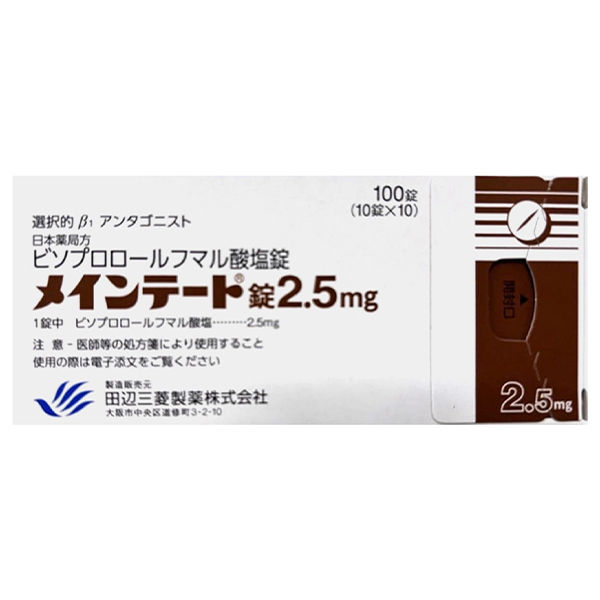
All Names: Bisoprolol fumarate tablets、Mainteate、富马酸比索洛尔片、博苏、メインテート錠
Indications:Suitable for adult hypertension, angina pectoris, premature ventricular contractions, chronic heart failure, and atrial fibrillation, it can effectively control blood pressure, reduce angina attacks, improve heart rhythm, and stabilize heart function.
Manufacturer:
Customs Clearance Procedure:If the customs requires the package for customs clearance, please pay the customs clearance fee according to the content of EMS SMS and customs regulations.
Bisoprolol fumarate tablets (Maintea) are a highly selective beta 1 adrenergic receptor antagonist that does not have an endogenous sympathetic nerve stimulation effect.
1、 Drug name
1. Common name: Bisoprolol Fumarate Tablets (Japanese FDA name: Bisoprolol Fumarate Tablets)
2. Product Name: Maintea
2、 Indications
Suitable for chronic heart failure and tachycardia induced atrial fibrillation caused by intrinsic hypertension (mild to moderate), angina pectoris, ventricular premature contractions, hypovolemic heart disease, or dilated cardiomyopathy.
3、 Specifications and characteristics
1. Specifications: Each tablet contains 2.5mg and 5mg of bisoprolol fumarate, respectively.
2. Appearance: All are white flakes (with scratches).
4、 Main components
Active ingredients: Each tablet contains Bisoprolol Fumarate, 2.5mg or 5mg, according to the Japanese Pharmacopoeia.
5、 Usage and dosage
1. Intrinsic hypertension, angina pectoris, and ventricular premature contractions: Adults usually take 5mg orally once a day. The dosage can be adjusted according to age and symptoms.
2. Chronic heart failure: Adults usually start taking 0.625mg orally once a day. Administer this dose for more than 2 weeks, and those with good tolerance can increase it to 1.25mg once daily. After that, gradually increase the dose at least 4 weeks intervals (which can be increased to 2.5mg, 3.75mg, or 5mg) while confirming tolerance. The usual maintenance dose is 1.25-5mg once daily. The maximum dose should not exceed 5mg once daily.
3. Tachytic atrial fibrillation: Adults usually start with oral administration of 2.5mg once a day, and may increase to 5mg once a day if the effect is not sufficient. The maximum dose should not exceed 5mg once a day.
6、 Dose adjustment
1. Chronic heart failure patients: Start with a low dose (0.625mg or lower) and gradually adjust to the maintenance dose based on patient tolerance. If intolerance occurs, the dosage should be reduced.
2. After stopping the medication, take it again: If the medication has been stopped for more than 2 weeks, start with a low dose and gradually increase the dosage according to the intended use.
3. Special populations: Elderly patients, patients with severe kidney or liver function impairment, should start with low doses and be administered with caution.
7、 Medication precautions
1. Medication time: It is not explicitly required to take before or after meals. A pharmacokinetic study showed that food has no effect on absorption.
2. Missed dose: However, as it is a once daily long-acting formulation, if missed, it is not recommended to double the dose next time.
3. Vomiting: If vomiting occurs shortly after taking medication, it may affect drug absorption. It is recommended to consult a physician or pharmacist.
4. Other important notes:
Long term medication requires regular check of cardiac function (pulse, blood pressure, electrocardiogram, etc.).
Do not suddenly stop taking medication, especially for patients with angina, as it may lead to worsening symptoms or myocardial infarction. The dosage should be gradually reduced when stopping the medication.
It is best to stop taking medication 48 hours before surgery.
During medication, dizziness and unstable standing may occur, and caution should be exercised when driving or operating dangerous machinery.
PTP packaged drugs need to be taken out of the aluminum foil plate before consumption to prevent accidental ingestion of the aluminum foil and esophageal damage.
8、 Medication for special populations
1. Pregnant women: Use only when the benefits of treatment outweigh the risks. It is necessary to closely observe the mother and fetus, and also observe whether there is hypoglycemia, bradycardia, etc. after the newborn is born.
2. Breastfeeding women: weigh the necessity of treatment and the benefits of breastfeeding to decide whether to continue breastfeeding or discontinue medication. Animal experiments have shown that drugs can be excreted through breast milk.
3. Children: No clinical trials have been conducted.
4. Elderly people: should start with small doses and closely observe. Avoid excessive blood pressure reduction and be aware of possible bradycardia.
5. Individuals with liver/kidney dysfunction: those with severe liver and kidney dysfunction, delayed drug metabolism and excretion, and potential enhanced effects, should use with caution and start at low doses.
9、 Adverse reactions
1. Common adverse reactions (incidence ≥ 1%) include bradycardia, dizziness, headache, fatigue, fatigue, edema, nausea, difficulty breathing, and elevated liver function indicators (AST, ALT).
2. Serious side effects: including heart failure, complete atrioventricular block, severe bradycardia, sick sinus syndrome, etc., immediate discontinuation of medication and medical attention are required.
10、 Contraindications
The following patients are prohibited:
1. Patients with severe bradycardia, second or third degree atrioventricular block, and sick sinus syndrome.
2. Patients with diabetes ketoacidosis and metabolic acidosis.
3. Patients with cardiogenic shock.
4. Patients with right heart failure caused by pulmonary arterial hypertension.
5. Patients with decompensated heart failure who require intravenous administration of cardiac stimulants or vasodilators.
6. Patients with severe peripheral circulatory disorders.
7. Untreated patients with pheochromocytoma.
8. People who are allergic to the ingredients of this medicine.
11、 Drug interactions
1. Prohibited or extremely cautious combination: Combination with other drugs that inhibit the sympathetic nervous system (such as reserpine), calcium channel blockers (such as verapamil, diltiazem), digitalis drugs, antiarrhythmic drugs (such as amiodarone), etc. may excessively inhibit cardiac function, leading to severe bradycardia, hypotension, etc.
2. Attention should be paid to combination use: Combining with hypoglycemic drugs may enhance the hypoglycemic effect and mask hypoglycemic symptoms (such as palpitations); The combination with nonsteroidal anti-inflammatory drugs may weaken the antihypertensive effect; Combined use with antihypertensive drugs may enhance the antihypertensive effect.
12、 Storage method
Store at room temperature.
13、 Manufacturer
Marketing Authorization Holder/Manufacturer: Tanabe Mitsubishi Pharmaceutical Co., Ltd.
Mainteateinformation