- All Drug Categories
- Home
- Anti-cancer Drugs
- Healthcare Products
- Medical Information
- Statement
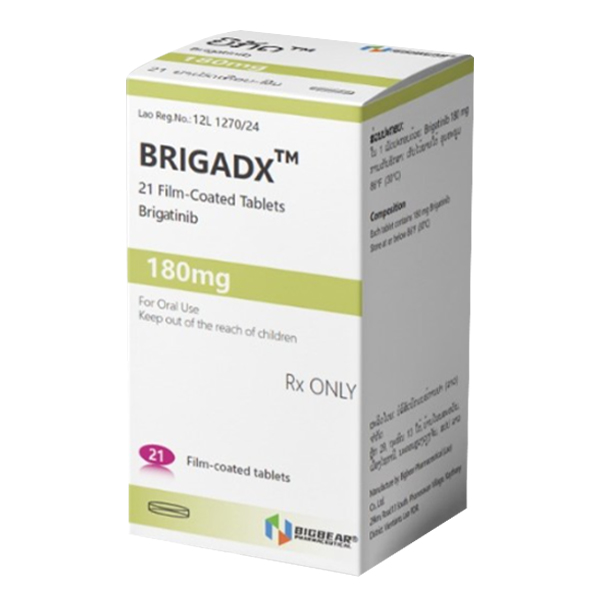
All Names: Alunbrig、brigatinib 、AP26113、布吉他滨、布加替尼、卡布宁布格替尼、布吉替尼、布格替尼
Indications:Locally advanced or metastatic non-small cell lung cancer (NSCLC) patients with anaplastic lymphoma kinase (ALK) positivity.
Manufacturer:Daxiong
Customs Clearance Procedure:If the customs requires the package for customs clearance, please pay the customs clearance fee according to the content of EMS SMS and customs regulations.
As a novel dual inhibitor of ALK and EGFR, brigatinib significantly enhances its binding affinity with ALK protein through its unique DMPO structure, thereby improving drug activity.
1、 Drug name
1. Common name: Bugatinib
2. Product Name: ALUNBRIG
3. English name: Brigatinib
2、 Indications
Bugatinib is a kinase inhibitor used to treat patients with anaplastic lymphoma kinase (ALK) positive metastatic non-small cell lung cancer (NSCLC) who experience disease progression or intolerance after treatment with crizotinib.
3、 Specifications and characteristics
Specification: 180 milligrams per tablet.
4、 Main components
1. Active ingredient: Bugatinib.
2. Non active ingredients: The tablet core contains lactose monohydrate, microcrystalline cellulose, A-type starch sodium hydroxide, magnesium stearate, and hydrophobic colloidal silica. The coating contains talcum powder, polyethylene glycol, polyvinyl alcohol, and titanium dioxide.
5、 Usage and dosage
1. Recommended dosing regimen: Take 90 milligrams orally once a day for the first 7 days; If tolerable for the first 7 days, increase to once daily oral intake of 180 milligrams starting from the 8th day.
2. Usage: Can be taken with food or on an empty stomach. It should be swallowed whole, without crushing or chewing.
3. Omission or vomiting: If one dose is missed or vomiting occurs after taking the medication, additional doses should not be taken and medication should be resumed at the next scheduled time.
6、 Dose adjustment
1. Dose reduction steps: For patients with an initial dose of 180 milligrams, reduce the initial dose to 120 milligrams; Reduce the second dose to 90 milligrams; The third dose was reduced to 60 milligrams. For patients with an initial dose of 90 milligrams, the first dose is reduced to 60 milligrams; If it cannot be tolerated, it will be permanently discontinued. Once the dosage is reduced due to adverse reactions, it cannot be increased in the future.
2. Adjustment for adverse reactions: Dose should be temporarily suspended, reduced, or permanently discontinued based on the severity of the adverse reactions.
3. Adjustments caused by drug interactions: Simultaneous use with potent CYP3A inhibitors should be avoided. If unavoidable, the daily dose of brigatinib should be reduced by about 50% (i.e. from 180 milligrams to 90 milligrams, or from 90 milligrams to 60 milligrams). After discontinuing the potent CYP3A inhibitor, restore the tolerated dose of brigatinib before using the inhibitor.
7、 Medication precautions
1. Medication time: once a day, preferably at a fixed time, before and after meals.
2. Omission treatment: Skip the missed dose and take the next dose at the next regular time. Do not take double doses to make up for missed doses.
3. Vomiting treatment: If vomiting occurs after taking the medication, there is no need to take the next dose as planned.
4. Monitoring requirements: During the treatment period, regular monitoring of lung symptoms (especially in the first week of treatment), blood pressure (at least once a month after 2 weeks of treatment), heart rate and rhythm, visual changes, serum creatine kinase (CPK), lipase and amylase, fasting blood glucose, etc. are required.
8、 Medication for special populations
1. Pregnant women: Based on the mechanism of action and animal studies, it may pose a risk to the fetus. Pregnant women should be informed of potential risks to the fetus.
2. Breastfeeding women: It is recommended not to breastfeed during the treatment period and within one week after the last dose.
Women and men with fertility potential: Women should take effective non hormonal contraceptive measures during treatment and for at least 4 months after the last dose, as brigatinib may render certain hormonal contraceptives ineffective. Men should use effective contraceptive measures during treatment and for at least 3 months after the last dose when having a female partner with fertility potential.
3. Child patients: Safety and efficacy have not yet been established.
4. Elderly patients: Clinical studies have not found any clinically relevant differences compared to younger patients.
5. Liver injury patients: Mild liver injury patients do not require dose adjustment. The pharmacokinetics and safety of patients with moderate or severe liver injury have not been studied.
6. Kidney injury patients: Mild to moderate kidney injury patients do not require dose adjustment. The pharmacokinetics and safety of patients with severe kidney injury have not been studied.
9、 Adverse reactions
1. The most common adverse reactions (≥ 25%) include nausea, diarrhea, fatigue, cough, and headache.
2. Common laboratory abnormalities include: elevated aspartate aminotransferase, hyperglycemia, elevated creatine phosphokinase, elevated lipase, elevated alanine aminotransferase, elevated amylase, anemia, decreased lymphocytes, etc.
3. Serious adverse reactions include: interstitial lung disease/pneumonia, hypertension, bradycardia, visual impairment, elevated creatine kinase, elevated pancreatic enzymes, hyperglycemia, etc.
10、 Contraindications
There are no clear contraindications, but it is contraindicated for those who are allergic to this product or excipients.
11、 Drug interactions
1. It should be avoided to use potent CYP3A inhibitors (such as itraconazole, clarithromycin, etc.) in combination, as they can increase the blood concentration of brigatinib. If unavoidable, the dose of brigatinib needs to be reduced.
2. It should be avoided to use potent CYP3A inducers (such as rifampicin, carbamazepine, St. John's wort, etc.) in combination, as they can reduce the blood concentration of brigatinib and affect its efficacy.
3. Bugatinib is a CYP3A inducer that may reduce the blood concentration of CYP3A substrates (including hormonal contraceptives), leading to the loss of its therapeutic effect. Effective non hormonal contraceptive methods should be used.
4. Avoid consuming grapefruit or drinking grapefruit juice as it may increase the concentration of brigatinib in the blood.
12、 Storage method
Store at controlled room temperature of 20 ° C to 25 ° C (68 ° F to 77 ° F); allow for short distance transportation between 15 ° C to 30 ° C (59 ° F to 86 ° F).
Alunbriginformation