- All Drug Categories
- Home
- Anti-cancer Drugs
- Healthcare Products
- Medical Information
- Statement
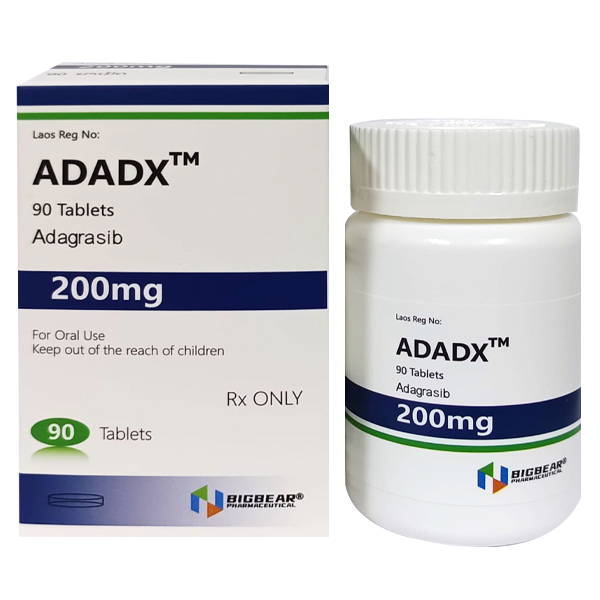
All Names: Adagrasib、Krazati、MRTX849、阿达格拉西布
Indications:Suitable for adult patients with locally advanced or metastatic non-small cell lung cancer confirmed to have KRAS G12C mutation through FDA approved testing, and who have received at least one systemic treatment.
Manufacturer:Daxiong
Customs Clearance Procedure:If the customs requires the package for customs clearance, please pay the customs clearance fee according to the content of EMS SMS and customs regulations.
Adagrasib is an oral small molecule drug that covalently binds to the cysteine residue of the mutated protein to inhibit the activity of KRAS protein, immobilizing it in an inactive state, blocking downstream signaling pathways, inhibiting tumor cell proliferation, and promoting apoptosis.
1、 Drug name
1. Common name: Adagracibu
2. Product Name: KRAZATI ™
3. English name: Adagrasib
2、 Indications
Adagracilib is a RASGTPase family inhibitor suitable for treating adult patients with locally advanced or metastatic non-small cell lung cancer confirmed by FDA approved testing methods to have KRASG12C mutations, who have received at least one systemic treatment in the past.
3、 Specifications and characteristics
200mg tablets.
4、 Main components
1. Active ingredient: Adagracilib.
2. Accessories: Colloidal silica, cross-linked pyrrolidone, plant-based magnesium stearate, mannitol, microcrystalline cellulose. The film coating premix contains hydroxypropyl methylcellulose, maltodextrin, medium chain triglycerides, polyglucose, talc powder, and titanium dioxide.
5、 Usage and dosage
1. Recommended dosage: 600mg (i.e. 3 200mg tablets) orally, twice daily.
2. Usage: Take at approximately the same time every day, either with food or on an empty stomach. Swallow the whole piece, do not chew, crush or break it open.
3. Duration of treatment: until disease progression or unacceptable toxicity occurs.
6、 Dose adjustment
1. Dose reduction level: The initial dose is reduced to 400 milligrams twice daily; Reduce the second dose to 600 milligrams once daily. If unable to tolerate 600 milligrams once daily, the medication will be permanently discontinued. A maximum of two dose reductions are allowed.
2. Adjustment for adverse reactions: Based on the severity of the adverse reaction (according to NCICTCAE5.0 grading), measures such as suspending medication, reducing dosage, or permanently stopping medication will be taken. For example, for grade 3 or 4 nausea, vomiting, or diarrhea that still occurs after supportive treatment, medication should be temporarily discontinued until it returns to ≤ grade 1 or baseline levels, and then resumed at the next lower dose level. For specific criteria such as QTc interval prolongation, hepatotoxicity, interstitial lung disease/pneumonia, there are corresponding rules for suspension, reduction, or permanent discontinuation of medication.
7、 Medication precautions
1. Before and after meals: can be taken with food or on an empty stomach, no specific requirements.
2. Missing dose: If one dose is missed, it should be taken as soon as possible when remembered. If the next scheduled medication time has exceeded 4 hours, skip the missed dose and take the next dose at the regular time. Do not take two doses at the same time to make up for missed doses.
3. Vomiting: If vomiting occurs after taking medication, there is no need to take additional doses, and medication should be taken at the next scheduled time according to the original plan.
8、 Medication for special populations
1. Pregnant women: There is no available data yet. According to animal data, it may pose a risk to the fetus.
2. Breastfeeding women: It is recommended not to breastfeed during the medication period and within one week after the last dose.
3. Patients with fertility: Based on animal studies, this product may impair the fertility of both females and males.
4. Child patients: Safety and efficacy have not yet been established.
5. Elderly patients: No overall differences in safety or efficacy were observed compared to younger patients.
6. Patients with liver/kidney dysfunction: Mild to severe liver or kidney dysfunction patients are not expected to require dose adjustment.
9、 Adverse reactions
1. Common adverse reactions (≥ 25%) include nausea, diarrhea, vomiting, fatigue, musculoskeletal pain, hepatotoxicity, renal dysfunction, edema, difficulty breathing, and decreased appetite.
2. Common level 3 or 4 laboratory abnormalities (≥ 2%) include: decreased lymphocytes, decreased hemoglobin, increased alanine aminotransferase, increased aspartate aminotransferase, hypokalemia, hyponatremia, increased lipase, decreased white blood cells, decreased neutrophils, and increased alkaline phosphatase.
3. Serious adverse reactions include: severe gastrointestinal adverse reactions, prolonged QTc interval, hepatotoxicity, interstitial lung disease/pneumonia, etc.
10、 Contraindications
None.
11、 Drug interactions
1. Avoiding co administration with potent CYP3A4 inducers can significantly reduce the blood concentration of adagracilib.
2. Avoid co administration with potent CYP3A4 inhibitors until Adagracilib reaches steady-state blood concentration (approximately 8 days).
3. Avoid co administration with sensitive CYP3A4 substrates, CYP2C9 substrates, CYP2D6 substrates, or P-glycoprotein substrates unless otherwise recommended in their prescription information, as adaglaxib can inhibit these enzymes or transporters, increasing exposure and toxicity risks of co administered drugs.
4. Avoid using with products known to prolong QTc interval. If unavoidable, monitor electrocardiogram and electrolytes.
12、 Storage method
1. Store at room temperature between 20 ° C and 25 ° C, with short-term storage allowed between 15 ° C and 30 ° C.
2. Keep the original packaging bottle with desiccant inside. Do not discard or swallow.
3. Keep out of reach of children.
Adagrasibinformation