- All Drug Categories
- Home
- Anti-cancer Drugs
- Healthcare Products
- Medical Information
- Statement
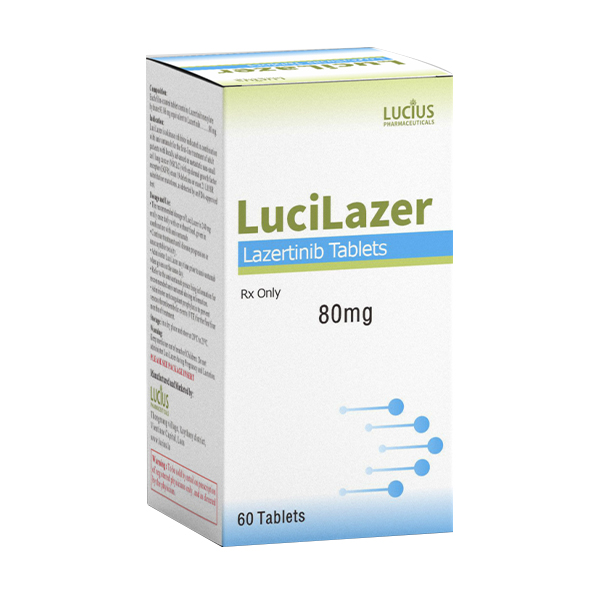
All Names: Lazertinib、Leclaza、拉泽替尼
Indications:As a first-line treatment, it is suitable for adult patients with locally advanced or metastatic non-small cell lung cancer (NSCLC) confirmed by FDA approved testing to have EGFR exon19 deletion or exon21 L858R substitution mutation.
Manufacturer:LUCIUS PHARMACEUTICAL (LAOS) CO., LTD
Customs Clearance Procedure:If the customs requires the package for customs clearance, please pay the customs clearance fee according to the content of EMS SMS and customs regulations.
On August 20, 2024, the FDA approved its combination with bevacizumab (EGFR-MET bispecific antibody) as a first-line treatment option. Currently, clinical trials of razetinib have been conducted in 26 countries worldwide.
1、 Drug name
1. Common name: Lazetinib
2. Product Name: LAZCLUZE ™
2、 Indications
Combined with amivantamab, it is used for first-line treatment of locally advanced or metastatic non-small cell lung cancer (NSCLC) adult patients with confirmed epidermal growth factor receptor (EGFR) exon 19 deletion or exon 21L858R substitution mutation detected by FDA approval testing.
3、 Specifications and characteristics
1. Specification: 80 milligrams.
2. Appearance: Tablets.
4、 Main components
1. Active ingredient: Razetinib Mesylate Hydrate.
2. Accessories: cross-linked carboxymethyl cellulose sodium, magnesium stearate, mannitol, microcrystalline cellulose, hydrophobic colloidal silica, etc. The coating ingredients include glycerol octanoate ester, iron oxide (black, red, yellow), polyethylene glycol polyvinyl alcohol graft copolymer, partially hydrolyzed polyvinyl alcohol, talc powder, titanium dioxide, etc.
5、 Usage and dosage
1. Recommended dosage: Take 240 milligrams orally once daily, in combination with bevacizumab.
2. Usage: Swallow the whole tablet, do not crush, split or chew. Can be taken before or after meals.
3. When administered on the same day as bevacizumab, razetinib should be taken before bevacizumab.
4. Treatment should continue until disease progression or unacceptable toxicity occurs.
6、 Dose adjustment
1. Handling of missed doses: If missed doses are discovered within 12 hours, they should be immediately replenished; If it exceeds 12 hours, skip this dose and take the next dose at the original scheduled time.
2. Vomiting treatment: If vomiting occurs after taking the medication, there is no need to take the next dose according to the original plan.
3. Dose adjustment for adverse reactions: Based on the severity of the adverse reactions, it is recommended to suspend, reduce, or permanently discontinue the dosage. The initial dose can be reduced from 240 milligrams to 160 milligrams (two tablets of 80 milligrams), and the second dose can be reduced to 80 milligrams. If further reduction is required, the medication will be permanently discontinued. Specific adjustments should refer to the Adverse Reaction Severity Guidelines.
7、 Medication precautions
1. Venous thromboembolism event: Anticoagulants are recommended for prevention 4 months before treatment. Relevant symptoms need to be monitored.
2. Interstitial lung disease/pneumonia: Monitor for new or worsening lung symptoms, suspend medication if suspected, and permanently discontinue medication if diagnosed.
3. Skin adverse reactions: common and potentially serious. It is recommended to use non-alcoholic moisturizer, limit sun exposure, wear protective clothing, and use broad-spectrum sunscreen. Prophylactic use of oral antibiotics may be considered.
4. Eye toxicity: may cause keratitis, etc. New or worsening eye symptoms should be promptly referred to an ophthalmologist.
5. Embryo fetal toxicity: may cause harm to the fetus. Women and men with reproductive potential need to take effective contraceptive measures during treatment and 3 weeks after the last dose.
8、 Medication for special populations
1. Pregnant women: May pose a risk to the fetus, and should be informed of the risks.
2. Breastfeeding period: It is recommended not to breastfeed during the treatment period and within 3 weeks after the last dose.
3. People with fertility potential: need to undergo pregnancy testing and take effective contraceptive measures. May impair fertility.
4. Children: Safety and effectiveness have not yet been established.
5. Elderly individuals: No differences in overall safety or efficacy were observed.
6. Liver and kidney dysfunction: Patients with mild to moderate liver injury or mild to moderate kidney injury do not require dose adjustment. The use of drugs in patients with severe liver injury, severe kidney injury, and end-stage renal disease has not been studied.
9、 Adverse reactions
1. The most common adverse reactions (with an incidence rate of ≥ 20%) include: rash, nail toxicity, infusion related reactions to bevacizumab, musculoskeletal pain, edema, stomatitis, venous thromboembolism, sensory abnormalities, fatigue, diarrhea, constipation COVID-19、 Bleeding, dry skin, decreased appetite, itching, nausea, eye toxicity.
2. Common level 3 or 4 laboratory abnormalities (≥ 2%) include: decreased albumin, decreased sodium, increased ALT, decreased potassium, decreased hemoglobin, increased AST, increased GGT, and increased magnesium.
3. Serious adverse reactions include venous thromboembolism, interstitial lung disease/pneumonia, severe skin reactions, etc.
10、 Contraindications
None.
11、 Drug interactions
1. It should be avoided to use strong and medium acting CYP3A4 inducers (such as rifampicin and efavirenz) simultaneously, as they can significantly reduce the blood concentration of razetinib and may affect the efficacy.
2. Lazotinib is a weak CYP3A4 inhibitor and BCRP inhibitor, and its combination with drugs metabolized through these pathways (such as midazolam and rosuvastatin) may increase the exposure and risk of adverse reactions in the latter, requiring close monitoring.
3. The combination with gastric acid reducing agents has no clinically significant effect.
12、 Storage method
Store at room temperature of 20 ° C to 25 ° C (68 ° F to 77 ° F); Allow for brief storage between 15 ° C and 30 ° C (59 ° F and 86 ° F).
Lazertinibinformation