- All Drug Categories
- Home
- Anti-cancer Drugs
- Healthcare Products
- Medical Information
- Statement
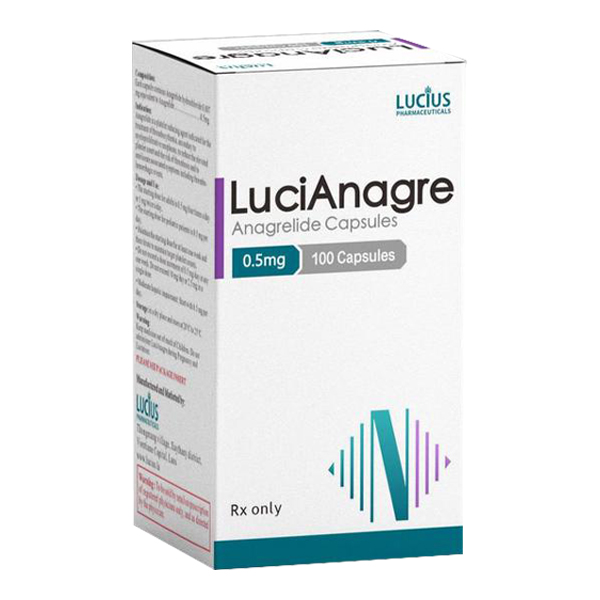
All Names: Anagrelide、Agrylin、Xagrid、阿那格雷、盐酸阿那格雷胶囊、安归宁
Indications:Patients with essential thrombocytosis and secondary thrombocytosis.
Manufacturer:LUCIUS PHARMACEUTICAL (LAOS) CO., LTD
Customs Clearance Procedure:If the customs requires the package for customs clearance, please pay the customs clearance fee according to the content of EMS SMS and customs regulations.
Anagrelide is a selective thrombopoietin inhibitor primarily used to treat thrombocytosis caused by primary thrombocytosis (ET) and other myeloproliferative neoplasms (MPN).
1、 Drug name
Anagrelide (English name: Anagrelide, product name: AGRYLIN) ®)
2、 Indications
Used to treat thrombocytosis secondary to myeloproliferative tumors, in order to reduce platelet count, lower the risk of thrombosis, and improve related symptoms (including thrombotic bleeding events).
3、 Specifications and characteristics
The specification is capsules, each containing 0.5mg of anagrel (equivalent to 0.61mg of anagrel hydrochloride).
4、 Main components
Active ingredient: Anagrel hydrochloride.
5、 Usage and dosage
Adults: The recommended starting dose is 0.5mg each time, four times a day; Or 1mg each time, twice a day.
Pediatric patients (7 years old and above): The recommended starting dose is 0.5mg per day.
Patients with moderate liver dysfunction: The initial dose is 0.5mg per day.
6、 Dose adjustment
The initial dose should be maintained for at least one week, and then adjusted to the target level based on platelet count (recommended to be maintained at 150000-40000/μ L).
The dose increment within any week shall not exceed 0.5mg/day.
The total daily dose should not exceed 10mg, and the single dose should not exceed 2.5mg.
The effective maintenance dose for most patients is 1.5 to 3.0mg per day.
During the dose adjustment period, platelet count should be monitored weekly, and after reaching the maintenance dose, it should be monitored monthly or as needed.
For patients with moderate liver dysfunction, if they tolerate treatment for one week, an increase in dosage can be considered, but the weekly increase should not exceed 0.5mg/day. Should be avoided for patients with severe liver dysfunction.
7、 Medication precautions
Before and after meals: Food can reduce the peak blood concentration of anagrel and its active metabolites, but the effect on total exposure (AUC) is inconsistent (the AUC of anagrel increases by 20%, while its active metabolite AUC has no effect). It is recommended to follow the doctor's advice for a fixed way of taking medication.
General precautions:
Treatment requires clinical monitoring, including complete blood cell count, liver and kidney function, and electrolytes.
To prevent thrombocytopenia, platelet counts should be monitored every two days during the first week of treatment, and at least once a week thereafter until the maintenance dose is reached.
After discontinuing medication or interrupting treatment, platelet count may begin to rise within 4 days and return to baseline levels within 1-2 weeks, possibly rebounding beyond baseline values and requiring frequent monitoring.
8、 Medication for special populations
Pregnant women: No significant birth defects or miscarriage risks related to medication have been found in the existing data. But thrombocytosis itself is associated with an increased risk of adverse pregnancy outcomes.
Breastfeeding women: It is recommended not to breastfeed during the treatment period and within one week after the last dose.
Children (7 years old and above): Safety and efficacy have been established. There is no data available for children under 7 years old.
Older adults (65 years and older): No overall difference in safety or efficacy was observed compared to younger patients, but some older adults have higher sensitivity.
Patients with liver dysfunction:
Moderate liver dysfunction: The dose should be reduced (starting at 0.5mg/day) and cardiovascular events should be monitored frequently. Risk benefit assessment should be conducted before use.
Severe liver dysfunction: avoid use.
Patients with renal insufficiency: After a single dose, there was no significant impact on pharmacokinetics in patients with severe renal insufficiency (creatinine clearance rate<30mL/min).
Male and female reproductive age: Based on animal research, Anagrelor may impair female fertility.
9、 Adverse reactions
The most common adverse reactions (incidence rate ≥ 5%): headache, palpitations, diarrhea, fatigue, edema, nausea, abdominal pain, dizziness, pain, difficulty breathing, cough, bloating, vomiting, fever, peripheral edema, rash, chest pain, anorexia, tachycardia, discomfort, sensory abnormalities, back pain, itching, indigestion.
Serious adverse reactions: including congestive heart failure, myocardial infarction, cardiomyopathy, cardiac enlargement, complete heart block, atrial fibrillation, cerebrovascular accident, pericardial effusion, pleural effusion, pulmonary infiltration, pulmonary fibrosis, pulmonary arterial hypertension, pancreatitis, etc.
Other significant risks:
Cardiovascular toxicity: May cause QT interval prolongation and ventricular tachycardia. All patients should undergo cardiovascular examinations, including electrocardiograms, before treatment. Patients with known risk factors for QT interval prolongation should avoid using it.
Pulmonary arterial hypertension: Potential cardiovascular disease needs to be evaluated before and during treatment.
Bleeding risk: Co administration with aspirin or other drugs that increase bleeding risk (such as anticoagulants, PDE3 inhibitors, nonsteroidal anti-inflammatory drugs, antiplatelet drugs, SSRIs) can increase bleeding risk and requires close monitoring.
Pulmonary toxicity: There have been reports of interstitial lung disease (such as allergic alveolitis, eosinophilic pneumonia, interstitial pneumonia) after listing, which may manifest as progressive respiratory distress with lung infiltration.
10、 Contraindications
None.
11、 Drug interactions
Medications that prolong the QT interval: Avoid combining with drugs that may prolong the QT interval, such as chloroquine, clarithromycin, haloperidol, methadone, moxifloxacin, amiodarone, etc.
PDE3 inhibitors: Avoid combination with other PDE3 inhibitors (such as cilostazol, milrinone) or drugs with similar properties (positive inotropic drugs), which may exacerbate cardiovascular effects.
Aspirin and drugs that increase the risk of bleeding: Co administration can increase the risk of bleeding, especially in cases of major bleeding events. Before use, it is necessary to assess the risks and benefits, and closely monitor for signs of bleeding.
CYP1A2 inhibitors, such as fluvoxamine and ciprofloxacin, may increase the exposure of Anagar thunderstorms and require monitoring of cardiovascular events and adjustment of dosage accordingly.
CYP1A2 inducers, such as omeprazole, may reduce the amount of anagra thunderstorm exposure and may require dose adjustment to maintain efficacy.
CYP1A2 substrates: Anagrel may alter the exposure levels of co administered CYP1A2 substrates such as theophylline, fluvoxamine, and ondansetron.
12、 Storage method
Stored at 25 ° C (77 ° F), allowing fluctuations within the range of 15 ° C to 30 ° C (59 ° F to 86 ° F). Store away from light.
Anagrelideinformation