- All Drug Categories
- Home
- Anti-cancer Drugs
- Healthcare Products
- Medical Information
- Statement
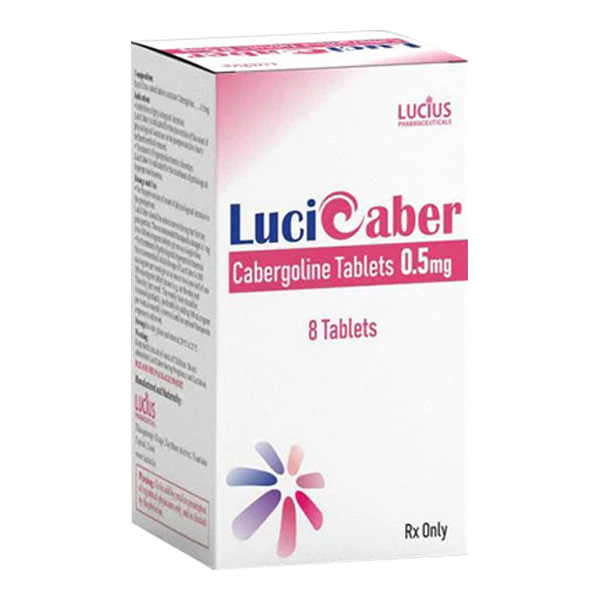
All Names: Dostinex、Cabergoline、卡麦角林
Indications:Suitable for adult patients with idiopathic or pituitary adenoma induced hyperprolactinemia
Manufacturer:LUCIUS PHARMACEUTICAL (LAOS) CO., LTD
Customs Clearance Procedure:If the customs requires the package for customs clearance, please pay the customs clearance fee according to the content of EMS SMS and customs regulations.
The mechanism of action of Cabergoline is derived from its efficient regulation of the hypothalamic pituitary axis, which can significantly reduce serum prolactin levels and is suitable for the treatment of idiopathic or pituitary adenoma related hyperprolactinemia.
1、 Drug name
1. Common name: Cabergoline
2. Product Name: Dostinex ®
2、 Indications
1. Indications: Used to treat adult hyperprolactinemia, including elevated prolactin levels caused by idiopathic or pituitary adenomas.
2. Restricted use: Prohibited for inhibiting or blocking postpartum physiological lactation due to the risk of serious adverse reactions.
3、 Specifications and characteristics
1. Specification: Each tablet contains 0.5mg of cabergoline.
2. Appearance: White capsule shaped tablet, with scratches on one side marked with "P" and "U", and "700" engraved on the other side.
4、 Main components
1. Active ingredient: 0.5mg of camarolin.
2. Accessories: Leucine (USP) and Lactose (NF).
5、 Usage and dosage
1. Initial dose: 0.25mg, taken orally twice a week.
2. Dose adjustment: Increase by 0.25mg every 4 weeks (twice a week) until serum prolactin levels return to normal; The maximum recommended dose is 1mg, twice a week.
3. Monitoring after discontinuation of medication: Regular monitoring of serum prolactin levels is required after discontinuation of medication to assess whether treatment needs to be resumed.
6、 Medication precautions
1. Before and after meals: can be taken with food or on an empty stomach, and food does not affect its pharmacokinetics.
2. Missed dose: If missed, it should be taken as soon as possible. If it is close to the next dose, skip it and do not double the dose.
3. Vomiting: Vomiting after taking medication should be judged based on the duration of vomiting, and if necessary, consult a physician.
4. Other: Prior to treatment, a cardiac ultrasound examination is required to rule out valve disease; Follow up cardiac ultrasound every 6-12 months during treatment.
7、 Medication for special populations
1. Liver dysfunction:
Mild (Child Pugh A) does not require dose adjustment;
Moderate (Child Pugh B) requires strengthened monitoring of adverse reactions;
Avoid severe (Child Pugh C) use.
2. Renal insufficiency: There is no significant change in pharmacokinetics in patients with moderate to severe renal insufficiency, and dose adjustment is not necessary.
3. Elderly: Insufficient data, use with caution.
4. Pregnant women and lactation period:
Pregnant women should only use it when the benefits outweigh the risks, and re evaluate it after discovering pregnancy;
Prohibited during lactation, not used to inhibit lactation.
8、 Adverse reactions
1. Common adverse reactions (incidence>10%): nausea (27%), headache (26%), dizziness (15%).
2. Serious adverse reactions:
Heart valve disease and pericardial fibrosis;
Pleural, pulmonary, and retroperitoneal fibrosis;
Orthostatic hypotension (incidence rate 4%);
Impulsive control disorders (such as pathological gambling, hypersexuality, compulsive consumption, etc.).
3. Other reported adverse reactions include constipation, fatigue, abnormal vision, hair loss, and mental disorders.
9、 Contraindications
1. Uncontrolled hypertension;
2. Allergic to ergot derivatives;
3. History of heart valve disease or pericardial fibrosis;
4. History of pleural, pulmonary, or retroperitoneal fibrosis.
10、 Drug interactions
Do not use in combination with dopamine D2 receptor antagonists (such as phenothiazine, butyrylphenyl, thianthracene, or metoclopramide).
11、 Storage method
Room temperature storage (20 ° C-25 ° C/68 ° F-77 ° F);
Keep in the original packaging and avoid contact with children.
Cabergolineinformation