- All Drug Categories
- Home
- Anti-cancer Drugs
- Healthcare Products
- Medical Information
- Statement
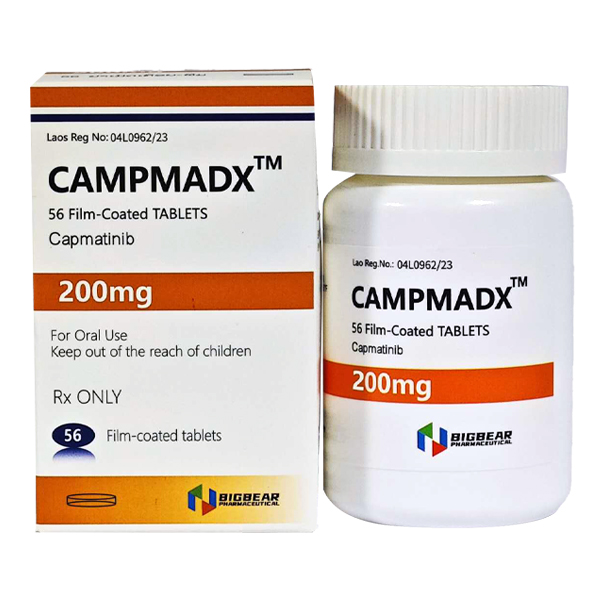
All Names: Capmatinib、Tabrecta、卡马替尼、卡玛替尼、妥瑞达
Indications:Suitable for adult patients with metastatic non-small cell lung cancer who have MET exon 14 jump mutation
Manufacturer:Daxiong
Customs Clearance Procedure:If the customs requires the package for customs clearance, please pay the customs clearance fee according to the content of EMS SMS and customs regulations.
Capmatinib is an oral small molecule kinase inhibitor that selectively targets mesenchymal epithelial transition factor (MET), particularly targeting mutations that cause MET exon 14 skipping.
1、 Drug name
1. Common name: Capmatinib
2. Product Name: TABRECTA ™
2、 Indications
Used for the treatment of adult metastatic non-small cell lung cancer (NSCLC), the tumor contains a mutation that causes MET exon 14 skipping and requires confirmation by FDA approved testing methods.
3、 Specifications and characteristics
1. Specification: 200mg/tablet.
2. Appearance: 200mg: yellow oval film coated piece, with beveled edges, no scratches, one side engraved with "LO" and the other side engraved with "NVR".
4、 Main components
1. Active ingredient: Kamatinib (150mg or 200mg, calculated as anhydrous Kamatinib hydrochloride at 176.55mg and 235.40mg, respectively).
2. Accessories: colloidal silica, polyvinylpyrrolidone, magnesium stearate, mannitol, microcrystalline cellulose, polyvinylpyrrolidone, sodium dodecyl sulfate; The film coating contains iron oxide, hydroxypropyl methylcellulose, polyethylene glycol 4000, talcum powder, titanium dioxide, etc.
5、 Usage and dosage
1. Recommended dosage: 400mg orally, twice daily, can be taken with food or on an empty stomach.
2. Medication method: Swallow the whole tablet, do not break, chew or crush it.
3. Omission or vomiting: If missed or vomited, there is no need to take the next dose as originally planned.
6、 Dose adjustment
Adjust the dosage according to the severity of adverse reactions:
1. First dose reduction: 300mg, twice daily;
2. Second dose reduction: 200mg, twice a day;
3. Unable to tolerate permanent discontinuation of 200mg twice daily.
The specific adjustment plan includes:
1. Interstitial lung disease/pneumonia: permanent discontinuation of medication at any level;
2. Hepatotoxicity: Suspend or reduce the dosage based on the degree of elevation of ALT/AST and total bilirubin, and permanently discontinue at level 4;
3. Other adverse reactions: Level 2 can maintain dosage or reduce dosage after pause, Level 3 can reduce dosage after pause, and Level 4 can permanently discontinue medication.
7、 Medication precautions
1. Before and after meals: can be taken with food or on an empty stomach. A high-fat diet may increase exposure, but the clinical impact is not significant.
2. Missed dose: No need to supplement, take the next dose according to the original plan.
3. Vomiting: If vomiting occurs after taking medication, there is no need to take additional medication.
4. Other:
Regularly monitor liver function before and during treatment;
Pay attention to sun protection and limit exposure to ultraviolet rays;
Patients of childbearing age need to take effective contraceptive measures.
8、 Medication for special populations
1. Liver dysfunction: Mild to moderate without dose adjustment, severe (Child Pugh C) not studied.
2. Renal insufficiency: Mild to moderate (CLcr30-89mL/min) does not require dose adjustment, while severe (CLcr15-29mL/min) has not been studied.
3. Elderly patients: Patients aged 65 and above account for 57%, and there is no significant difference in safety and efficacy compared to younger patients.
4. Pregnant women and lactation period:
Pregnant women may pose a risk to the fetus, and it is necessary to inform them of the risks and use effective contraception;
Breastfeeding is prohibited, and it is not recommended to breastfeed within one week after discontinuing the medication.
9、 Adverse reactions
1. Common adverse reactions (≥ 20%): peripheral edema (52%), nausea (44%), fatigue (32%), vomiting (28%), difficulty breathing (24%), decreased appetite (21%).
2. Serious adverse reactions:
Interstitial lung disease/pneumonia (4.5%, fatal);
Hepatotoxicity (ALT/AST elevation, 13%);
Other: Non cardiac chest pain, back pain, fever, etc.
3. Laboratory abnormalities: decreased albumin (68%), increased creatinine (62%), increased ALT (37%), decreased lymphocytes (44%).
10、 Contraindications
There are currently no contraindications.
11、 Drug interactions
1. Strong CYP3A inducers (such as rifampicin): Avoid co administration as it may reduce exposure to carbamatinib;
2. Strong CYP3A inhibitors (such as itraconazole): closely monitor adverse reactions;
3. CYP1A2, P-gp, BCRP substrates: may increase exposure to these drugs and require dose adjustment;
4. Proton pump inhibitors: may reduce exposure to carbamatinib.
12、 Storage method
Original packaging preservation, containing desiccant;
Store at room temperature (20 ° C-25 ° C), allowing short-term storage at 15 ° C-30 ° C;
Moisture proof, discard if not used within 6 weeks after opening the bottle.
Capmatinibinformation