- All Drug Categories
- Home
- Anti-cancer Drugs
- Healthcare Products
- Medical Information
- Statement
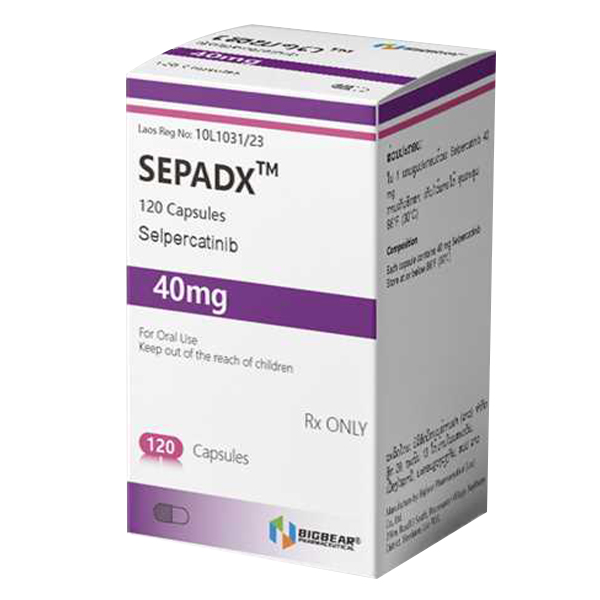
All Names: Selpercatinib、Retevmo、LOXO-292、塞普替尼、赛普替尼、塞尔帕替尼
Indications:Suitable for patients confirmed to have RET gene fusion or RET gene mutation through testing, including adults and children and adolescents aged 2 years and above.
Manufacturer:Daxiong
Customs Clearance Procedure:If the customs requires the package for customs clearance, please pay the customs clearance fee according to the content of EMS SMS and customs regulations.
Selpercatinib is a highly selective and potent kinase inhibitor that works by targeting the mutated or fused form of the RET (RearrangedDuringTransfection) gene.
1、 Basic information of drugs
1. Drug name: Selperatinib/Selpercatinib
2. Product Name: Retevmo
3. Main ingredient: The active ingredient is Serpatinib.
4. Specifications and characteristics:
40mg capsules
2、 Indications
This product is a kinase inhibitor used for the treatment of:
1. Adult metastatic RET gene fusion positive non-small cell lung cancer.
2. Adult and pediatric patients aged 12 and above with advanced or metastatic RET mutant medullary thyroid carcinoma who require systemic treatment.
3. Adult and pediatric patients aged 12 and above with advanced or metastatic RET gene fusion positive thyroid cancer who require systemic treatment and are refractory to radioactive iodine (if applicable).
Note: The latter two indications are approved through accelerated approval pathways, and continued approval may depend on the validation of clinical benefits in confirmatory trials.
3、 Usage and dosage
1. Patient selection: Based on the presence of RET gene fusion or specific RET gene mutations in tumor tissue or plasma.
Recommended dosage (based on weight):
2. Weight<50 kg: 120 mg, taken orally twice a day.
Weight ≥ 50 kg: 160 mg, taken orally twice a day.
Treatment should be continued until the disease progresses or unacceptable toxicity occurs.
3. Usage:
General requirement: Swallow the whole pill, do not chew or crush it. Twice a day, with an interval of approximately 12 hours.
Taken with food: usually taken with or without food. But if used in combination with proton pump inhibitors (PPIs), it must be taken with food.
Missed dose: If one dose is missed and there is more than 6 hours left until the next dose, it can be taken again; Otherwise, the missed dose should be skipped and the next dose should be taken at the original scheduled time.
Vomiting: If vomiting occurs after taking medication, additional doses should not be taken and one should wait until the next scheduled medication time.
4、 Dose adjustment
1. Reduction plan for adverse reactions:
First reduction: For those weighing less than 50 kg, reduce to 80 mg twice daily; For those weighing ≥ 50 kg, reduce to 120 mg twice daily.
Second reduction: For those weighing less than 50 kg, reduce to 40 mg twice daily; For those weighing ≥ 50 kg, reduce to 80 mg twice daily.
Third reduction: For those weighing less than 50 kg, reduce to 40 mg once daily; For those weighing ≥ 50 kg, reduce to 40 mg twice daily.
2. If unable to tolerate three dose reductions, the medication will be permanently discontinued.
3. Adjustment principles for specific adverse reactions:
Hepatotoxicity (grade 3/4): Suspend medication, resume at two dose levels after recovery, and gradually adjust back.
Hypertension (Grade 3): Suspend medication and resume with reduced dosage after control; (Level 4): Permanent discontinuation of medication.
QT interval prolongation (grade 3): Discontinue medication and reduce dosage after recovery; (Level 4): Permanent discontinuation of medication.
Bleeding event (grade 3/4): Discontinue medication and evaluate after recovery; Permanently discontinue medication for those who are seriously or life-threatening.
Hypersensitivity reactions (all levels): Suspend medication and use corticosteroids, starting at three dose levels after recovery, gradually reducing and decreasing steroids.
4. Dose adjustment caused by drug interactions:
Avoid co administration with strong/moderate CYP3A inhibitors. If unavoidable, reduce:
Original dose 120 mg bid → Combination with moderate inhibitor: 80 mg bid; Combined with strong inhibitors: 40 mg bid.
Original dose 160 mg bid → Combination with moderate inhibitor: 120 mg bid; Combined with strong inhibitors: 80 mg bid.
5. Liver dysfunction:
Patients with severe liver injury need to reduce their dosage: from 120 mg bid to 80 mg bid; Reduce the original 160 mg bid to 80 mg bid.
5、 Medication precautions (warnings and preventive measures)
1. Hepatotoxicity: Common and potentially severe. Monitor ALT and AST every 2 weeks before treatment and for the first 3 months, and monthly thereafter. Suspend, reduce or permanently discontinue medication based on severity.
2. Hypertension: Common and potentially severe. Optimize blood pressure before treatment, and monitor blood pressure at least monthly after 1 week of treatment. Suspend, reduce or permanently discontinue medication based on severity.
3. QT interval prolongation: Concentration dependent QTc prolongation may occur. Regular monitoring of electrocardiogram, electrolytes, and TSH during baseline and treatment periods. High risk patients and those taking specific medications need to be monitored more closely. Suspend, reduce or permanently discontinue medication based on severity.
4. Bleeding event: Severe or even fatal bleeding may occur. Serious or life-threatening bleeding should result in permanent discontinuation of medication.
5. Hypersensitivity reaction: May occur, manifested as fever, rash, joint pain/muscle pain, etc. Suspend medication and use corticosteroids when it occurs, and gradually increase the dosage after recovery.
6. Risk of damage to wound healing: may affect wound healing. Medication should be stopped for at least 7 days before elective surgery, and should be administered at least 2 weeks after major surgery and after the wound has fully healed.
7. Embryo fetal toxicity: may cause harm to the fetus. Women and men of childbearing age should take effective contraceptive measures during treatment and at least one week after the last dose. Pregnant women should avoid using it.
6、 Medication for special populations
1. Children: The safety and efficacy of patients aged 12 and above have been established; Patients under 12 years old have not been confirmed.
2. Elderly individuals (≥ 65 years old): No overall difference in safety or efficacy was observed compared to younger patients.
3. Liver dysfunction: mild or moderate without dose adjustment; Severe cases require reduction.
4. Renal insufficiency: Mild or moderate (CLcr ≥ 30 mL/min) does not require dose adjustment; The recommended dosage for patients with severe (CLcr<30 mL/min) or end-stage renal disease has not been established.
5. Pregnancy: May cause harm to the fetus, inform the pregnant woman of the risks to the fetus.
6. Breastfeeding: Women are advised not to breastfeed during treatment and for one week after the last dose.
7. Fertility: May impair the fertility of both women and men.
7、 Adverse reactions
1. Common adverse reactions (≥ 25%):
Laboratory abnormalities: increased aspartate aminotransferase, increased alanine aminotransferase, elevated blood glucose, decreased white blood cells, decreased albumin, decreased blood calcium, increased creatinine, increased alkaline phosphatase, hypertension, fatigue, edema, decreased platelets, increased total cholesterol, rash, decreased sodium, constipation.
Clinical symptoms: dry mouth, diarrhea.
2. Serious adverse reactions: including liver toxicity, severe hypertension, QT interval prolongation, severe bleeding, hypersensitivity reactions, etc.
8、 Contraindications
There are currently no clear contraindications.
9、 Drug interactions
1. Medications that should be avoided in combination:
Strong/moderate CYP3A inducers (such as rifampicin and bosentan): can significantly reduce the blood concentration of Serpatinib and weaken its efficacy.
Proton pump inhibitors (PPIs), H2 receptor antagonists, and local acting antacids: can reduce the blood concentration of Serpatinib. It should be avoided to use it together.
2. Medications that need to be used with caution and adjusted in dosage:
Strong/moderate CYP3A inhibitors (such as itraconazole and diltiazem): significantly increase the blood concentration of Serpatinib and increase the risk of adverse reactions. If unavoidable, it is necessary to reduce the dosage and strengthen QT interval monitoring.
3. The effects of Serpatinib on other drugs:
This product is a moderate CYP2C8 inhibitor and a weak CYP3A inhibitor. Co administration with drugs metabolized by CYP2C8 or CYP3A, such as regorafenib and midazolam, can increase the blood concentration of these drugs and may increase the risk of adverse reactions. Caution should be exercised when using drugs in combination, and consideration should be given to reducing the dosage of the drugs used in combination.
QT interval prolonging drugs: Co administration with drugs known to prolong the QT interval increases the risk and requires enhanced electrocardiogram monitoring.
4. Usage in combination with acid suppressants (if unavoidable):
Combined with PPI: RETEVMO should be taken with food.
Combination with H2 receptor antagonists: RETEVMO should be taken 2 hours before or 10 hours after taking H2 receptor antagonists.
Combination with antacids: RETEVMO should be taken 2 hours before or 2 hours after taking antacids.
10、 Storage method
1. Store at room temperature of 20 ° C to 25 ° C (68 ° F to 77 ° F); Allow short distance transportation between 15 ° C and 30 ° C (59 ° F and 86 ° F).
2. Please keep out of reach of children.
Retevmoinformation