- All Drug Categories
- Home
- Anti-cancer Drugs
- Healthcare Products
- Medical Information
- Statement
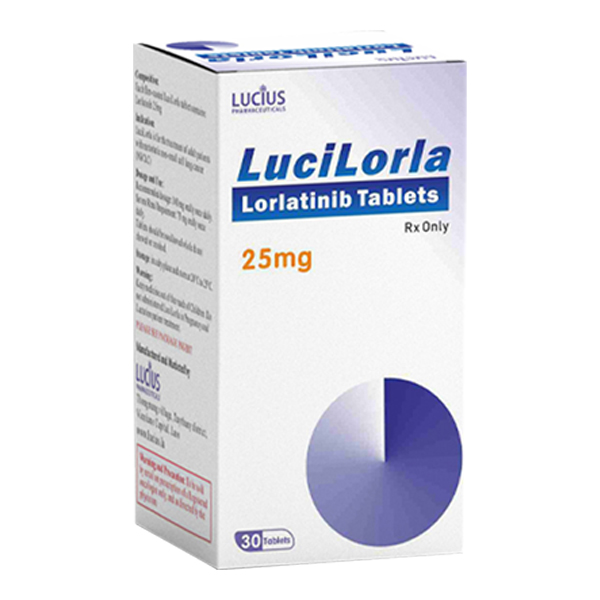
All Names: Lorlatinib、Lorbrena、洛拉替尼、劳拉替尼、博瑞纳
Indications:Adult patients with metastatic non-small cell lung cancer
Manufacturer:LUCIUS PHARMACEUTICAL (LAOS) CO., LTD
Customs Clearance Procedure:If the customs requires the package for customs clearance, please pay the customs clearance fee according to the content of EMS SMS and customs regulations.
Lorlatinib is a third-generation inhibitor of anaplastic lymphoma kinase (ALK) and ROS1 tyrosine kinase, which significantly inhibits various ALK resistant mutations (such as G1202R, I1171T, etc.) and can penetrate the blood-brain barrier, effectively controlling central nervous system metastases.
1、 Drug name and main ingredients
1. Common name: Lorlatinib
2. Product Name: LORBRENA ®
3. Dosage form: Film coated tablets
4. Main ingredients: Each tablet contains 25mg or 100mg of lorlatinib, and excipients include microcrystalline cellulose, anhydrous calcium hydrogen phosphate, sodium carboxymethyl starch, magnesium stearate, etc.
2、 Indications
ALK positive metastatic non-small cell lung cancer (NSCLC): Used to treat patients with disease progression after treatment with crizotinib and at least one other ALK inhibitor, or as an option after failure of the first ALK inhibitor treatment with alectinib or celetinib. This indication is approved based on accelerated tumor response rate and duration of response, and further clinical benefits need to be validated.
3、 Specifications and characteristics
1. Specifications: 25mg, 100mg.
2. Appearance: Thin film coated sheet, smooth surface, content is white to off white powder.
4、 Usage and dosage
1. Recommended dosage: 100mg orally, once daily, can be taken with food or on an empty stomach.
2. Medication method: Swallow the whole tablet, do not chew, crush or break it open. If the missed dose is more than 4 hours away from the next administration, it can be taken again. There is no need to take it again after vomiting.
5、 Dose adjustment
1. Adverse reaction adjustment: The first dose is reduced to 75mg once daily, and the second dose is reduced to 50mg once daily. If intolerable, the medication will be permanently discontinued.
2. Liver dysfunction: The starting dose for patients with moderate to severe liver dysfunction is halved.
3. Drug interactions: When combined with strong CYP3A inhibitors, the dose should be reduced to 75mg once daily, and when combined with strong CYP3A inducers, it is contraindicated.
6、 Medication precautions
1. Central nervous system response: 54% of patients experience cognitive impairment, emotional changes, or hallucinations, and need to avoid driving or operating machinery.
2. Hepatotoxicity monitoring: ALT/AST will be monitored every 2 weeks during the first month of treatment, and then changed to monthly monitoring thereafter.
3. Drug interactions: Do not use strong CYP3A inducers (such as rifampicin) in combination, and avoid using medium acting CYP3A inducers or sensitive CYP3A substrates in combination.
7、 Medication for special populations
1. Pregnant women: prohibited (animal experiments show teratogenicity).
2. Breastfeeding period: Breastfeeding is prohibited during the treatment period and within 7 days after the last dose.
3. Children: Safety has not been established.
4. Elderly: No need to adjust dosage.
8、 Adverse reactions
1. Common (≥ 20%): Edema (57%), peripheral neuropathy (47%), cognitive impairment (27%), dyspnea (27%), fatigue (26%), weight gain (24%), joint pain (23%), emotional disorders (23%), diarrhea (22%).
2. Serious reactions: ILD/pneumonia (1.5%), grade 3-4 ALT/AST elevation (2.1%), complete atrioventricular block (0.3%).
9、 Contraindications
Combined use of strong CYP3A inducers (such as rifampicin and phenytoin).
10、 Drug interactions
1. Strong CYP3A inhibitors (such as ketoconazole): Increase the blood concentration of lorlatinib and reduce the dosage.
2. CYP3A substrates (such as midazolam): reduce their efficacy and avoid combination therapy.
11、 Storage method
1. Keep in original packaging, away from light and moisture.
2. Storage temperature: 20-25 ° C (short-term fluctuations of 15-30 ° C are allowed).
Note: Regular monitoring of electrocardiogram, blood lipids, and neurological symptoms is required during the treatment period. Avoid using with grapefruit or St. John's wort.
Lorlatinibinformation